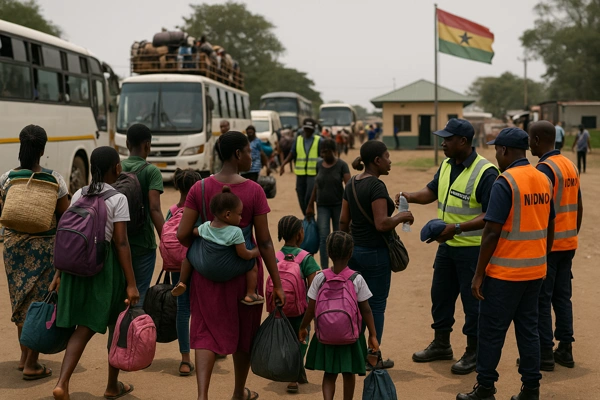
The Gbeniyiri conflict has triggered one of the most significant waves of displacement in Ghana’s recent history. According to Ghana’s Foreign Affairs Minister, Samuel Okudzeto Ablakwa, more than 8,000 Ghanaians have returned home after fleeing into neighboring Côte d’Ivoire, while about 5,309 remain stranded abroad. The government is working with Ivorian and Burkinabé authorities, humanitarian agencies, and traditional leaders to stabilize affected communities and prevent a resurgence of violence.
Background of the Gbeniyiri Conflict
The Gbeniyiri conflict erupted in Ghana’s Savannah Region in mid-2025. Rooted in decades-old disputes over land boundaries, farming rights, and chieftaincy succession, the situation escalated into widespread violence. Villages were attacked, homes and farms were destroyed, and residents were forced to flee for safety.
- Displacement numbers: By early September, more than 13,253 Ghanaians fled into Côte d’Ivoire.
- Burkina Faso impact: At least 1,455 Ghanaians also crossed into Burkina Faso.
- Domestic toll: In Ghana, entire villages were left deserted, schools closed, and farmland abandoned.
Analysts argue that the Gbeniyiri conflict highlights how unresolved land disputes and chieftaincy issues continue to destabilize northern Ghana.
Ablakwa Confirms Over 8,000 Returnees
Foreign Affairs Minister Samuel Okudzeto Ablakwa confirmed that over 8,000 displaced Ghanaians have returned from Côte d’Ivoire. His diplomatic mission to Ivorian border towns such as Vonkoro reassured citizens that conditions in Ghana are stabilizing.
Still, approximately 5,309 Ghanaians remain in Côte d’Ivoire, reluctant to return due to fears of renewed clashes, destroyed housing, and lack of livelihoods. Ablakwa appealed to them to consider coming home, noting that the government is prioritizing safety and resettlement.
The return of these thousands is seen as a hopeful turning point in the conflict, though challenges remain.
Diplomatic Engagements in Côte d’Ivoire
During his recent visit, Ablakwa held talks with Ivorian officials, UN representatives, and Ghanaian community leaders in displacement camps. His engagements centered on:
- Ensuring voluntary and safe returns.
- Guaranteeing access to food, shelter, and medical services for those still displaced.
- Coordinating logistics with ECOWAS to facilitate cross-border support.
President John Mahama also donated 6 million CFA francs (≈ USD 9,800) to support displaced Ghanaians in Côte d’Ivoire. His contribution was meant to provide immediate relief and strengthen trust among returnees.
Observers note that these gestures are crucial for rebuilding confidence among victims of the Gbeniyiri conflict.
Challenges Hindering Full Return
Despite positive progress, several hurdles continue to slow full reintegration of displaced citizens:
- Security Concerns – Many fear renewed violence unless lasting peace agreements are reached.
- Destroyed Housing – Villages razed during the conflict leave returnees with no shelter.
- Livelihood Collapse – Cocoa farms, livestock, and small businesses were wiped out.
- Psychological Trauma – Families, especially children, suffer from long-term emotional scars.
Experts warn that without addressing these issues, the Gbeniyiri conflict could easily reignite.
Government Response and Relief Efforts
The Ghanaian government has launched multiple initiatives to address humanitarian needs. Agencies like the National Disaster Management Organization (NADMO) are distributing relief supplies including food, blankets, and medicines.
The Ministry of the Interior, working with traditional leaders, has also formed mediation committees to tackle the root causes of the conflict. Security personnel have been deployed to prevent further clashes and restore calm in volatile areas.
International partners, including UN agencies and NGOs, are coordinating with Ghana to sustain relief operations.
Civil Society and International Role
Civil society organizations are stepping up to support victims and push for long-term solutions. Groups argue that without addressing structural causes, the Gbeniyiri conflict will persist. They recommend:
- Peace dialogues involving rival chiefs and elders.
- Youth employment programs to prevent radicalization.
- Land reform initiatives to resolve disputes fairly.
International actors such as ECOWAS, the African Union, and the UNHCR are also being called upon to intensify mediation and prevent the crisis from spreading across West Africa.
The Outlook: Can Lasting Peace Be Achieved?
Analysts agree that the return of 8,000 citizens is encouraging, but sustainable peace depends on addressing root causes.
For Ghana to move forward, the following steps are seen as critical:
- Comprehensive peace agreements between rival groups.
- Restoration of destroyed communities through housing and infrastructure support.
- Cross-border cooperation with Côte d’Ivoire and Burkina Faso to monitor displacement.
- Conflict-sensitive development programs in the Savannah Region.
Ablakwa emphasized that the Gbeniyiri conflict must serve as a national wake-up call. Without bold reforms, land and chieftaincy disputes will continue to threaten Ghana’s stability.
Conclusion
The return of more than 8,000 Ghanaians from Côte d’Ivoire marks an important milestone in efforts to stabilize the situation. Yet, with over 5,000 still abroad and thousands more traumatized at home, the humanitarian and political dimensions of the Gbeniyiri conflict remain unresolved.
To prevent further displacement, the government, traditional leaders, civil society, and international partners must coordinate strategies for peacebuilding, reconstruction, and reconciliation. Only then can the scars of the Gbeniyiri conflict begin to heal.
Internal Links
- Burkina Faso Visa-Free Access Shocks Africa
- Trump Foreign Aid Freeze Reaches Supreme Court
- World Bank $360M Ghana Disbursement to Stabilize Economy