A Historic March Turns Chaotic
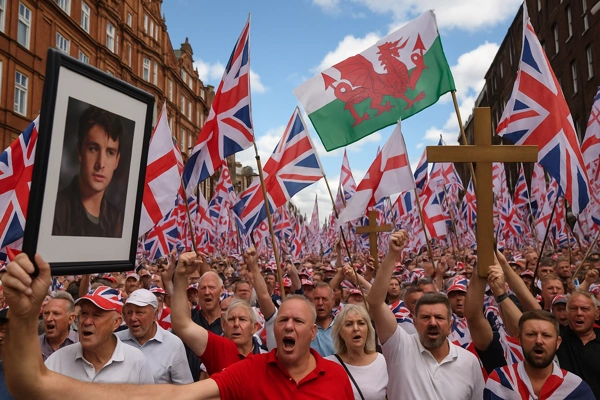
The UK Anti-Immigration Protest on September 13, 2025, has gone down as one of the largest far-right demonstrations in British history. Over 110,000 protesters flooded central London under the banner “Unite the Kingdom,” organized by activist Tommy Robinson. What began as a political rally quickly descended into violent confrontations, leaving 26 officers injured and 25 protesters arrested, as police battled to contain the unrest.
A Nation Divided Over Immigration
The protest follows months of public tension over Britain’s immigration policy. With more than 28,000 small-boat arrivals across the English Channel this year, the issue has dominated headlines and fueled heated parliamentary debates.
The UK Anti-Immigration Protest built upon a wave of right-wing mobilization across Europe, echoing similar rallies in France, Italy, and Germany. Analysts say these movements have capitalized on growing frustrations over asylum hotels, border controls, and economic hardship.
Activist Tommy Robinson, known for his controversial anti-Islam and nationalist rhetoric, framed the protest as a “patriotic stand” against what he called “uncontrolled migration.” Flyers and online posts ahead of the march urged Britons to “defend their country” — messaging that critics say verged on hate speech.
Escalating Tensions in London
The UK Anti-Immigration Protest stretched from Whitehall to Trafalgar Square, where participants waved Union Jacks, St George’s crosses, Israeli, and U.S. flags. Many wore MAGA hats, chanting against Prime Minister Keir Starmer and calling for stricter immigration policies.
Police deployed 1,600 officers, but were at times “overwhelmed” by the size of the crowd. The clashes began when protesters breached barriers separating them from counter-protesters. Officers were punched, kicked, and pelted with bottles and flares.
The Metropolitan Police confirmed that four officers suffered severe injuries — including concussions, fractures, and head trauma. Emergency units rushed the injured to hospitals, while reinforcements were called from neighboring boroughs.
“The level of violence we witnessed is wholly unacceptable,” said a Met Police spokesperson, emphasizing that officers were attacked “simply for doing their duty.”
Arrests and Ongoing Investigation
By Sunday morning, authorities had arrested 25 people on charges of violent disorder, assault, affray, and criminal damage. Police say additional arrests are expected as they review CCTV and bodycam footage.
Commander Karen Findlay described the UK Anti-Immigration Protest as “a major policing challenge,” warning that repeat mobilizations could lead to stricter public order controls. The Crown Prosecution Service has also confirmed fast-tracking cases linked to the violence.
Organizers, Online Amplifiers, and Global Voices
At the center of the storm stood Tommy Robinson, whose branding of the rally as the “Tommy Robinson Rally” drew far-right supporters from across the UK and Europe. Adding to the controversy, Elon Musk appeared via video message, criticizing “mass migration policies” and calling for “open debate.”
Lawmakers across party lines condemned Musk’s remarks, warning that foreign figures should not inflame Britain’s domestic tensions.
Despite the violence, Robinson declared the event a “historic success,” boasting that “the people have spoken in numbers never seen before.” Critics, however, argue the turnout reflects growing radicalization rather than legitimate grievance.
Counter-Protests and Calls for Unity
While central London descended into chaos, around 5,000 counter-protesters marched peacefully under the banner Stand Up To Racism. Their chants of “Refugees are welcome here” echoed through the streets, countering Robinson’s message of exclusion.
Although largely peaceful, minor skirmishes erupted near Trafalgar Square when the two groups came within close proximity. Police formed human barriers to prevent a broader clash.
“We cannot let hate divide this country,” said Sabby Dhalu, co-convener of Stand Up To Racism. “This is about defending human rights, not inflaming fear.”
Political and Public Response
Prime Minister Keir Starmer condemned the assaults on police while defending the right to peaceful protest.
“Violence against officers is never acceptable,” he stated, adding that “Britain’s democracy must allow peaceful dissent — but never at the expense of safety or unity.”
Several Labour MPs expressed alarm over what they described as “mainstreaming of far-right sentiment.”
Home Secretary Yvette Cooper announced an urgent review of extremist activity online, citing concerns over disinformation and hate-fueled mobilization. Conservative MPs, meanwhile, warned that the unrest reflects “legitimate frustration” with the pace of immigration reform.
Public opinion remains divided. A YouGov poll released two days later showed 48% of Britons agreeing that immigration “needs to be drastically reduced,” while 37% feared that protests like this “normalize extremism.”
Wider European Context
The UK Anti-Immigration Protest did not occur in isolation. Across Europe, far-right movements have grown increasingly coordinated. France has seen violent anti-migrant riots in Marseille and Lyon, while Italy’s ruling coalition continues to push hardline border policies.
Experts at Chatham House warn that Britain’s unrest mirrors “a broader European shift toward nationalist populism.” Social media has amplified this dynamic, allowing transnational networks to spread misinformation and mobilize supporters.
Earlier London demonstrations rarely exceeded 20,000 participants, making the 2025 event an unprecedented escalation in both scale and aggression.
From Online Anger to Street Mobilization
Analysts believe the UK Anti-Immigration Protest represents a critical shift — from online radicalization to physical mobilization.
Dr. Helena Morris of King’s College London notes that “digital echo chambers have evolved into real-world flashpoints,” warning that political leaders must “address the underlying anxieties driving these movements — not just their symptoms.”
The protest also raises questions about policing strategy. Despite increased intelligence-sharing, authorities appeared underprepared for the massive turnout, prompting calls for better coordination between counter-extremism units and tech platforms.
Global and Local Impact
For the UK government, the violence has both domestic and diplomatic implications. With international media coverage highlighting the scale of unrest, the UK Anti-Immigration Protest risks damaging Britain’s image as a stable democracy.
Locally, the event has rekindled debates on social cohesion, immigration reform, and media accountability. Advocacy groups urge the government to invest in community dialogue rather than reactive policing.
Globally, human rights organizations, including Amnesty International and Human Rights Watch, have condemned the violence and urged restraint from all sides.
A Turning Point for Britain’s Far Right
The UK Anti-Immigration Protest will likely be remembered as a watershed moment — when Britain’s far-right shifted from fringe activism to mass political theater. As investigations continue and political debate intensifies, London’s turmoil stands as both a warning and a mirror of Europe’s deeper social fault lines.
Internal Links
- France Hit by Protests and Disruption as New Prime Minister Takes Office
- Burkina Faso Visa-Free Access Shocks Africa
- AI Antibiotic Breakthrough: New Solutions for Gonorrhoea & MRSA
External Links
- Reuters – Over 100,000 anti-immigration protesters march in London
- AP News – Clashes break out in London protest organized by far-right activist
- The Guardian – Far-right London rally sees record crowds and violent clashes