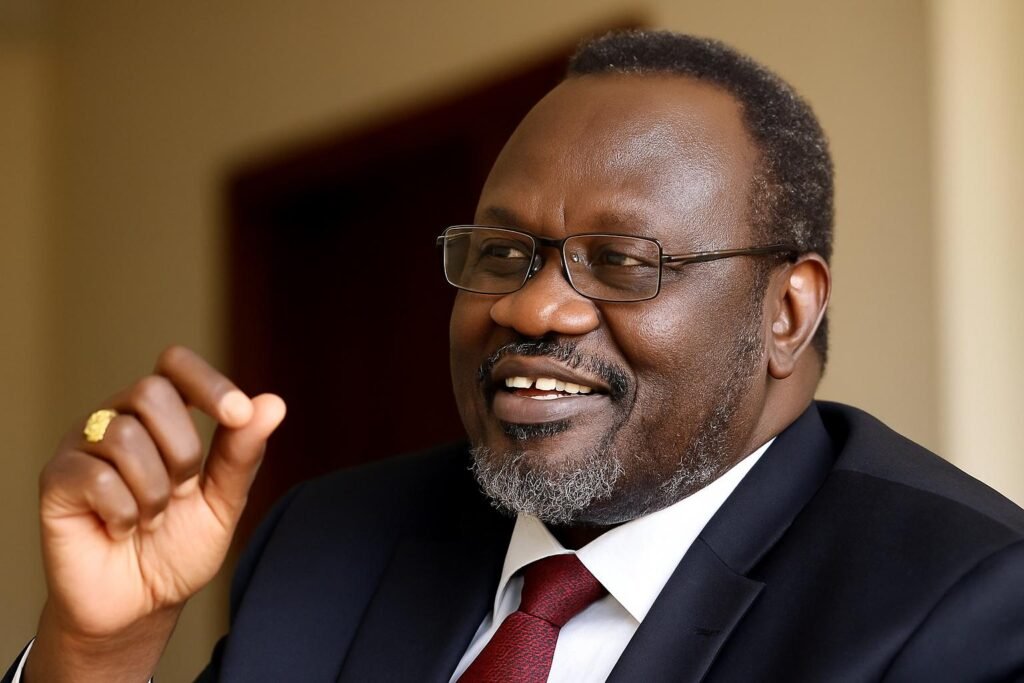
JUBA, South Sudan — The fragile political balance in Juba is under severe strain after South Sudan VP treason charges were officially filed against First Vice President Riek Machar. The indictment has jolted the country’s coalition government and reignited fears of renewed civil war in the world’s youngest nation.
Announced on September 11, 2025, the charges mark one of the most serious political crises since the signing of the 2018 Revitalized Peace Agreement that ended a devastating five-year conflict. Observers warn that if mismanaged, the case could plunge the country back into instability.
Historic Treason Charges Announced
Authorities allege that Machar orchestrated March 2025 militia attacks in Nasir, Upper Nile State, by coordinating with the White Army, an ethnic Nuer militia notorious for past violence. According to prosecutors, the South Sudan VP treason case includes charges of murder, terrorism, conspiracy, and crimes against humanity, accusing Machar of mobilizing armed groups through his political and military networks.
Government spokesperson Ateny Wek Ateny said the charges “reflect the gravity of crimes committed against the state.” But the announcement has split the political establishment, with opposition factions denouncing it as a calculated move to eliminate rivals ahead of elections.
House Arrest and Suspension Deepen Division
Since March 2025, Machar has been held under house arrest following the Nasir clashes. President Salva Kiir has suspended him from his post, claiming that the ongoing South Sudan VP treason trial “renders it impossible for him to perform official duties.”
However, members of the SPLM-IO, Machar’s opposition movement, insist the suspension breaches the 2018 peace deal and threatens the unity framework that underpins the transitional government. One senior opposition figure told Global Standard News that the decision “tears apart the delicate political fabric holding this country together.”
Analysts at the International Crisis Group (ICG) warn that the move risks reigniting factional fighting between Kiir’s Dinka loyalists and Machar’s Nuer supporters—two groups whose rivalry fueled the country’s civil war.
Peace Agreement at Risk of Collapse
The South Sudan VP treason proceedings pose the gravest threat yet to the Revitalized Peace Agreement signed in Addis Ababa in 2018, which ended a conflict that killed nearly 400,000 people and displaced millions. Under that accord, Kiir and Machar shared power in a fragile unity government aimed at stabilizing the country.
With Machar sidelined, the agreement’s power-sharing arrangements are unraveling. Political analysts warn that if the peace deal collapses, renewed violence between ethnic factions could engulf the country once more.
“The treason case jeopardizes the peace dividend we’ve been building for seven years,” said Dr. Luka Biong, a political scientist at the University of Juba. “South Sudan cannot afford another descent into war.”
Rights Groups Question Fairness of Proceedings
Human rights organizations have raised alarms about the judicial process. Amnesty International, Human Rights Watch, and local watchdogs argue that treason trials in South Sudan are often politically motivated and lack transparency. They urge authorities to ensure due process, citing previous cases where political prisoners were denied legal counsel.
Amnesty’s East Africa office stated:
“The government must guarantee a fair and transparent trial for Riek Machar. Anything less risks undermining public trust and reigniting violence.”
The South Sudan VP treason case could thus become a litmus test for the independence of the judiciary and the government’s commitment to rule of law—principles crucial to democratic consolidation.
Regional and International Response
The indictment has sparked strong diplomatic reactions across East Africa and beyond. Neighboring Kenya, Uganda, and Ethiopia—key signatories to the peace process—have called for restraint and dialogue. The Intergovernmental Authority on Development (IGAD), which brokered the peace deal, expressed “serious concern” that the case could destabilize not just South Sudan but the entire Horn of Africa.
The African Union (AU) and United Nations Mission in South Sudan (UNMISS) are closely monitoring developments. UN Special Representative Nicholas Haysom urged all parties to avoid actions that could derail national elections slated for 2026.
Western diplomats, including representatives from the U.S., UK, and EU, have echoed the same message: the South Sudan VP treason trial must not stall ongoing reforms, disarmament efforts, or constitutional review processes critical to the country’s democratic transition.
Opposition Outcry and Protest Threats
Machar’s SPLM-IO faction has dismissed the treason charges as a political witch-hunt aimed at consolidating power within a single ethnic bloc. In a statement released in Nairobi, the group vowed to resist what it called an “authoritarian purge of the unity government.”
“This is not justice—it’s an attempt to erase the opposition,” said SPLM-IO spokesperson Mabior Garang. “We will not accept one-party rule disguised as democracy.”
Reports from Juba suggest that small protests have already erupted in some Nuer-dominated regions. Security forces have increased patrols in the capital to prevent demonstrations from spreading.
Citizens Fear Return to War
For ordinary citizens, the South Sudan VP treason case evokes painful memories of past wars. Many fear the charges could trigger new ethnic clashes and worsen the already dire humanitarian crisis. The UN World Food Programme (WFP) warns that renewed instability could disrupt aid delivery to millions of displaced people and push food insecurity to catastrophic levels.
“I just want peace to continue,” said Mary Nyaluak, a displaced mother of three in Bentiu. “If leaders fight again, we will suffer the most.”
Local churches and civil society groups have urged both leaders to pursue reconciliation rather than confrontation, reminding them that the 2018 peace accord was hard-won after years of bloodshed.
What Lies Ahead for South Sudan’s Transition
The coming months will determine whether South Sudan’s fragile unity government survives. Legal experts say the South Sudan VP treason case could either affirm judicial independence or expose political manipulation within state institutions.
If conducted fairly, the trial could mark a turning point toward stronger rule of law. If mishandled, however, it could unravel years of reconciliation efforts and ignite another wave of violence.
Regional analysts note that South Sudan’s stability is crucial for the Horn of Africa’s security architecture. “A peaceful resolution is not just a South Sudanese issue—it’s a regional imperative,” said Ethiopian diplomat Mesfin Tadesse.
A Defining Moment for a Fragile Nation
The treason case against Riek Machar has become a defining test for the country’s justice system, its leadership, and the endurance of its peace accord. As the world watches, the choices made in Juba will determine whether South Sudan moves toward lasting peace—or slips once again into the darkness of war.
Internal Links (GSN)
- Trump Birthright Citizenship Ban Overturned: 5 Bold Wins
- UK Immigration Rules 2025: 3 Big Changes Now in Effect
- Evictions of Bengali Muslims in Assam Escalate