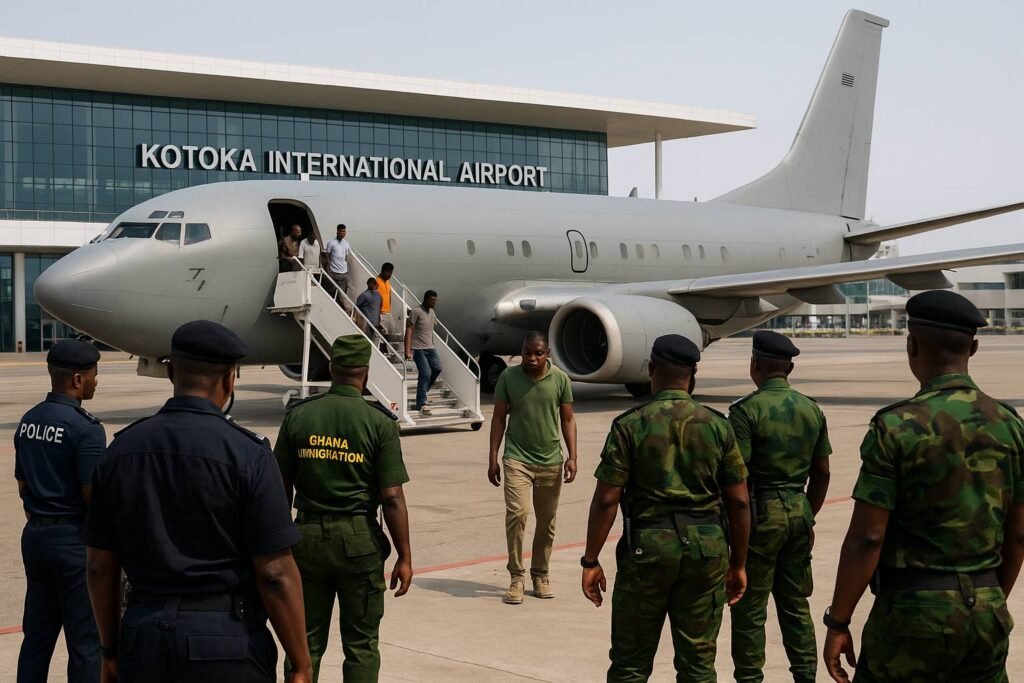
The Ghana-US deportation agreement has become a flashpoint in Ghana’s political and constitutional discourse. The Minority Caucus in Parliament is demanding the immediate suspension of the agreement, claiming it violates Article 75 of the 1992 Constitution and compromises national sovereignty. The deal, which enables Ghana to temporarily receive deported West Africans from the United States, has already brought 14 individuals to Accra—13 Nigerians and one Gambian.
Origins and Scope of the Ghana-US Deportation Agreement
The Ghana-US deportation agreement, finalized earlier this year, allows Ghana to serve as a transit hub for West African nationals deported from the United States. Officially presented as a regional cooperation initiative, the arrangement was designed to facilitate humane repatriation of ECOWAS citizens. However, the Minority argues that the deal was executed without parliamentary approval, contravening constitutional provisions governing international agreements.
According to lawmakers, the government’s decision to implement the Ghana-US deportation agreement without oversight from Parliament represents an overreach of executive power and a breach of democratic accountability.
Constitutional and Legal Dimensions
At the heart of the controversy lies Article 75 of Ghana’s 1992 Constitution, which requires that any international treaty or agreement must be laid before Parliament for approval. The Minority maintains that this process was ignored, making the Ghana-US deportation agreement unconstitutional.
They reference the 2016 Supreme Court ruling in the Gitmo Two case, where the Court declared that an unratified international arrangement—in that instance involving two Yemeni detainees transferred to Ghana—was unconstitutional and unenforceable. The Minority insists that the same principle applies here, stressing that constitutional compliance cannot be sacrificed for diplomatic expediency.
“This deal is unconstitutional and dangerous. It disregards Parliament’s authority and undermines Ghana’s sovereignty,” the Minority’s statement declared.
Implications for National Sovereignty and Foreign Policy
Critics of the Ghana-US deportation agreement warn that it risks compromising Ghana’s independence in foreign policy decision-making. The arrangement, they argue, could be seen as placing U.S. interests above Ghana’s sovereign control over immigration.
While Ghana’s ECOWAS membership permits free movement across the region, the Minority notes that such privileges apply only to voluntary migration, not forced deportations from non-ECOWAS countries. By accepting deportees under American directives, Ghana could inadvertently become a “dumping ground” for migrants the U.S. seeks to expel.
Political analyst Dr. Kwame Asare of the University of Ghana explained to GSN, “This issue goes beyond migration. It speaks to Ghana’s sovereign right to determine who enters its territory and under what terms. The government must ensure that foreign policy decisions do not undermine constitutional sovereignty.”
Transparency and Human Rights Oversight
Concerns have also been raised about the transparency of the Ghana-US deportation agreement. The Minority is pressing the government to clarify the following:
- How deportees are identified and screened before arrival
- The nature of temporary housing and monitoring facilities
- Whether deportees’ human rights and privacy are being respected
- The level of oversight by Parliament and human rights bodies
Civil society organizations have echoed these concerns. The Ghana Refugee Council has urged the government to guarantee due process and humane treatment for all deportees, warning that failure to do so could tarnish Ghana’s international image.
“Ghana must demonstrate that it upholds the highest human rights standards,” said the Council’s spokesperson. “Secrecy and lack of accountability only invite suspicion and reputational risk.”
Government’s Defense and Justification
In response, the Ministry of Foreign Affairs and Regional Integration has defended the Ghana-US deportation agreement as a legitimate part of Ghana’s regional obligations. Officials say Ghana is simply acting as a facilitator to ensure ECOWAS citizens deported from the United States can safely return to their home countries.
Deputy Minister Kwaku Ampratwum-Sarpong stated, “The Ghana-US deportation agreement strengthens Ghana’s humanitarian leadership in the subregion and reflects our long-standing partnership with the United States.” He added that the arrangement is consistent with Ghana’s executive authority under international cooperation frameworks.
Supporters of the deal claim it enhances Ghana’s diplomatic credibility and showcases its role as a stable and responsible nation within ECOWAS. However, critics argue that it risks setting a precedent for bypassing legislative oversight in future foreign policy decisions.
Legal Precedents and Possible Court Intervention
Legal experts believe the Ghana-US deportation agreement could be challenged in court based on constitutional grounds. The precedent set by the 2016 Supreme Court decision provides a clear legal pathway for civil society or individual citizens to question the legality of the agreement.
If brought before the Supreme Court, the justices could invalidate the Ghana-US deportation agreement on the basis that it was not properly ratified. Such an outcome could create diplomatic tension between Accra and Washington while reaffirming the primacy of parliamentary oversight in Ghana’s governance system.
Political and Electoral Repercussions
The Ghana-US deportation agreement controversy has entered the political arena at a sensitive time. With national elections approaching in 2026, opposition parties are framing the issue as a test of leadership and constitutional integrity. The Minority’s stance resonates with citizens who perceive the agreement as a surrender of national control.
Public sentiment is divided. Some Ghanaians view the arrangement as a pragmatic solution to regional migration issues, while others see it as undermining the country’s sovereignty. Online discussions across platforms like X (formerly Twitter) and Facebook reveal growing skepticism toward the government’s handling of foreign agreements.
One post that went viral read: “Ghana must not become a deportation hub. Sovereignty is not negotiable.”
Regional and International Ramifications
Beyond Ghana’s borders, the Ghana-US deportation agreement could reshape migration diplomacy in West Africa. If upheld, it may encourage other ECOWAS states to enter similar bilateral deals with Western nations, potentially fragmenting regional migration policy.
For Washington, the agreement simplifies deportation procedures and highlights Ghana as a dependable African partner. Yet, analysts warn that domestic backlash in Ghana could complicate future U.S.-Africa collaborations, particularly in migration and security sectors.
Constitutional Integrity at Stake
The Ghana-US deportation agreement has become a litmus test for Ghana’s commitment to constitutional order and sovereignty. Whether Parliament intervenes or a court challenge emerges, the outcome will shape future boundaries between executive authority and legislative oversight.
For many observers, the issue is not simply about deportations but about protecting Ghana’s constitutional framework. As the debate intensifies, one question remains clear: Can Ghana balance diplomacy with constitutional fidelity?
Internal Links
- World Bank $360M Ghana Disbursement to Stabilize Economy
- US Customs Bulldozer Seizure Stops Ghana Shipment
- Congo Ex-Justice Minister Convicted of $19M Embezzlement in Prison Project