A $237,000 Theft That Shook Two Continents
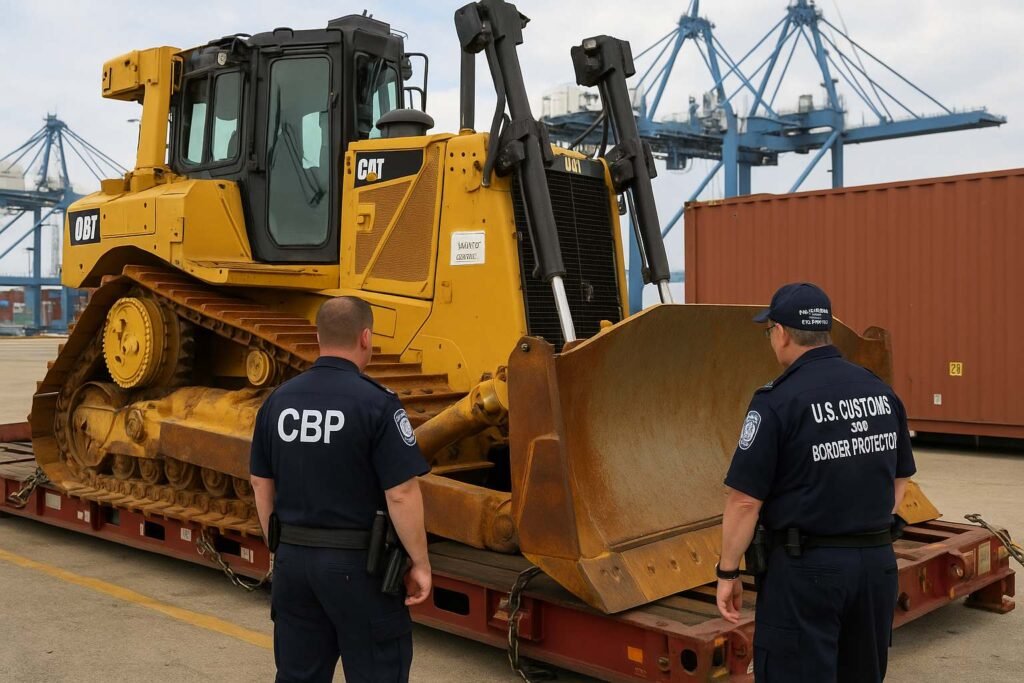
The US Customs Bulldozer Seizure at the Port of Baltimore has sent ripples across both the United States and Ghana, exposing how sophisticated criminal operations exploit global trade channels. On September 3, 2025, U.S. Customs and Border Protection (CBP) officers intercepted a 2015 Caterpillar D8T tractor-dozer valued at $237,000 during a routine export inspection. The heavy-duty machine was set to be shipped to Accra, Ghana, before its vehicle identification number (VIN) revealed it was stolen property.
CBP confirmed that the VIN matched an active theft report from Carroll County, Maryland, turning the routine inspection into a full-blown criminal investigation involving multiple law enforcement agencies.
“This US Customs Bulldozer Seizure demonstrates our vigilance in protecting American property owners while securing the integrity of international trade,” said a CBP spokesperson.
Anatomy of a Transnational Theft Scheme
The recovery of the Caterpillar bulldozer is not an isolated case—it fits a broader pattern seen across major U.S. ports. Organized criminal syndicates systematically steal high-value machinery, forge export documentation, and disguise the cargo as legitimate trade. These machines are then shipped abroad, often to West Africa, where they are sold to construction and mining companies with little awareness of their illicit origins.
The US Customs Bulldozer Seizure reflects how enforcement agencies are fighting back against this complex network. According to a 2024 CBP report, 1,445 stolen vehicles and heavy machines were intercepted nationwide—a 10% increase from the previous year. A significant proportion of these were headed to African nations, with Ghana, Nigeria, and Liberia among the top destinations.
Investigators say such crimes thrive due to gaps in international verification systems and limited data-sharing between U.S. and African customs authorities.
From Export Hub to Crime Hotspot
The Port of Baltimore has emerged as a major node in this global machinery trafficking web. As one of America’s busiest roll-on/roll-off cargo hubs, it handles thousands of heavy-duty shipments monthly, making it a prime target for smuggling operations.
CBP’s Baltimore Field Office reported 250 stolen exports intercepted in 2024, of which 60% were bound for West Africa. Among those, 28 containers were headed for Ghana, indicating a well-established trade route.
Officials say criminals often use false shipping manifests, mislabeling heavy equipment as scrap metal, used parts, or agricultural tools. In the US Customs Bulldozer Seizure, officers discovered discrepancies in documentation that triggered a detailed VIN check—leading to the recovery of the stolen Caterpillar.
“Our officers rely on both technology and intuition,” said a CBP enforcement director. “Every success story like this US Customs Bulldozer Seizure comes from vigilance and collaboration.”
The Demand Behind the West African Market
Ghana’s expanding construction, mining, and infrastructure sectors have created massive demand for imported heavy machinery. Bulldozers, excavators, and tractors from brands like Caterpillar and Komatsu are in constant shortage, with new models often priced beyond the reach of small and medium contractors.
This demand fuels a black market for cheaper, second-hand—or stolen—equipment. Experts estimate that up to 15% of heavy machinery circulating in parts of West Africa originates from theft-for-export operations.
Economist Kwame Asare-Bediako told Global Standard News that such incidents damage Ghana’s credibility in global trade.
“The US Customs Bulldozer Seizure shows how Ghana can be exploited as a destination for stolen machinery. Strengthening import vetting procedures is vital to protect legitimate contractors and our international image,” he said.
Official Reactions: U.S., Ghana, and International Agencies Respond
The successful interception has drawn praise from both U.S. and Ghanaian authorities. The National Insurance Crime Bureau (NICB) confirmed that its cooperation with CBP helped verify the stolen asset within hours. NICB’s Director of International Recovery Programs noted that cases like the US Customs Bulldozer Seizure prove how swift data-sharing can prevent multimillion-dollar losses.
Interpol’s U.S. office also confirmed ongoing collaboration with Ghana Customs and the Economic and Organized Crime Office (EOCO) to track and return stolen American assets. These partnerships are expanding into information exchange portals allowing real-time VIN checks across borders.
Security analyst Dr. Efua Mensima Asare described the development as “a milestone in the fight against transnational organized crime,” warning that such networks often operate alongside illegal gold exports and fuel smuggling.
“The US Customs Bulldozer Seizure is a reminder that global crime has diversified. Heavy machinery smuggling now rivals narcotics in profitability—but carries fewer risks for perpetrators,” she said.
Strengthening Border Security and Verification
In the aftermath of the US Customs Bulldozer Seizure, the CBP announced renewed efforts to tighten port inspectionsusing advanced imaging systems and AI-based VIN recognition. Exporters are being urged to register all machinery transactions through the Automated Export System (AES) to ensure full traceability.
Meanwhile, Ghana’s Ministry of Trade and Industry is reviewing its import oversight procedures. According to officials, new reforms may include mandatory digital verification of machinery ownership documents before clearance.
Trade policy advisor Emmanuel Ofori-Danso told GSN that Ghana’s collaboration with CBP and Interpol could “mark a turning point in cleansing the sector.” He emphasized that “genuine contractors must not pay the price for a few criminal exporters who tarnish the entire industry.”
Wider Consequences: Implications for Global Trade Integrity
The US Customs Bulldozer Seizure highlights a rising challenge for global trade regulators—how to balance efficient commerce with fraud prevention. Experts warn that smuggling of industrial assets not only drains national revenues but also distorts international trade data.
Ports in New Jersey, Houston, and Savannah have recently reported similar cases involving stolen tractors and excavators, indicating a continent-wide pattern. Unchecked, such activity can erode public trust and embolden international cartels.
To counter this, logistics companies are exploring blockchain-based shipping verification systems that create unalterable digital records of ownership. Industry stakeholders believe such technology could make operations like the US Customs Bulldozer Seizure easier to detect earlier in the process.
Impact on Ghana and the Region
For Ghana, the case underscores an urgent need to reform import due diligence. Construction companies that unknowingly buy stolen equipment face confiscation, reputational damage, and legal liability. Insurance firms are already adjusting policies to require stricter origin verification for imported heavy machinery.
The US Customs Bulldozer Seizure has prompted the Ghana Ports and Harbours Authority (GPHA) to re-evaluate customs protocols, while private sector associations are calling for an equipment ownership registry accessible to importers, banks, and insurers.
“We can’t allow Ghana to become a dumping ground for stolen foreign machinery,” said a representative of the Ghana Chamber of Construction Industries. “The US Customs Bulldozer Seizure should be the wake-up call we needed.”
Future Outlook: Toward Transparent International Trade
As global law enforcement agencies adopt more integrated databases, future seizures may become faster and more efficient. CBP is expanding its intelligence network to include machine-learning risk assessments, capable of identifying suspicious cargo patterns before ships leave port.
For developing economies like Ghana, closer partnerships with U.S. authorities will help boost regulatory credibilityand protect legitimate business operators from accidental complicity in smuggling chains.
If the lessons of the US Customs Bulldozer Seizure are applied effectively, both nations stand to benefit from cleaner trade records, better security, and restored confidence in international commerce.
A Wake-Up Call for Global Trade Security
The US Customs Bulldozer Seizure of a $237,000 Caterpillar D8T at Baltimore’s port is not just a victory for American law enforcement—it is a cautionary tale for global trade. The operation illustrates how data sharing, cross-border collaboration, and digital tracking systems can close loopholes that criminals exploit.
As CBP continues to enhance inspections and Ghana pursues tighter import checks, this case serves as a model of how cooperation between nations can stop stolen assets from fueling black markets abroad.
Ultimately, the US Customs Bulldozer Seizure stands as proof that vigilance, technology, and trust are the cornerstones of secure international trade.
Internal Links
- Interpol Cybercrime Crackdown: 1,200 Arrests in Africa
- Kotoka Airport Firearms Seizure: 7 Shocking Facts on Ghana’s Airport Security Breach
- Italian Facebook Group Sharing Wives’ Photos Shut Down