Ghana’s Diplomatic Response to US Deportations
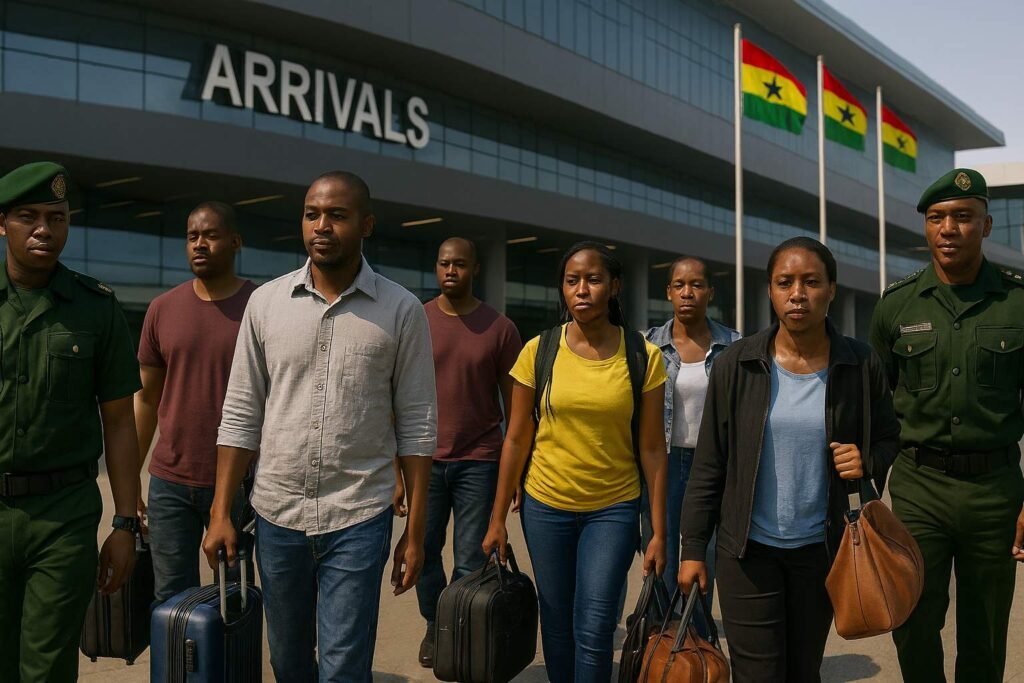
Accra, Ghana – President John Dramani Mahama has confirmed that Ghana received deported West Africans from US, marking the start of a structured bilateral and humanitarian partnership between Accra and Washington. Speaking during the Presidential Media Encounter at the Jubilee House on September 10, 2025, the President revealed that 14 nationals — 13 Nigerians and one Gambian — arrived in Ghana earlier in the week.
The development comes amid broader international efforts to coordinate migration and repatriation in compliance with ECOWAS and international law, positioning Ghana as a responsible regional intermediary.
Legal Basis for Ghana’s Decision
According to President Mahama, Ghana received deported West Africans from US under the ECOWAS Protocol on Free Movement, Residence and Establishment, which allows citizens of member states to enter and reside in other West African countries for up to 90 days without a visa.
He explained that the initiative followed a formal request from the U.S. government for Ghana’s assistance in facilitating the transit and safe return of West African nationals facing deportation.
“Ghana received deported West Africans from US as part of our ECOWAS obligations. This is not mass deportation; it is structured cooperation under humanitarian and legal frameworks,” Mahama stated.
Officials clarified that Ghana’s role is limited to transit facilitation, not permanent settlement, and that all procedures comply with both international human rights and ECOWAS standards.
Handling and Coordination of the Deportees
Of the 14 deportees, thirteen were Nigerians and one was a Gambian. Ghana’s Ministry of the Interior, in partnership with the Nigerian High Commission and the Gambian Embassy, supervised the process to ensure smooth handover and onward travel.
The Nigerian nationals were provided safe bus transport to Lagos, while the Gambian was assisted with a flight to Banjul. Each deportee underwent basic health and identity verification checks to meet international return protocols.
President Mahama stressed that Ghana received deported West Africans from US purely as a transit operation, reiterating that no individuals will remain in Ghana permanently.
“This is not relocation or resettlement,” he said. “Ghana’s role is to uphold humane procedures while facilitating lawful returns.”
Clarifying Misconceptions: Mahama Addresses Deportation Fears
With rumors circulating about possible mass deportations across West Africa, Mahama used the occasion to clarify Ghana’s position. He emphasized that Ghana received deported West Africans from US only after comprehensive consultations with regional partners and U.S. authorities.
“There will be no indiscriminate deportations. Ghana received deported West Africans from US only after full legal and diplomatic engagement,” he said.
The President’s reassurance was aimed at dispelling speculation that Ghana was collaborating in large-scale expulsions. Instead, the country’s approach reflects careful adherence to due process, ECOWAS solidarity, and humanitarian responsibility.
Regional Diplomacy: Strengthening ECOWAS Cooperation
Migration experts say the decision that Ghana received deported West Africans from US illustrates a maturing regional partnership model between West Africa and the United States.
By serving as a transit hub for ECOWAS citizens, Ghana reinforces its commitment to the free movement principle and demonstrates its readiness to collaborate on cross-border migration issues.
Dr. Ibrahim Tanko, a migration analyst at the University of Ghana, told Global Standard News:
“Ghana’s cooperation strengthens regional solidarity. It sets a positive precedent for other ECOWAS states that may face similar diplomatic requests.”
This act of collaboration could improve Ghana’s diplomatic capital in Washington, showcasing the country as a constructive partner in global migration governance.
Humanitarian Oversight: Safeguarding Dignity and Rights
Civil society organizations have also commended the initiative but urged continued vigilance. The Centre for Migration and Human Development (CMHD) emphasized that Ghana received deported West Africans from US not as criminals but as vulnerable returnees requiring assistance.
CMHD’s Executive Director, Nana Afua Boateng, said:
“Our concern is the welfare of the deportees. Reintegration support should be prioritized to prevent further marginalization.”
Advocacy groups have called on ECOWAS to establish a regional monitoring framework ensuring that deportees are treated with dignity and integrated back into their home societies under humane conditions.
Historical Reflection: Learning from Past Experiences
Ghana’s history with deportations stretches back decades. During the 1969 Aliens Compliance Order and subsequent regional expulsions in the 1980s, Ghana faced severe criticism for harsh repatriations.
President Mahama acknowledged these historical lessons, stressing that today’s policy framework ensures human rights protection, international oversight, and multilateral consultation.
He said the fact that Ghana received deported West Africans from US through transparent and lawful channels proves that the nation has evolved into a modern diplomatic facilitator, not an enforcer of exclusion.
Expert Analysis: Strategic and Economic Implications
Analysts believe this cooperation could have broader implications for Ghana’s foreign policy and regional influence. By ensuring that Ghana received deported West Africans from US under a formal, rules-based arrangement, Accra strengthens its standing as a trusted partner for both the U.S. and ECOWAS.
This approach also aligns with Ghana’s foreign policy of constructive engagement, which emphasizes peacekeeping, humanitarian diplomacy, and multilateralism.
Economically, Ghana could gain from technical assistance in border management, migration data systems, and reintegration capacity-building under new U.S.–West Africa migration programs.
Diplomatic and Public Reactions
The Nigerian High Commission in Accra expressed appreciation to the Ghanaian government for its professionalism in handling the deportees.
“We commend Ghana’s leadership for ensuring humane, lawful, and efficient facilitation of Nigerian returnees,” the Commission said.
The Gambian Embassy similarly thanked Accra for its coordination efforts and adherence to ECOWAS principles.
Domestically, some opposition legislators have urged greater transparency in future arrangements, calling for parliamentary oversight on migration-related cooperation with external partners.
Wider Implications: Ghana’s Role in Global Migration Governance
Globally, migration has become a key issue in U.S.–Africa relations. By ensuring that Ghana received deported West Africans from US within a structured, rights-based framework, Accra projects a positive diplomatic image that balances sovereignty with humanitarian accountability.
For ECOWAS, the case may shape future guidelines for collective handling of deportations from Western countries — a pressing need as migration pressures intensify.
Locally, this initiative reinforces Ghana’s image as a stable, law-abiding democracy that upholds its regional responsibilities while maintaining international goodwill.
A Model for Humane Regional Repatriation
In summary, Ghana received deported West Africans from US not to isolate them, but to facilitate their safe and lawful return in partnership with regional states. President Mahama’s approach highlights Ghana’s leadership in balancing diplomacy, legality, and compassion within the ECOWAS framework.
As migration remains a sensitive and evolving issue, Ghana’s actions may well define a new regional standard for humane and coordinated deportation management across Africa.
Internal Links
- Congo Ex-Justice Minister Convicted of $19M Embezzlement in Prison Project
- Assembly Member Killed in Mining Clash
- Audit Uncovers Babies on NSA Payroll