Paris, France — France hit by protests and disruption on Wednesday as newly appointed Prime Minister Sébastien Lecornu took office under tense political conditions. Massive demonstrations, transportation paralysis, and violent clashes erupted nationwide, signaling one of the most turbulent transitions of power in recent French history. The protests, organized under the banner of the “Block Everything Movement,” have challenged the government’s authority and tested the resilience of President Emmanuel Macron’s leadership.
Austerity Measures and Public Resentment
The wave of unrest sweeping across France stems from years of frustration with austerity-driven governance. France hit by protests and disruption after the outgoing Prime Minister François Bayrou announced an aggressive €43–44 billion budget reduction plan that included freezing pensions, eliminating certain public holidays, and slashing social welfare allocations.
The announcement reignited memories of the 2018 Yellow Vest protests, which also began as opposition to fiscal austerity and economic inequality. Unions, educators, and healthcare workers accused the government of prioritizing deficit targets over citizens’ welfare. Political analysts say Lecornu’s rise coincided with this combustible climate, leaving him to inherit both political instability and public rage.
“The government underestimated the scale of the discontent,” noted Dr. Jean-Luc Fournier, a political analyst at Sciences Po Paris. “The appointment of a new prime minister was meant to reset the conversation, but instead, it reopened old wounds.”
Nationwide Demonstrations Escalate into Civil Unrest
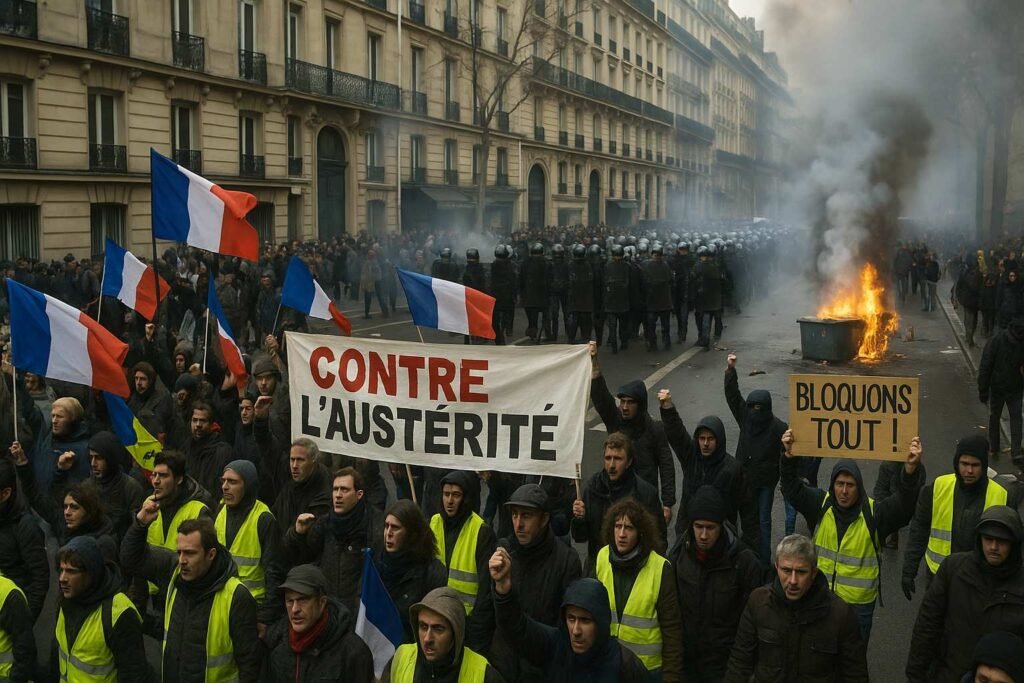
Across major cities—Paris, Lyon, Marseille, Bordeaux, and Lille—streets turned into protest zones. Riot police confronted demonstrators with tear gas and water cannons as barricades, burning bins, and overturned vehicles filled the avenues. Authorities confirmed the deployment of 80,000 officers nationwide, resulting in 450 arrests and multiple injuries.
Trade unions claimed over 250,000 protesters joined the nationwide campaign, which gained momentum through social media platforms including X (formerly Twitter), Telegram, and TikTok.
The movement’s decentralized structure and digital mobilization mirrored the Yellow Vest phenomenon, but with a broader coalition of workers, students, and civil rights groups.
“We’re fighting for dignity, not just wages,” said Marie Lefèvre, a nurse from Marseille. “These cuts will push working families into deeper hardship.”
Lecornu’s Leadership Tested from Day One
For Prime Minister Sébastien Lecornu, a close Macron ally and former Defence Minister, the timing could not be worse. Sworn in only days earlier, Lecornu has become the symbol of continuity for a government many perceive as disconnected from ordinary citizens.
In his first national address, he vowed to pursue “ruptures in both form and substance”—a phrase signaling reform within the existing framework. He promised dialogue, technical rigor, and creativity in addressing the crisis, yet critics argue that words alone will not quell the anger.
Opposition leader Jean-Luc Mélenchon of La France Insoumise declared that his party would file a no-confidence motion, calling Lecornu’s appointment “a recycled face for the same failed policies.” Analysts warn that France hit by protests and disruption exposes the growing fragility of Macron’s centrist project as his administration struggles to maintain credibility.
Essential Services Crippled Across the Country
The protests have paralyzed vital sectors, disrupting the daily lives of millions:
- Public Transport: Train, metro, and bus networks were shut down in multiple regions, including the Paris metropolitan area. The SNCF confirmed “unprecedented delays and cancellations.”
- Education: Thousands of teachers participated in the strike, leading to widespread school closures.
- Healthcare: Hospital staff and paramedics joined demonstrations, citing threats to healthcare access under austerity.
- Sanitation: Garbage piled up across Paris as municipal waste collectors halted services for the third consecutive day.
According to the Interior Ministry, disruptions affected at least nine major regions, with the cost of property damage and lost productivity expected to exceed €200 million if unrest continues through the week.
Professional Assessments of the Crisis
Political scientists describe France hit by protests and disruption as symptomatic of a governance legitimacy crisis.
Dr. Isabelle Dupont, a senior lecturer at the University of Strasbourg, argues that Macron’s repeated reliance on executive decrees has weakened public faith in parliamentary democracy.
“The erosion of trust is now structural. Citizens perceive executive decisions as detached from social realities,” Dupont stated.
Economists, meanwhile, warn that continued instability could slow France’s 2025 growth forecast of 1.3%, as industrial production, tourism, and consumer confidence decline. The IMF recently cautioned that domestic unrest poses one of the key downside risks to the eurozone’s recovery.
Historical Context: Echoes of the Yellow Vest Era
Observers see striking parallels between today’s movement and the Gilets Jaunes (Yellow Vests) uprising. While both began as economic protests, France hit by protests and disruption demonstrates a more organized, cross-sector coalition, blending labor union coordination with social media activism.
Unlike the 2018–2019 protests, however, “Block Everything” has achieved institutional traction, with nine national trade unions signing a joint communiqué demanding the withdrawal of austerity reforms and the restoration of wage indexation to inflation.
“This is not a flash in the pan,” said Laurent Berger, Secretary-General of the CFDT union. “We are witnessing the reawakening of France’s social conscience.”
International Alarm and Diplomatic Ripples
The unrest has drawn swift reactions from France’s global partners.
The U.S. Embassy in Paris issued a Level 2 travel advisory, urging citizens to avoid demonstrations.
Germany and Italy voiced concern over potential disruptions to the EU supply chain, particularly in logistics hubs around Lyon and Marseille.
Meanwhile, labor federations in Belgium, Spain, and Portugal announced solidarity demonstrations, underscoring how French unrest often ignites wider European movements for labor rights and fiscal justice.
Financial analysts warned of short-term turbulence, as the CAC 40 index slipped 1.4%, and investors shifted toward safe-haven assets. The euro briefly dipped against the U.S. dollar amid fears that prolonged instability could affect the EU’s fiscal cohesion.
Expert Analysis: Lecornu’s Tightrope Between Reform and Resistance
Lecornu’s challenge lies in balancing fiscal credibility with social stability.
As Defence Minister, he was praised for his strategic discipline and bureaucratic efficiency, but political analysts caution that governing France’s streets requires empathy and adaptability more than command-style leadership.
“The Lecornu government must reframe austerity as modernization, not punishment,” said Dr. Pascal Thibault, an economist at Sorbonne University. “Without a clear narrative shift, protests will continue to define his tenure.”
If Lecornu fails to defuse tensions or faces defeat in parliament, France could be forced into a snap legislative election, further paralyzing policy implementation and eroding Macron’s influence within the European Union.
Global and Domestic Implications
Beyond France, the implications of France hit by protests and disruption extend to European financial markets and global perceptions of French governance.
International investors fear instability could delay Paris’s plans to attract foreign capital post-Brexit. The unrest also jeopardizes Macron’s ambition to position France as a leader in green transition funding and defense innovation within the EU framework.
Domestically, prolonged unrest risks deepening polarization between rural and urban France. Analysts warn that failing to restore confidence could empower far-right movements ahead of the 2026 regional elections, reshaping the political landscape for years.
What Comes Next for France
The Council of Ministers is expected to meet this weekend to draft a crisis response framework focusing on social dialogue, minimum service guarantees, and inflation-relief measures. Lecornu has hinted at partial reversals of the most unpopular reforms but remains committed to fiscal discipline.
Public opinion polls by Ifop show that 68% of respondents support the demonstrations, though only 32% believe the protests will lead to concrete government change.
The coming weeks will test whether Lecornu’s promises of “rupture” can translate into renewed trust—or whether France hit by protests and disruption will deepen into another cycle of unrest reminiscent of the Yellow Vest years.
A Leadership Defining Moment
For now, France hit by protests and disruption stands as the defining test of Sébastien Lecornu’s political future and Emmanuel Macron’s legacy. The French Republic has faced countless moments of upheaval, but the stakes today feel existential—a struggle between fiscal orthodoxy and social justice, between state authority and public will.
Whether Lecornu can bridge that divide will determine not only his survival but also France’s stability in the years ahead.
Internal Links
- France Immigration Protests: 5 Shocking Military Moves
- Japanese Police Apology at Grave Sparks Historic Reform Debate
- France Grants Ghana Debt Relief Under G20 Framework
External Links
- Reuters – France Protests Coverage
- AP News – No-Confidence Motion
- Washington Post – Lecornu Appointment