Ghana’s Excavator Boom Sparks National Concern
Accra, Ghana – Ghana Excavator Imports have surged dramatically, making the nation West Africa’s largest and Africa’s second-largest importer of heavy machinery after South Africa. JoyNews Research reports that in 2023 alone, Ghana imported over US $205 million worth of excavators, surpassing Nigeria’s US $94 million.
This trend marks a turning point in Ghana’s industrial and mining landscape. What began as a sign of economic modernization is now raising serious concerns over illegal mining (galamsey), water pollution, and weak regulatory oversight.
A Decade of Unchecked Machinery Influx
From 2013 to 2023, Ghana Excavator Imports totaled nearly US $967 million, indicating sustained growth over a decade. Initially, these machines were used mainly for road building, dam construction, and real estate projects. However, as government infrastructure contracts expanded and the gold rush intensified, demand for excavators surged beyond official projections.
According to trade data, excavators entered Ghana’s top ten most imported commodities in 2023—surpassing computers, mobile phones, and sugar. This suggests a dramatic realignment of the country’s import priorities toward machinery with dual economic and environmental implications.
Industry experts argue that while urban expansion and public works justify part of the increase, a significant share of Ghana Excavator Imports ends up powering illegal mining operations across rural communities.
Massive Influx at Tema Port Raises Oversight Challenges
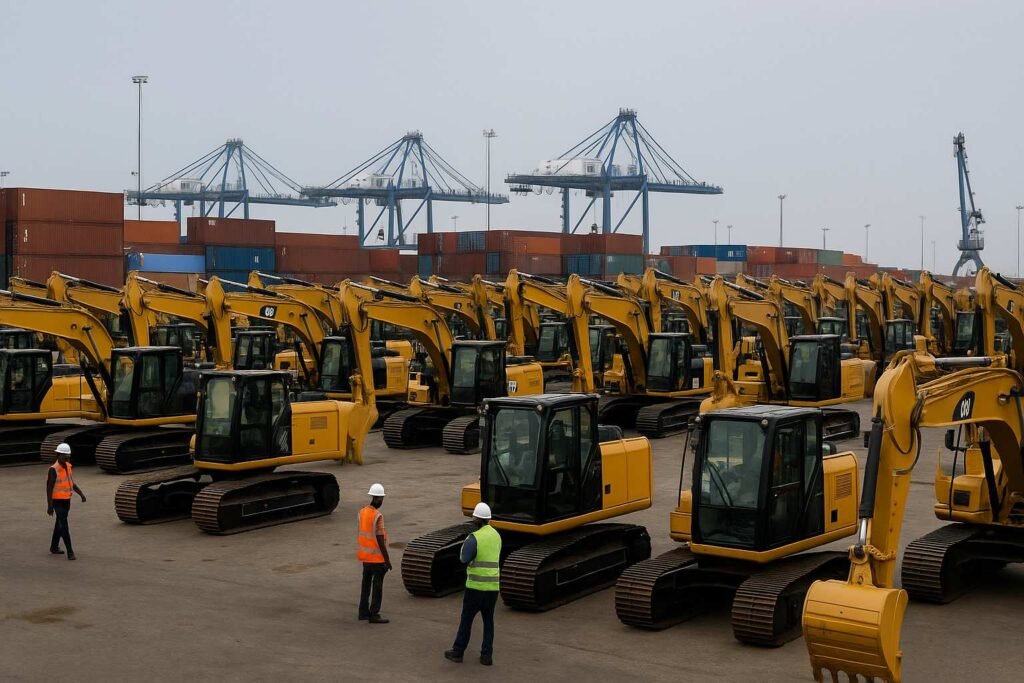
Tema Port, Ghana’s largest maritime gateway, has become ground zero for the surge in Ghana Excavator Imports. Transport Minister Joseph Nikpe Bukari described the phenomenon as an “invasion,” revealing that more than 200 excavators arrive daily, overwhelming port infrastructure and inspection teams.
Customs officials confirm that many importers use generic classification codes—such as “construction equipment”—to bypass detailed scrutiny. This loophole allows thousands of machines to enter the country with minimal traceability, increasing the risk of diversion to illegal mining sites.
Recent intelligence reports show that an additional 3,000 excavators are still en route to Ghana despite a temporary import suspension. Authorities have since detained over 1,200 units at Tema Port, pending verification of their ownership and intended use.
Economic Dimensions: Growth, Opportunity, and Oversupply
The surge in Ghana Excavator Imports reflects both economic opportunity and structural risk. On the economic front, heavy machinery supports government-led infrastructure programs such as Agenda 111 hospitals, new highways, and industrial parks.
But oversupply has flooded the local market, causing prices to fall and leasing rates to collapse. Financial institutions now report defaults on machinery loans as operators struggle to find legitimate work. Meanwhile, parallel demand from unregulated gold mining has kept second-hand excavator sales high in mining regions.
Economic analysts suggest this boom mirrors trends seen in commodity-dependent economies—where sudden equipment imports rise during high gold-price periods, then crash when regulatory or price shocks occur.
Environmental Toll: Rivers, Forests, and Farmlands in Peril
While the fiscal implications of Ghana Excavator Imports dominate headlines, the environmental cost is far greater. The proliferation of excavators in illegal mining has devastated water bodies like the Pra, Offin, and Ankobra rivers.
The Ghana Water Company warns that treatment costs have doubled in the past five years due to siltation and chemical contamination from galamsey operations that rely heavily on imported excavators. Satellite imagery from the Environmental Protection Agency (EPA) confirms a rapid increase in deforestation and topsoil loss in mining districts such as Wassa Amenfi, Obuasi, and Dunkwa-on-Offin.
Environmental campaigners describe the situation as “an unfolding ecological emergency” that threatens both biodiversity and national food security.
Government Measures: Temporary Ban and Policy Review
The government has initiated several steps to rein in uncontrolled Ghana Excavator Imports. The Ministry of Trade and Industry introduced a temporary suspension of new excavator import licenses, citing concerns about unregulated inflows and their link to illegal mining.
The Minerals Commission and the EPA are collaborating on a joint digital tracking system to register all imported heavy machinery. Each excavator will soon carry a QR-coded tag linked to its importer’s tax identification number and approved project site.
Officials are also drafting amendments to the Minerals and Mining Act, which would introduce stricter penalties for importers whose equipment is found in unauthorized operations.
Balancing Industry Growth with Sustainability
Experts stress that Ghana must strike a balance between legitimate industrial expansion and environmental protection. One industry analyst told GSN that the influx of machinery could benefit national development “only if managed transparently and matched with clear policy enforcement.”
Economists at the University of Ghana have proposed introducing environmental bonds—refundable deposits paid by importers to ensure responsible usage. Others recommend a differentiated tariff system, with lower duties for registered construction firms and higher levies for speculative buyers.
Meanwhile, civil society organizations call for a centralized Heavy Equipment Leasing Authority, where excavators can be rented through verified vendors instead of mass private importation.
Ghana’s Growing Lead in West Africa
Regionally, Ghana Excavator Imports now surpass those of Nigeria, Côte d’Ivoire, and Senegal combined. Only South Africa, with US $436 million in imports, ranks higher on the continent.
This surge highlights Ghana’s evolving industrial footprint—but also its vulnerability to regulatory breakdown. Cross-border environmental risks have also emerged: polluted rivers and displaced galamsey miners are spilling into neighboring countries, complicating regional water management and border security.
Experts at the West African Monetary Institute warn that without harmonized equipment-tracking laws, the subregion could face escalating cross-border environmental crimes.
From Alarm to Advocacy
Public sentiment reflects growing frustration. Farmers in the Western and Bono regions report severe loss of arable land. “Our cocoa trees are dying because excavators have destroyed the soil,” one farmer told GSN.
Social media campaigns under hashtags like #StopGalamseyNow and #ProtectOurRivers have gained traction, urging the government to restrict heavy equipment imports. Environmental NGOs, including A Rocha Ghana, have petitioned Parliament for permanent legislation to cap the number of excavators entering the country each year.
Toward a Regulated Future
As the debate intensifies, the government faces a difficult policy dilemma. Banning Ghana Excavator Importscompletely could stall key infrastructure projects, while inaction risks deepening environmental collapse.
The path forward, according to multiple policy experts, lies in a balanced framework:
- Strict digital registration of every excavator upon entry.
- Real-time satellite monitoring of active mining sites.
- Enforcement of environmental compensation schemes.
- Cross-ministerial coordination between Trade, Environment, and Interior Ministries.
If effectively implemented, such reforms could transform Ghana from a machinery-dependent economy into a model of sustainable resource governance.
The Machinery That Builds and Destroys
The surge in Ghana Excavator Imports symbolizes both Ghana’s ambition and its Achilles’ heel. These machines can power progress—building hospitals, bridges, and housing—but in the wrong hands, they become tools of ecological destruction.
Whether Ghana can harness this influx responsibly will depend on political will, transparent enforcement, and public vigilance. The nation stands at a crossroads: regulate wisely, or risk watching its rivers turn to mud and its farmlands to dust.
Internal Links
- Clash Between Youth and Mine Claims Assembly Member
- Engineers & Planners Take Over Major Gold Projects
- Audit Uncovers Babies on NSA Payroll in Shocking Scandal