Accra, Ghana – September 10, 2025:
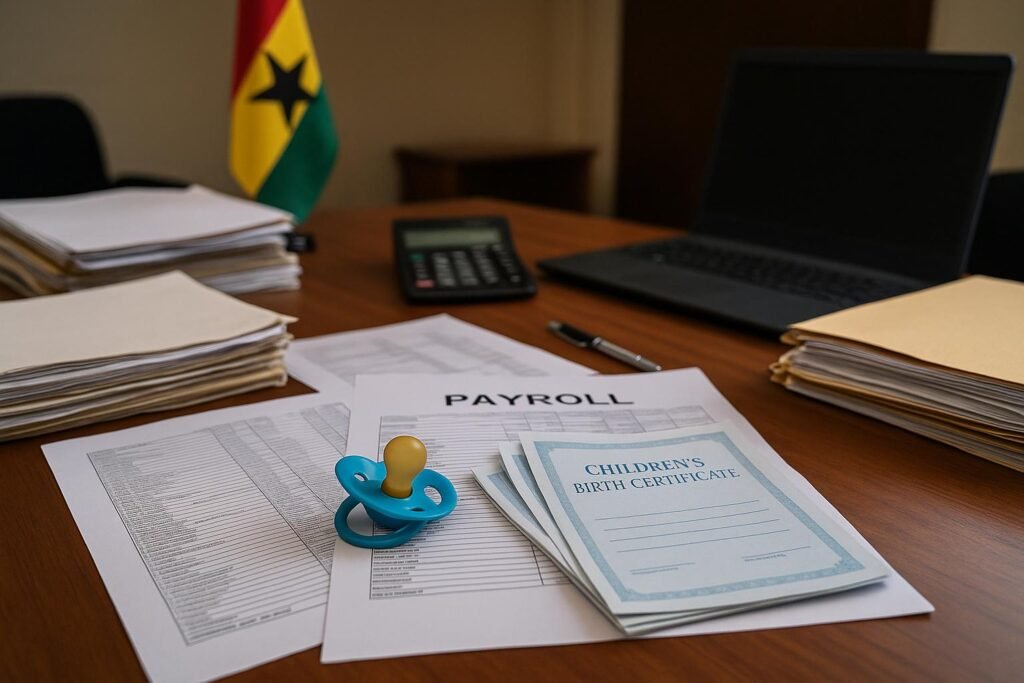
A shocking forensic audit uncovers babies on NSA payroll, revealing over 1,000 infants, including newborns, falsely listed as national service personnel. This startling revelation has stunned Ghanaians and reignited debate about corruption, accountability, and weak digital governance within the National Service Authority (NSA).
The discovery — that an audit uncovers babies on NSA payroll — adds a bizarre twist to the ongoing ghost name scandal that has haunted Ghana’s public sector for years.
Background: The Ghost Name Legacy and Institutional Weaknesses
The audit uncovers babies on NSA payroll months after an earlier probe exposed 81,000 suspected ghost names on the National Service Authority’s database. This new layer of fraud, involving infants, shows that the payroll irregularities were not accidental but deliberately engineered by insiders exploiting outdated systems.
The National Service Scheme (NSS), which deploys tertiary graduates for one year of service, has long struggled with payroll integrity. However, the inclusion of babies — some less than six months old — demonstrates how administrative neglect and collusion have undermined public confidence.
Investigation Findings: How the Babies Were Discovered
The revelation that an audit uncovers babies on NSA payroll came after a three-month forensic investigation that matched biometric records, Ghana Card numbers, and bank accounts. Auditors found multiple entries showing “service personnel” born between 2024 and 2025 — ages that make participation impossible.
Investigators believe fraudulent records were inserted by payroll officers and data clerks who reused inactive credentials to receive monthly allowances. Each fictitious entry was reportedly paid GHS 559–715 per month, leading to estimated losses exceeding GHS 12 million annually.
Such findings confirm long-standing fears that systemic corruption, not technical error, drives Ghana’s payroll irregularities.
Fiscal Impact: A Blow to Budget Credibility
The timing of the audit uncovering babies on NSA payroll is particularly damaging. Ghana’s economy remains under strict fiscal discipline following the IMF Extended Credit Facility, which prioritizes payroll reform. Economists warn that fraudulent entries distort wage data and erode credibility in the government’s financial reporting.
According to IMANI Africa, payroll fraud across public institutions costs taxpayers over GHS 4 billion yearly. This single case, where an audit uncovers babies on NSA payroll, highlights how deep inefficiencies can drain resources meant for education, health, and youth employment.
“It’s shocking that infants could exist on payroll while genuine graduates remain unpaid,” said Dr. Amanda Boadi, a governance analyst.
“This discovery proves our internal controls are dangerously weak.”
Official Response: Emergency Reforms and Accountability
The Presidency described the revelations as “deeply disturbing and shameful,” directing the NSA, EOCO, and Auditor-General’s Office to collaborate on a full investigation.
Acting NSA Director Dr. Bernard Tetteh pledged that this audit uncovering babies on NSA payroll will serve as a turning point for institutional reform. His announced measures include:
- A nationwide biometric payroll re-validation to remove ghost names.
- Integration with the NIA database for real-time identity verification.
- Anonymous whistleblower channels to report payroll anomalies.
The Auditor-General is considering sanctions under Article 187 of the Constitution, while EOCO prepares criminal charges for forgery, conspiracy, and financial loss to the state.
Public Outcry: Outrage Turns to Satire
The finding that an audit uncovers babies on NSA payroll quickly became a viral sensation. Hashtags such as #BabyOnPayroll and #GhostNameScandal trended for days on X (formerly Twitter), as Ghanaians expressed disbelief and humor in equal measure.
Memes showed toddlers in “service uniforms” holding fake posting letters. Yet beneath the satire lay anger: many graduates complained about delayed postings while “ghost workers” enjoyed public funds.
Opposition MPs called the episode “the most absurd fraud in Ghana’s administrative history.” Civil society groups like OccupyGhana and the Ghana Integrity Initiative demanded the publication of full audit details and prosecution of complicit officials.
Expert Insights: Why Payroll Systems Keep Failing
Policy analysts say the audit uncovering babies on NSA payroll exposes how Ghana’s public sector remains dependent on disjointed and manual data systems. Many payroll units still operate without unified digital verification across agencies.
Dr. Kwadwo Asante of CDD-Ghana argues that only AI-driven payroll analytics can close loopholes.
“Until we connect payroll data directly to Ghana Card, SSNIT, and bank verification, corruption will thrive,” he warned.
Economist Prof. Patrick Asuming added that payroll fraud distorts national employment figures and undermines debt sustainability planning. “If data cannot be trusted, policy decisions collapse,” he said.
Both experts agree that the audit uncovering babies on NSA payroll should catalyze full digital integration across government databases.
Regional Context: A Continental Governance Challenge
Across Africa, ghost-name scandals remain common, but Ghana’s case stands out for its absurdity. Nigeria’s IPPIS once uncovered 70,000 fake workers, while Kenya’s Education Service discovered 11,000 phantom teachers. Yet nowhere has an audit uncovered babies on NSA payroll or its equivalent — making Ghana’s case a global cautionary tale.
Transparency International warns that such payroll corruption costs African economies billions annually, deepening inequality and undermining public trust in governance systems.
Moral and Institutional Lessons
Beyond financial losses, the audit uncovering babies on NSA payroll reflects a deeper moral crisis. It symbolizes institutional complacency and ethical decay. Religious and civic leaders say it exposes how corruption has become normalized even within youth-oriented institutions meant to foster national development.
Social commentator Efua Ntiamoah captured it succinctly:
“If babies can appear on payrolls, then our institutions have lost their moral compass. This is more than theft; it’s a national embarrassment.”
Universities and training institutions are now considering adding integrity modules to pre-service orientation to reinforce ethical conduct in public office.
The Path Forward: Building a Clean, Verified Payroll
Governance experts propose practical measures to prevent another scandal of this magnitude:
- Unified Payroll Architecture: merge all state payrolls into one verified digital system.
- Real-Time Biometric Checks: every disbursement must match live identity data.
- Quarterly Public Disclosures: publish payroll summaries for transparency.
- Stiffer Legal Penalties: classify payroll fraud as economic sabotage.
They stress that unless reforms go beyond committee reports, Ghana risks repeating the same cycle. The audit uncovering babies on NSA payroll should therefore be remembered not just for its absurdity but for sparking irreversible change.
Conclusion: From Scandal to Systemic Reform
The audit uncovering babies on NSA payroll is both absurd and alarming — a mirror reflecting the fragility of Ghana’s governance systems. The discovery of over 1,000 infants on payroll is not a clerical error; it’s evidence of deliberate exploitation that robs the nation of vital development funds.
Whether this scandal becomes a catalyst for reform or fades into political noise will define Ghana’s fight against corruption. For now, the message is clear: when babies can appear on payrolls, accountability is overdue.
Internal Links (GSN)
- Galamsey Pits Central Region: 22 Dead, NADMO Acts
Stolen Vehicle Menace: Dealers Union Backs Crackdown - Ghana Military Helicopter Crash: 8 Top Officials Killed in Devastating Tragedy