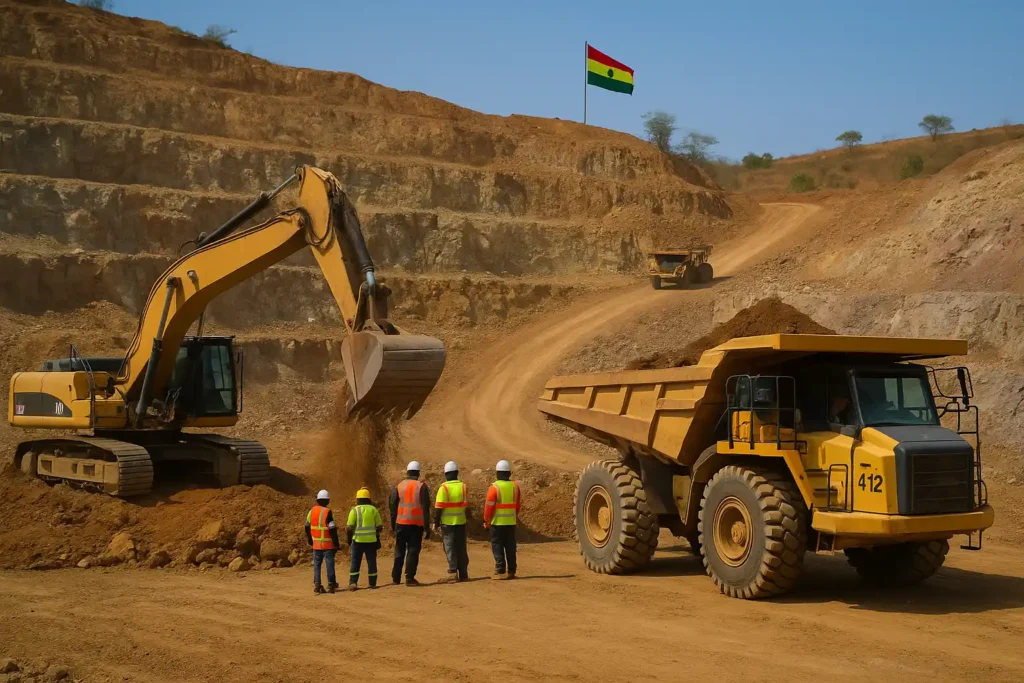
A New Era for Ghana’s Industrial Ambitions
The Engineers and Planners Takeover has positioned Ibrahim Mahama’s company at the center of Ghana’s resource-driven transformation. Engineers & Planners (E&P), one of West Africa’s largest indigenous mining and construction firms, has officially taken over operational control of a strategic mining project previously managed by a foreign contractor.
The contract, valued at hundreds of millions of dollars, marks a defining moment for local content participation in Ghana’s extractive industry — a sector long dominated by international players.
Building Toward the Engineers and Planners Takeover
Founded in 1997 by Ibrahim Mahama, Engineers & Planners has grown from a modest equipment-rental outfit into a major force across mining, infrastructure, and energy projects.
The Engineers and Planners Takeover follows years of steady expansion and strategic positioning. The firm’s experience in large-scale mining operations — including work with AngloGold Ashanti, Gold Fields, and the Ghana Bauxite Company — cemented its reputation for delivering complex engineering solutions.
E&P’s latest acquisition represents not just a business milestone, but a broader shift toward African ownership in resource management, aligning with Ghana’s industrialization and value-addition agenda.
Details of the Engineers and Planners Takeover
According to sources within the Ministry of Lands and Natural Resources, the takeover involves operational control of a high-capacity open-pit mine in Ghana’s Western Region.
The contract transfer was approved following months of evaluation by the Minerals Commission and the Ghana Investment Promotion Centre (GIPC). The agreement mandates E&P to assume full responsibility for equipment management, environmental compliance, and local workforce integration.
Officials praised the company’s technical capacity, modern fleet of Caterpillar and Komatsu heavy equipment, and its track record in adhering to ESG (Environmental, Social, and Governance) standards — key reasons for awarding the contract to a local player.
Why the Engineers and Planners Takeover Matters
Analysts describe the Engineers and Planners Takeover as a watershed moment for Ghana’s mining governance and economic independence.
For decades, foreign contractors dominated heavy-equipment operations, resulting in capital flight and limited local capacity development. E&P’s entry changes that narrative — redirecting operational value, tax contributions, and employment opportunities back into Ghana’s economy.
An economist with the Centre for Extractive Policy told GSN that the Takeover marks a pivotal shift in Ghana’s resource management strategy.
“The Engineers and Planners Takeover represents a defining moment for Ghana’s industrial independence,” the expert noted. “It demonstrates that indigenous companies can match global standards while keeping value and profits within the country.”
Economic Outlook: Job Creation and Industrial Multiplier Effects
Under the new contract, Engineers & Planners is expected to employ more than 2,000 Ghanaians, spanning mining technicians, engineers, logistics operators, and administrative staff.
The Engineers and Planners Takeover is projected to inject significant revenue into Ghana’s local supply chain — from equipment servicing to fuel distribution and component manufacturing.
According to the Ghana Chamber of Mines, increased local contracting could save the sector over US$150 million annually in import costs, while boosting skills transfer and domestic production.
Environmental and Social Responsibility Commitments
A cornerstone of the Takeover agreement is strict adherence to environmental sustainability and community-relations standards.
E&P has pledged to:
- Reclaim disturbed mining sites progressively
- Fund local school and health-center initiatives
- Ensure safe working conditions aligned with ILO standards
This approach reflects a maturing Ghanaian mining sector that balances profitability with sustainability — a factor that earned E&P strong support from both government and civil-society stakeholders.
Regional and Continental Impact
The ripple effect of the Engineers and Planners Takeover extends beyond Ghana’s borders.
Across West Africa, governments are increasingly prioritizing local participation in extractive industries, echoing Ghana’s success story. Industry observers say E&P’s move could inspire similar takeovers in Nigeria, Liberia, and Sierra Leone — where indigenous engineering firms are pushing for equal opportunities in mining and infrastructure development.
Moreover, the takeover reinforces ECOWAS industrial policy goals, encouraging cross-border collaboration on energy, construction, and logistics projects.
Challenges and Future Outlook
While the Takeover marks a major win, analysts caution that sustaining efficiency will require continued investment in modern equipment, digitalization, and safety training.
Rising operational costs, global commodity-price fluctuations, and community expectations may test the company’s resilience. However, given Ibrahim Mahama’s proven leadership and E&P’s growing influence, many see this takeover as the beginning of a new chapter for Ghana’s industrial renaissance.
A mining consultant told GSN that the Engineers and Planners Takeover goes beyond a routine contract transfer.
“The Engineers and Planners Takeover is more than a business deal — it’s a statement that Ghanaian firms are capable of managing multi-billion-dollar projects with world-class efficiency and professionalism.”
Engineers and Planners Takeover Ushers in Local Empowerment
The Takeover encapsulates Ghana’s drive toward self-reliance and sustainable development. It demonstrates that African engineering firms can compete globally, deliver quality, and transform the economic landscape from within.
As the company expands its footprint across mining, energy, and infrastructure, E&P’s success will likely redefine what local participation truly means — not just in Ghana, but across Africa’s booming industrial frontier.
Internal Links
- Gold Price Record High: Gold Surges Past $3,500 Mark
- Cocoa Smuggling Crisis Costs Ghana 150,000 Tonnes
- Ghana’s Road Safety Emergency: Over 1,500 Lives Lost