Market Showdown in the Capital
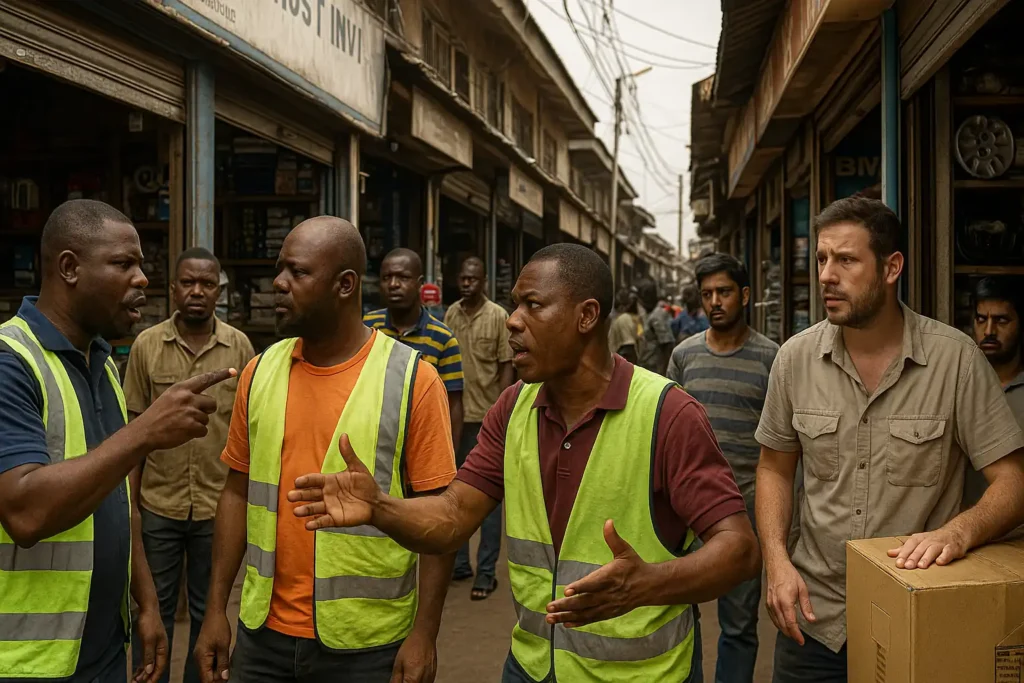
Accra, Ghana — September 8, 2025. The Abossey Okai Ultimatum has sparked a dramatic confrontation in Ghana’s largest automobile spare-parts hub after the Spare Parts Dealers Association issued a three-day deadline for foreign-owned retail shops to close. The traders argue that their action complies with the Ghana Investment Promotion Centre (GIPC) Act, 2013 (Act 865), which reserves retail trading for Ghanaian citizens unless foreigners invest at least $1 million in capital or operate on a wholesale basis.
What began as a local standoff has quickly evolved into a national test of Ghana’s commitment to enforcing its own economic laws amid mounting regional and diplomatic pressures.
The Roots of Ghana’s Retail Protection Law
The GIPC Act was enacted to safeguard local enterprises from unfair competition. It stipulates that only Ghanaian citizens may engage in retail trade unless foreign investors meet specific criteria:
- A minimum equity investment of $1 million.
- Employment of at least 20 skilled Ghanaian workers.
These requirements were meant to ensure that foreign participation contributes substantially to Ghana’s economy. Yet, implementation has been inconsistent.
For years, local traders have protested that foreign nationals—especially from neighboring West African states—continue to operate small shops without meeting the capital threshold. The ultimatum emerges as the most forceful trader-led demand for compliance since the previous showdowns of 2020 and 2021, when temporary closures and diplomatic negotiations failed to produce lasting reform.
The Three-Day Deadline and Growing Pressure
Countdown to Enforcement
On September 5, 2025, the Spare Parts Dealers Association delivered a public warning that all non-compliant shops must close within three days. The ultimatum was reaffirmed at a press conference on September 8, accompanied by announcements through market loudspeakers and local radio stations.
The ultimatum set September 11 as the final deadline — a date traders describe as “non-negotiable.” With the government yet to intervene, tensions are rising across Abossey Okai’s crowded lanes.
Association’s Standpoint
General Secretary Gifty Lovelock Naana Fianu defended the move as an act of lawful accountability rather than hostility:
“This is not xenophobia,” she said. “The Abossey Okai Ultimatum is about respecting Ghana’s own laws. Ghanaians must not obey rules that others freely ignore.”
The Association has since petitioned the Ministry of Trade and Industry and the Ghana Police Service to supervise the enforcement process, insisting that voluntary compliance is the only acceptable alternative to state-backed closure.
Reactions Within the Market: Divided Loyalties
Ghanaian Traders Applaud the Ultimatum
Many local dealers argue that the measure restores fairness.
“Profits from our markets should circulate among Ghanaians first. The Ultimatum brings long-awaited justice,” a shop owner told Citi Newsroom.
They point to unequal conditions: locals pay full taxes and rent while competing with foreign traders who may import goods through informal channels or enjoy cheaper labor.
Foreign Retailers Fear Economic Ruin
Foreign shop owners view the ultimatum as a potential catastrophe. Many cite ECOWAS trade protocols, which permit cross-border commerce within West Africa, and warn that sudden closures could destroy livelihoods built over decades.
One Nigerian trader explained, “We respect Ghana’s laws, but we also belong to the ECOWAS community. We need dialogue, not shutdowns.”
Thus, the Abossey Okai Ultimatum pits domestic protectionism against regional free-trade ideals, a conflict that has become emblematic across West Africa.
Expert Insights: The Legal and Economic Balancing Act
Policy Ambiguity and Political Risk
According to trade law lecturer Dr. Thelma Osei-Agyeman of the University of Ghana, “the GIPC Act is explicit, but applying it requires political courage.” Governments, she added, often hesitate because enforcement may inflame diplomatic tensions or disrupt commerce.
Economic Ripple Effects
Analysts predict that swift enforcement could trigger temporary price surges and supply shortages across Ghana’s vehicle-repair ecosystem. Since Abossey Okai supplies much of the country’s transport sector, any disruption could raise costs for motorists nationwide.
Nonetheless, economists argue that strict application of the law may enhance market formalization, attract legitimate investment, and increase tax revenue. Over time, it could also discourage illegal imports and promote quality standards.
Controversy Over Citizen-Led Enforcement
The Association’s call for citizens to help close foreign shops has drawn warnings from legal professionals. Under Ghana’s Criminal and Other Offences Act, civilians may only intervene during an active crime. Extending that authority to business regulation, experts warn, could lead to vigilantism.
Legal analyst Yaw Adomako Mensah remarked:
“Enforcing the Abossey Okai Ultimatum must remain a lawful state process. Delegating it to the public risks confrontation and legal chaos.”
Government in a Bind: Enforcing Law Without Fueling Hostility
Pressure to Act
The Spare Parts Dealers Association insists that the Ministry of Trade, the GIPC, and the Ghana Police Service must act decisively.
“The Abossey Okai Ultimatum should not be ignored,” Naana Fianu reiterated. “Authorities must show that Ghana’s statutes have value.”
Diplomatic Sensitivities
Enforcement, however, touches a diplomatic nerve. Many affected retailers are citizens of Nigeria, Togo, and Niger—key ECOWAS partners. Previous enforcement drives provoked protests abroad and official complaints from neighboring governments.
Political analysts caution that mishandling the issue could harm Ghana’s image as a regional trade hub and complicate relations within the African Continental Free Trade Area (AfCFTA). With national elections looming in 2026, the government is under pressure to balance rule of law with diplomatic restraint.
Historical Perspective: Lessons From Past Confrontations
Abossey Okai has long symbolized Ghana’s informal-sector resilience and entrepreneurial spirit. Yet, it has also become a recurrent flashpoint for economic nationalism.
In 2020, traders forcibly closed dozens of foreign shops, prompting police intervention and temporary market shutdowns. Government mediators later reopened the shops, promising regulatory reviews that never materialized.
The 2025 Abossey Okai Ultimatum marks a more organized and resolute phase—one in which traders appear ready to test state resolve rather than await government assurances. Police patrols have already increased across the market to pre-empt clashes, while mediation efforts continue behind closed doors.
Continental and Global Resonance
The Abossey Okai Ultimatum reverberates beyond Ghana’s borders. Across Africa, similar disputes over retail ownership and foreign competition have unfolded in Nigeria, Kenya, and South Africa, underscoring the tension between local job protection and free-market ideals.
Economists view Ghana’s standoff as a litmus test for AfCFTA’s credibility. If the host nation of the continental trade secretariat struggles to enforce domestic rules within a liberalized framework, other member states may question the agreement’s balance between sovereignty and openness.
The outcome will likely influence how future trade reforms are implemented across the continent.
Public Sentiment: Nationalism, Anxiety, and Debate
Public opinion in Accra is sharply divided. Supporters of the traders frame the Abossey Okai Ultimatum as a patriotic stand against economic marginalization. Critics fear it may escalate into xenophobic tension or violence.
Online debates under hashtags #AbosseyOkaiUltimatum, #BuyGhana, and #FairTradeNow capture this split—some celebrating “economic liberation,” others warning that targeting foreign traders undermines regional unity.
Opposition legislators have urged dialogue and phased enforcement, while government MPs insist that legal compliance is non-negotiable. Civil-society groups, meanwhile, call for education campaigns to prevent misinformation and inter-community hostility.
Conclusion: A Defining Moment for Ghana’s Trade Governance
The Abossey Okai Ultimatum stands as a watershed in Ghana’s evolving debate over economic nationalism, legal sovereignty, and regional cooperation. As the September 11 deadline approaches, the government’s decision will reveal whether Ghana can uphold its laws while preserving its reputation as a regional leader in commerce and diplomacy.
Whatever the outcome, this confrontation has redefined public discourse on who controls Ghana’s retail economy—and how national law interacts with broader African integration.
Internal links
- Engineers and Planners Takeover Sparks Ghana Mining Revival
- BoG Suspends UBA Ghana Licence
- MultiChoice Ghana Shutdown: Minister Warns of Sept. 6 Deadline
External Links
Retail trading sector reserved for Ghanaians – President…” (GhanaWeb) Ghana
Abossey Okai spare parts dealers threaten shutdown of foreign retail shops – MyJoyOnline
Does Ghana’s investment law ban all foreigners from doing business?