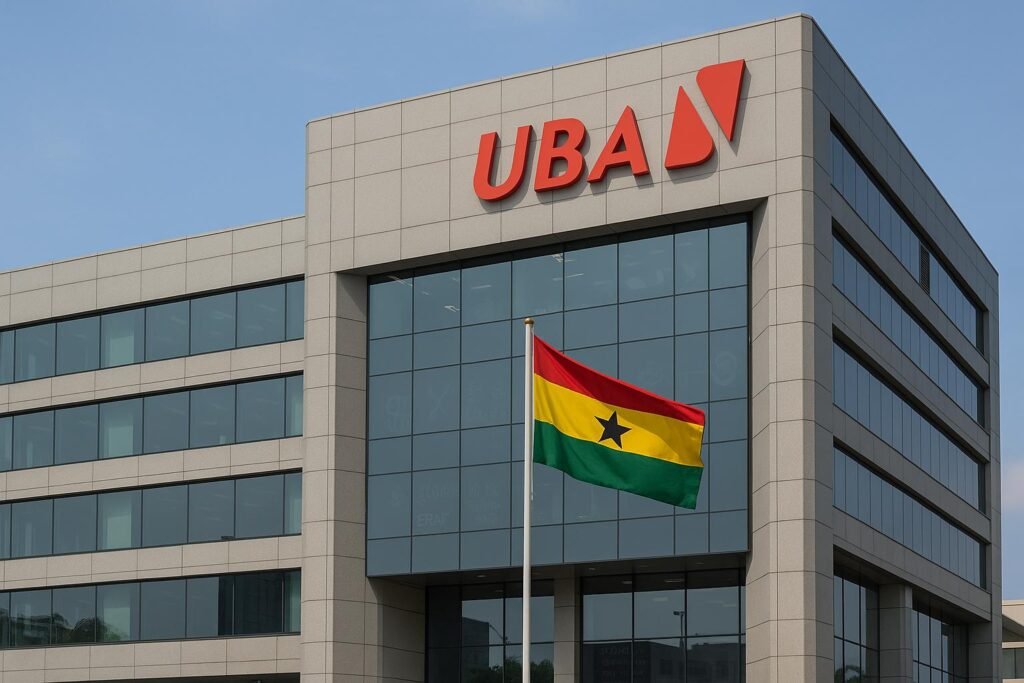
The BoG UBA Ghana suspension has jolted the country’s banking landscape. On September 4 2025, the Bank of Ghana (BoG) announced that it had suspended the foreign-exchange trading licence of United Bank for Africa (UBA) Ghana for one month, effective September 18 2025.
The enforcement—executed under Section 11(2) of the Foreign Exchange Act 2006 (Act 723)—followed findings of regulatory breaches involving unauthorized remittance activities tied to Payment Service Providers (PSPs) and Money Transfer Operators (MTOs).
This decisive suspension is one of the most high-profile sanctions in recent years, underscoring the regulator’s determination to restore integrity and discipline within Ghana’s financial ecosystem
Why the BoG UBA Ghana Suspension Happened
According to BoG, investigations revealed that UBA Ghana collaborated with three PSPs—Halges Financial Technologies Ltd, Cellulant Ltd, and Flutterwave Inc.—to process remittances on behalf of five international MTOs: Taptap Send, Top Connect, Remit Choice, Send App, and Afriex.
These partnerships allegedly breached forex-market regulations that require direct authorization and oversight from the BoG.
As part of the same enforcement action, the BoG also suspended the remittance operations of these five MTOs for one month beginning September 18 2025. Officials emphasized that the move aims to strengthen compliance, prevent illicit flows, and protect customers.
Current Development: Impact on UBA Operations
The BoG UBA Ghana suspension affects only the bank’s foreign-exchange functions. For one month, UBA Ghana cannot:
- Buy or sell foreign currencies.
- Process international transfers linked to forex.
- Facilitate FX-based remittances for clients.
All domestic banking services—including deposits, withdrawals, loans, and digital transactions—remain operational.
However, individuals and businesses that rely on UBA for forex transactions may experience temporary disruptions. BoG has advised customers to seek assistance from licensed banks and forex bureaux until the suspension is lifted.
The Legal Foundation: Act 723
The Bank of Ghana cited Section 11(2) of the Foreign Exchange Act 2006 (Act 723) as the legal basis for the sanction.
The provision authorizes BoG to suspend or revoke a foreign-exchange licence if a financial institution fails to comply with market regulations or supervisory requirements.
By invoking this law, BoG demonstrates its mandate to:
- Protect the integrity of Ghana’s financial system.
- Curb unauthorized remittance flows.
- Uphold anti-money-laundering (AML) and counter-terrorism financing (CTF) standards.
The BoG UBA Ghana suspension therefore reaffirms the central bank’s commitment to a cleaner, more transparent financial environment.
Industry and Public Reactions
The announcement sparked wide-ranging reactions across the banking community and public discourse.
- Analysts applauded the move as proof that BoG is asserting its regulatory authority without fear or favor.
- Compliance experts believe the action will encourage banks and fintech partners to audit their operations and tighten monitoring mechanisms.
- Customers voiced mixed feelings — some worried about forex delays, others welcomed the renewed focus on transparency.
One industry observer told local media:
“The BoG UBA Ghana suspension is a wake-up call. It proves that even major banks must prioritize compliance over profit.”
The incident has prompted other banks to review their foreign-exchange relationships with PSPs and MTOs, anticipating stricter scrutiny from the central bank.
Implications for Ghana’s Banking Sector
Experts interpret the BoG UBA Ghana suspension as a strategic signal to stabilize Ghana’s financial markets amid a volatile global environment.
- Strengthening Regulatory Discipline – The action sets a precedent that compliance lapses will carry real consequences, no matter the institution’s size.
- Encouraging Transparency – By making UBA’s case public, BoG builds confidence among investors and the public that oversight is alive and credible.
- Market Stability – Short-term forex delays may occur, but long-term discipline will strengthen the financial system’s resilience.
Financial analysts predict that other banks will accelerate internal compliance audits to avoid similar sanctions.
Economic Effects and Wider Impact
Ghana’s economy relies heavily on foreign exchange and remittances. According to the World Bank, remittance inflows account for over 5 % of GDP.
A temporary halt in operations like the BoG UBA Ghana suspension could delay some inflows and put minor pressure on foreign-currency liquidity.
SMEs and importers/exporters using UBA’s forex desks may face short-term cash-flow issues. Nonetheless, BoG has reassured the market that overall stability will be maintained through liquidity support and other banks’ capacity to absorb demand.
In the medium term, the incident may boost public trust in BoG’s resolve to enforce compliance uniformly across local and international banks.
What Happens Next
To restore its licence and resume foreign-exchange operations, UBA Ghana must demonstrate full compliance by:
- Addressing regulatory breaches identified by BoG.
- Submitting corrective action plans and progress reports.
- Implementing robust oversight mechanisms for PSP and MTO partners.
The suspension is set to expire on October 18 2025, but BoG retains the authority to extend or escalate penalties if deficiencies persist.
Observers say UBA’s swift response will be closely watched as a test of corporate accountability within the sector.
Broader Lessons for Ghana’s Financial Sector
The BoG UBA Ghana suspension is more than a disciplinary action — it is a turning point for the nation’s financial governance. It highlights the urgent need for:
- Stronger compliance departments and continuous staff training.
- Enhanced due diligence on third-party fintech partners.
- Transparent communication between banks and regulators.
If Ghana’s financial sector adapts to these lessons, the result will be a more resilient, transparent, and globally credible banking environment.
Conclusion
The BoG UBA Ghana suspension underscores the Bank of Ghana’s uncompromising stance on compliance and financial integrity. While the move has short-term operational impacts, it ultimately strengthens trust in the nation’s regulatory system.
As the suspension winds down, banks across the country are likely to re-evaluate their risk and compliance frameworks — a development that can only benefit Ghana’s financial future.
Internal Links
- Bank of Ghana Dollar Ban: Cedi Is Only Legal Tender
- Gold Price Record High: Gold Surges Past $3,500 Mark
- Nigeria Shea Nut Export Ban: 6-Month Boost for Local Industry