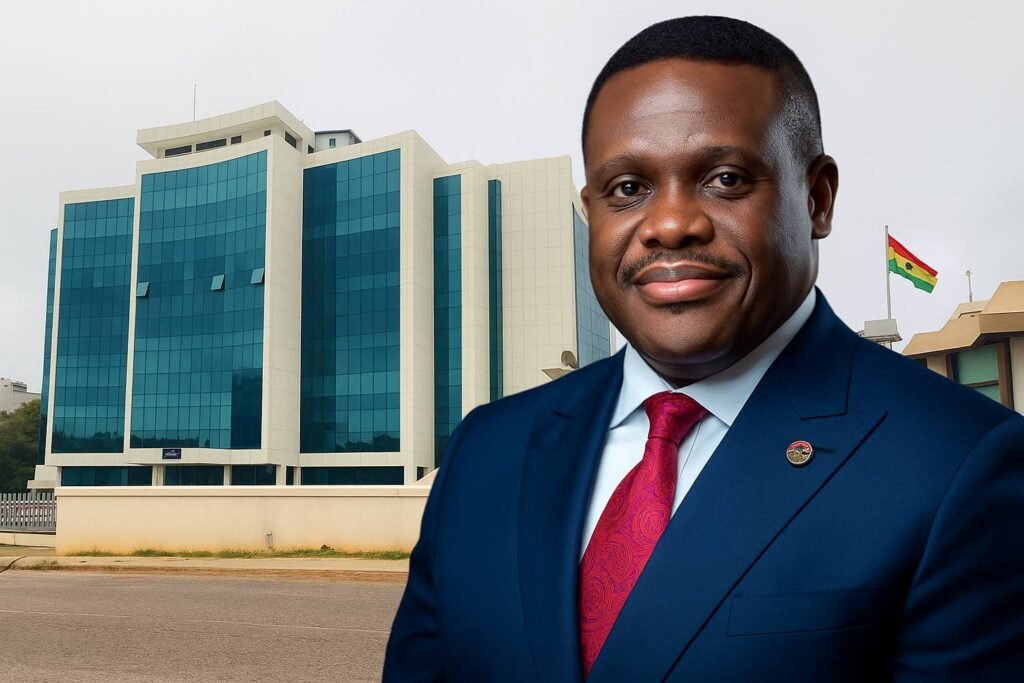
Accra, Sept. 3, 2025 — Ghana’s Minister of Communications and Digitalisation, Samuel Nartey George, has issued a stern ultimatum that could see a shutdown within days. The minister stressed that the satellite TV operator must comply with government directives by September 6, 2025, or risk having its broadcasting license revoked.
At the core of the escalating dispute is the MultiChoice Ghana shutdown ultimatum — a confrontation that extends far beyond subscription pricing, raising deeper questions about regulatory authority, consumer protection, and the balance of corporate power within Ghana’s digital economy.
Government Ultimatum
Speaking at the Digital Africa Summit in Accra, Minister Sam George warned that MultiChoice must reduce subscription fees by 30 percent and submit detailed pricing data to the National Communications Authority (NCA) in accordance with the Electronic Communications Act.
“They have up to the 6th of September. If by that time there is no resolution, we will shut down the operations of MultiChoice,” the minister declared.
His comments underscore the seriousness of the threat, which has captured national attention and drawn international interest.
Daily Fines Already Mounting
The conflict has been simmering for weeks. In mid-August, the Ministry began imposing a GH₵10,000 daily fine on MultiChoice Ghana for non-compliance. By early September, fines had ballooned to between GH₵150,000 and GH₵170,000, which the NCA confirmed it would collect in full.
Officials argue that the MultiChoice Ghana shutdown warning and fines are necessary to ensure corporate accountability and to protect consumers from unfair practices.
Previous Deadlines Ignored
This is not the first time MultiChoice Ghana has come under government scrutiny. On August 7, 2025, authorities issued an ultimatum demanding the company reduce its subscription fees or face suspension. When the deadline passed without compliance, officials renewed their threat to shut down the service.
Why the Government Is Acting
The Ministry insists that Ghana’s improving economic indicators should translate into lower costs for households.
- Inflation has dropped into single digits.
- The Ghana cedi has stabilized against major currencies.
- Fuel and transport costs have eased.
Despite these improvements, DStv subscription rates have remained unchanged, sparking accusations of price rigidity. Critics contend that MultiChoice’s refusal to revise its pricing structure has justified the government’s renewed threat of a shutdown.
Potential Impact of a Shutdown
If carried out, a MultiChoice Ghana would have sweeping consequences:
- Sports fans could lose access to the English Premier League, UEFA Champions League, and other major sporting events.
- Families would lose access to international networks such as CNN, BBC, Al Jazeera, and Cartoon Network.
- Local businesses and advertisers would lose a key platform for reaching customers.
- Content creators in Ghana’s entertainment industry could see partnerships disrupted.
The possibility of a MultiChoice Ghana shutdown therefore represents not just a regulatory matter, but a social and cultural disruption.
Industry Reactions
Analysts say Ghana’s hardline approach could set a precedent across Africa. MultiChoice operates in more than 50 countries, and a MultiChoice Ghana could embolden other governments to push for fee reductions and stronger consumer protections.
“Ghana may be setting a consumer-first precedent. If Accra succeeds, other markets could follow with similar demands,” one media analyst explained.
MultiChoice’s Position
So far, MultiChoice Ghana has remained silent publicly. In the past, the company has defended its pricing by citing:
- Rising costs of acquiring exclusive sports and entertainment rights.
- Currency volatility that affects operational expenses.
- High satellite infrastructure costs.
However, its silence on the looming MultiChoice Ghana shutdown has fueled speculation that behind-the-scenes negotiations are taking place.
Political Undertones
The timing of the MultiChoice Ghana shutdown warning has also raised political questions. With general elections approaching in 2026, some analysts believe the government is positioning itself as a protector of consumers against corporate giants.
On the other hand, critics argue that a MultiChoice Ghana shutdown could backfire, scaring away investors and undermining Ghana’s image as a stable free-market economy.
The Next Steps
Minister George confirmed that a final round of negotiations will be held before the September 6 deadline. Should the parties fail to reach an agreement, the government will move to revoke MultiChoice Ghana’s license — effectively initiating a full shutdown of its operations.
Such an outcome would mark the first time in Ghana’s broadcasting history that a major international operator is forcibly shut down over pricing and compliance issues.
African Context
Elsewhere in Africa, MultiChoice has faced similar controversies:
- In Nigeria, regulators fined the company for unapproved subscription hikes.
- In Kenya, consumer groups have called for affordable DStv packages.
- In South Africa, debates continue about MultiChoice’s control over sports broadcasting rights.
A MultiChoice Ghana shutdown could therefore influence regulatory strategies across the continent, reshaping how African governments handle global broadcasters.