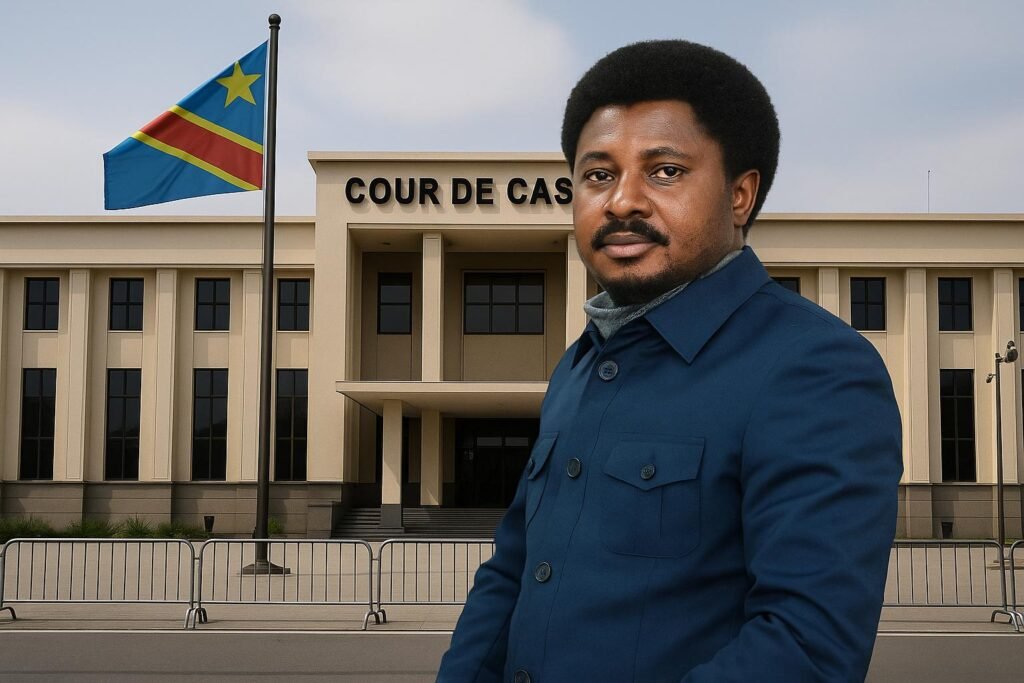
A Landmark Judgment in Congo’s Anti-Graft Drive
The conviction of the Congo ex-justice minister marks a pivotal moment in the Democratic Republic of Congo’s ongoing struggle against entrenched corruption. On September 2, 2025, the nation’s Court of Cassation found former Justice Minister Constant Mutamba guilty of embezzling $19 million earmarked for constructing a new high-security prison in Kisangani, Tshopo Province.
Mutamba was sentenced to three years of forced labor and banned from public office for five years after completing his term. His conviction represents a key test for President Félix Tshisekedi’s campaign to cleanse public institutions of graft — but also ignites fierce debate over the politicization of justice in one of Africa’s most resource-rich yet corruption-ridden nations.
Origins of the Scandal: How the Kisangani Project Collapsed
The downfall of the Congo ex-justice minister stems from a failed infrastructure project that was initially hailed as a milestone for prison reform. In 2022, the Ministry of Justice launched a $19 million initiative to construct a modern correctional facility in Kisangani, aimed at replacing overcrowded, crumbling detention centers that violated basic human rights.
However, a 2024 audit by the General Inspectorate of Finance (IGF) revealed massive irregularities. Millions of dollars had vanished from project accounts, contractors were overpaid, and no tangible progress had been made on the construction site.
Investigators traced part of the funds to private entities with no legal ties to the ministry. Witness testimonies and procurement records suggested deliberate manipulation of contracts and inflated invoices. The findings led to Mutamba’s resignation in June 2025, weeks before his arrest.
Mutamba has consistently denied wrongdoing, claiming that the funds were “reallocated” to other approved justice reforms. Yet auditors insisted that documentation did not support these claims.
Court Ruling: A Blow to Political Elites
After months of proceedings, the Court of Cassation concluded that the Congo ex-justice minister had “knowingly and willfully diverted state funds for unauthorized purposes.” Judges cited evidence of bank transfers made to intermediary companies registered under associates’ names, violating Congo’s public procurement laws.
The verdict ordered restitution of the embezzled funds and imposed a three-year term of forced labor, with an additional five-year ban on holding any public office.
Legal analysts view the sentence as both symbolic and strategic — signaling judicial independence but also raising questions about selective enforcement. The court emphasized that “corruption at the top undermines the nation’s credibility and deprives citizens of essential infrastructure.”
Mutamba’s defense attorney, Michel Bakanda, denounced the verdict as “a political performance rather than a fair trial,” vowing to appeal before the Constitutional Council. “This decision was influenced by those who fear Mutamba’s reformist record,” Bakanda told reporters outside the courtroom.
Public Unrest: Streets of Kinshasa Erupt After Verdict
The sentencing of the Congo ex-justice minister ignited widespread protests across Kinshasa and parts of Kisangani. Supporters of Mutamba poured into the streets chanting his name and accusing the government of using the judiciary to silence dissent.
Police deployed water cannons and tear gas to disperse crowds outside the Palais de Justice, where clashes broke out between demonstrators and security forces.
Eyewitnesses reported that several protesters were injured as authorities moved to restore order. Business owners shuttered shops amid fears of escalation. Civil society groups condemned the excessive police response while calling for calm and dialogue.
The Kinshasa Police Command later confirmed the arrest of 38 individuals for public disorder. Despite the unrest, government spokesperson Patrick Muyaya reiterated that “the rule of law must prevail, and no one is above justice.”
Political Consequences: From Reform Champion to Convicted Official
The downfall of the Congo ex-justice minister carries significant political implications. Constant Mutamba had once positioned himself as a reformist within President Tshisekedi’s coalition, pushing for judicial modernization and transparency. His prosecution, therefore, sends a chilling signal to other high-ranking officials navigating Congo’s volatile political terrain.
Opposition leader Moïse Katumbi argued that the conviction reflects “a pattern of weaponized justice,” where legal institutions are used to neutralize potential challengers. “If anti-corruption becomes selective, it ceases to be justice and turns into repression,” Katumbi told GSN World Desk.
Yet supporters of President Tshisekedi see the judgment as proof of the administration’s seriousness about fighting corruption. “This case demonstrates that accountability begins at the top,” said Jean-Pierre Lumbu, chair of the National Anti-Corruption Commission. “It’s a message to public servants: impunity is no longer guaranteed.”
What It Means for Congo’s Governance and Economy
The conviction of the Congo ex-justice minister has reverberated through both domestic and international circles. Development partners such as the World Bank, IMF, and European Union have long demanded stronger governance safeguards before disbursing aid to Congo.
Analysts believe this case could help rebuild donor confidence — but only if it is followed by systemic reforms. “This ruling is a small but meaningful step,” said Dr. Léonie Bisimwa, governance expert at the University of Kinshasa. “Yet if other high-profile corruption cases remain untouched, the perception of selective justice will persist.”
Congo’s justice sector, often described as opaque and underfunded, continues to face serious credibility challenges. Corruption not only diverts public resources but also discourages foreign investment, particularly in the mining sector that accounts for nearly 70% of export revenue.
Civil Society and International Response
The sentencing of the Congo ex-justice minister was met with cautious approval by civil society organizations. The Congolese Anti-Corruption League (LCC) praised the judiciary for “taking a bold step toward accountability.” However, it urged the government to extend investigations to other ministries implicated in procurement fraud.
Meanwhile, Transparency International called for publication of all audit findings related to the Kisangani project, noting that public transparency remains essential for rebuilding trust.
Internationally, the European Union Delegation to Congo released a statement welcoming the verdict but emphasizing that sustainable progress requires institutional independence and whistleblower protection. The World Bank also noted that continued collaboration with Congo depends on tangible governance outcomes.
Analysis: Justice or Political Strategy?
While many hail the conviction as a breakthrough, others see it as a tactical maneuver to consolidate political control. The case of the Congo ex-justice minister illustrates the double-edged nature of anti-corruption efforts in fragile democracies — capable of restoring public confidence but equally capable of being exploited for partisan gain.
Experts argue that true reform requires more than headline-grabbing prosecutions. It demands budget transparency, asset declarations by public officials, and effective oversight of state contracts.
“Anti-corruption must move from punishment to prevention,” said Dr. François Ilunga, a constitutional law lecturer. “Without institutional safeguards, each new government simply replaces old corrupt networks with new ones.”
Regional and Global Relevance
Congo’s anti-corruption developments are closely watched by its neighbors. The Great Lakes Region, heavily interdependent for trade and security, views political stability in Congo as critical. A clean justice system is vital for cross-border cooperation, especially as Congo positions itself as a hub for green-energy minerals like cobalt and lithium.
Globally, the conviction of the Congo ex-justice minister underscores Africa’s broader struggle for integrity in governance. According to Transparency International’s 2025 Corruption Perceptions Index, Africa loses an estimated $88 billion annually to illicit financial flows — money that could otherwise fund healthcare, education, and infrastructure.
By pursuing senior officials, Congo joins nations like Kenya and Nigeria in a growing wave of high-level prosecutions meant to reassure citizens and foreign partners alike that change is possible.
A Precedent or Political Performance?
The conviction of the Congo ex-justice minister stands as one of Congo’s most consequential corruption verdicts in recent history. For many citizens, it represents long-overdue accountability in a system where impunity has been the norm.
Yet the verdict also divides opinion: Is it a genuine sign of judicial awakening or a politically calibrated move to project reformist credibility ahead of upcoming elections?
As one Kinshasa activist summarized, “This is justice on trial — not just Mutamba.” The answer, and Congo’s future, will depend on whether the momentum for transparency continues beyond a single case.
Internal Links
- Ghana Tehran Embassy Reopening
- France Immigration Protests Turn Violent
- Gold Price Record High: Gold Surges Past $3,500 Mark