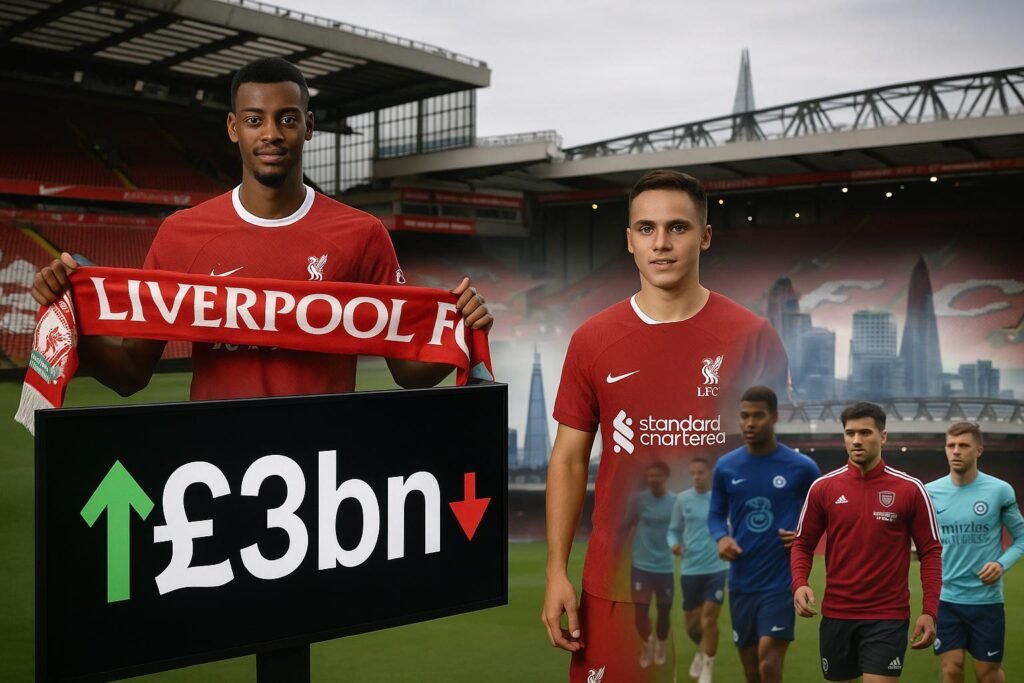
The Premier League summer spending of 2025 shattered all previous records, exceeding £3 billion in gross transfers. Deloitte confirmed that this figure represents over half of all gross transfer spending across Europe’s top five leagues, reinforcing the Premier League’s unrivaled dominance in football’s financial landscape.
This surge eclipsed the previous record of £2.7 billion set during the 2022–23 season. Net spending also skyrocketed to £1.2 billion, a staggering 114% increase compared to last summer’s outlay, underlining the financial muscle of English clubs.
Unlike many European rivals constrained by tighter financial fair play measures, English clubs leveraged their broadcasting revenues, commercial partnerships, and Champions League windfalls to push the transfer market into uncharted territory.
Liverpool’s Blockbuster Transfers Set the Tone
At the center of this spending spree was Liverpool, who executed two of the summer’s most eye-catching transfers:
- Alexander Isak joined from Newcastle United for £125 million, setting a new British transfer record.
- Florian Wirtz was signed from Bayer Leverkusen for £100 million, with performance add-ons potentially lifting the total fee to £116 million.
Together, these moves pushed Liverpool’s total outlay close to €483 million, making them the biggest spenders of the summer. Chelsea followed with €328 million, while Arsenal spent €293 million, further intensifying the competition among the Premier League’s elite.
These signings not only reinforced Liverpool’s ambition under Jürgen Klopp but also signaled a broader trend: the Premier League’s leading clubs are prepared to invest heavily to secure future dominance.
The Perfect Storm Behind Record Premier League Summer Spending
Industry analysts described the unprecedented Premier League summer spending as the result of a “perfect storm” of factors that converged in 2025:
- Broadcasting Stability
The introduction of a new four-year domestic broadcasting deal brought financial security, with a 4% uplift compared to the previous cycle. This ensured that even mid-table clubs enjoyed robust revenue streams, empowering them to compete more aggressively in the transfer market. - Champions League Expansion
A record six Premier League clubs qualified for the Champions League, each earning between £50–100 million in prize money and broadcasting revenue. These funds were directly reinvested in squad strengthening. - Club World Cup Windfalls
The expanded FIFA Club World Cup generated huge bonuses. Chelsea earned around £80 million, Manchester City received £40 million, and Liverpool also benefited from significant payouts. - Mega Sponsorship Deals
Commercial revenue exploded as clubs secured landmark sponsorships. Manchester City’s £1 billion Puma kit deal over 10 years and Liverpool’s £60 million per year Adidas agreement highlighted the growing corporate appetite for Premier League partnerships. - Relaxed Financial Constraints
With fewer clubs facing penalties under Profit and Sustainability Rules (PSR), there was more freedom to reinvest transfer funds, especially in cases where money circulated within the league itself. This “ripple effect” fueled the record outlay.
Europe Struggles to Keep Up
While Premier League summer spending soared, Europe’s other top leagues lagged behind:
- La Liga (Spain): Clubs averaged net spending of less than €90 million.
- Serie A (Italy): Italian clubs spent cautiously, focusing on loans and free transfers.
- Bundesliga (Germany): Teams emphasized youth development rather than blockbuster deals.
- Ligue 1 (France): Paris Saint-Germain remained the only club with significant spending power, though still modest compared to English clubs.
This disparity underscores the Premier League’s ability to generate unmatched revenues through global TV rights and commercial expansion.
Financial Risks and Sustainability Concerns
While fans welcome the influx of star players, critics argue that the Premier League summer spending boom raises questions about long-term financial sustainability.
- Escalating transfer fees risk creating a bubble that smaller clubs may struggle to survive.
- Rising wages and agent fees could destabilize the financial health of clubs outside the top tier.
- UEFA and FIFA may face mounting pressure to reform regulations to maintain balance across European football.
Despite these concerns, supporters are anticipating one of the most competitive Premier League seasons in history, with strengthened squads across the top half of the table.
Looking Ahead: What the Record Spending Means for the Season
The 2025–26 Premier League season promises intense drama. Liverpool’s record spending spree aims to restore their dominance under Klopp. Manchester City, Arsenal, and Chelsea have also reinforced their squads heavily, ensuring fierce competition for the title and Champions League places.
Meanwhile, mid-table clubs like Aston Villa, Tottenham, and Newcastle also made calculated investments, reflecting the depth of financial resources across the league. This means that not only will the title race be more competitive, but the battle for European spots could become even more unpredictable.
Conclusion
The Premier League summer spending surpassing £3bn is a watershed moment in football history. It highlights the league’s unique financial ecosystem, driven by TV deals, global sponsorships, Champions League revenues, and commercial growth.
While sustainability remains a concern, the immediate effect is clear: the Premier League has widened its dominance over Europe, making it the most financially powerful and competitive football league in the world.
Tags:
Premier League, Premier League summer spending, Transfer Market, Football Finance, Liverpool, Alexander Isak, Florian Wirtz, Chelsea, Arsenal
Internal Links:
- Liverpool £125m Isak Deal: Record Transfer Shakes British Football
- Darwin Núñez Transfer: Liverpool Agree £46m Deal with Al-Hilal
- AI Antibiotic Breakthrough: New Solutions for Gonorrhoea & MRSA