A Night of Horror in Eastern Afghanistan
The Afghanistan earthquake that struck late Sunday has left a trail of devastation across eastern provinces. Measuring magnitude 6.0, the tremor killed at least 620 people and injured more than 1,300, according to officials. With entire villages flattened and rescuers struggling to reach remote mountain areas, authorities fear the death toll could rise sharply in the coming days. The magnitude of this tragedy has once again exposed the country’s fragile infrastructure and its vulnerability to natural disasters.
A Nation Built on Fragile Ground
Afghanistan sits atop several major fault lines where the Indian and Eurasian tectonic plates collide, making it one of the most earthquake-prone regions in Asia.
The terrain—mountainous, remote, and filled with clay and timber homes—renders communities extremely vulnerable to seismic shocks.
Since 2022, the country has endured a series of deadly quakes. A 6.2-magnitude tremor in Paktika that year killed more than 1,050 people, while a 6.3-magnitude disaster in western Afghanistan in 2023 killed thousands. Despite repeated catastrophes, limited infrastructure, political instability, and chronic poverty hinder the implementation of modern, earthquake-resistant building standards.
Experts say the earthquake pattern follows decades of neglect, leaving millions exposed to recurring tragedy.
Epicenter and Immediate Impact
The Afghanistan earthquake struck near Jalalabad, the capital of Nangarhar Province, at a shallow depth of just 8 kilometers (5 miles), according to the U.S. Geological Survey (USGS).
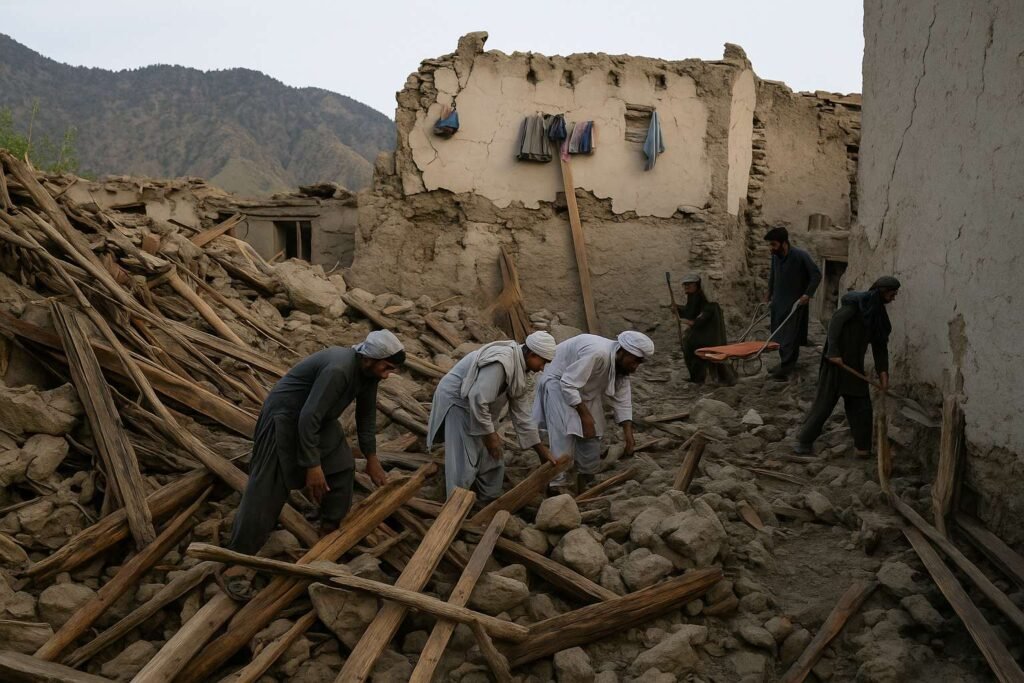
Its shallow depth made the shockwaves devastating, collapsing mud-brick homes and triggering landslides that wiped out entire villages.
Residents were jolted awake by a deafening roar as ceilings crumbled and the ground split beneath them.
“It was like the earth was breathing fire,” said Ahmad Shinwari, a survivor from Kunar Province. “People screamed, children cried, and everything went dark within seconds.”
Aftershocks lasting through the night forced thousands to flee their homes, gathering in open fields under cold skies as tremors continued to shake the earth.
Kunar Province Bears the Brunt
According to the Taliban’s Ministry for Disaster Management, Kunar Province recorded the heaviest toll, with 610 deaths and over 1,300 injuries.
In Nangarhar, at least 12 people died and 255 were wounded, while Laghman Province reported dozens of collapsed homes and destroyed mosques.
Survivors described scenes of anguish as families dug through the rubble with bare hands in search of loved ones. Roads blocked by landslides isolated mountain villages, cutting off access to emergency aid.
Witnesses spoke of livestock buried under debris and entire communities left homeless overnight. The earthquake has turned once-bustling villages into silent graveyards.
Rescue Operations Hampered by Terrain and Infrastructure Damage
Helicopters and rescue teams have been deployed to the hardest-hit regions, but operations are painfully slow.
Blocked mountain passes, destroyed bridges, and widespread power outages have severely limited access. Communication lines in several districts remain down, leaving officials unsure of the true extent of damage.
Medical teams in Jalalabad and Asadabad have set up temporary triage centers, yet hospitals are overwhelmed with trauma victims.
Taliban spokesperson Zabihullah Mujahid told Global Standard News that efforts are underway to reach remote areas:
“We are working tirelessly to save lives, but many villages remain cut off. The death toll from the earthquake may rise further.”
Local volunteers, Afghan Red Crescent teams, and community elders are aiding rescue workers, but supplies of food, fuel, and medicine are dwindling fast.
Humanitarian Crisis Emerging
Hospitals across eastern Afghanistan are overrun, treating fractures, burns, and head injuries with limited resources.
The World Health Organization (WHO) and United Nations have issued urgent appeals for assistance, warning that disease outbreaks could emerge as clean water and sanitation become scarce.
Tens of thousands of survivors now live in open fields or makeshift tents as aftershocks continue to rattle the region. With winter approaching, humanitarian groups fear that the crisis will deepen unless aid arrives quickly.
“We are deeply concerned about access to clean water and medical care,” said Dr. Richard Brennan, WHO’s Regional Emergency Director. “The Afghanistan earthquake has struck communities already weakened by poverty and years of conflict.”
Without shelter, food, and healthcare, experts warn the disaster’s human cost could multiply within weeks.
Analysis: Why the Toll Is So High
Experts say the heavy loss of life from the Afghanistan earthquake is the result of intertwined factors—poor infrastructure, unregulated construction, and the absence of national preparedness.
Unenforced building codes and fragile materials like clay and timber make most rural homes collapse-prone.
Decades of war have drained state capacity, diverting funds from public safety initiatives.
Comparisons with similar quakes in Turkey and Japan reveal that even stronger tremors in those nations cause far fewer casualties because of strict regulations and resilient housing.
Dr. Huma Ahmad, a Kabul-based seismologist, noted:
“Without long-term investment in earthquake-resistant housing and community preparedness, every Afghanistan earthquake will continue to take lives needlessly.”
Reactions and Global Response
Condolences and aid pledges have poured in from across the world.
The United Nations and International Committee of the Red Cross (ICRC) mobilized rapid-response teams. Pakistan, Iran, and Qatar have pledged medical supplies, tents, and food.
The European Union announced €5 million in emergency funds, while UNICEF prepared airlifts of blankets and clean water.
Neighboring countries have offered to open humanitarian corridors to allow aircraft to deliver aid directly to Jalalabadand Kunar.
However, logistical barriers, mountainous terrain, and limited airport capacity continue to slow progress.
Global and Regional Implications
Beyond the immediate destruction, the earthquake highlights the broader vulnerabilities of countries struggling with poverty, conflict, and isolation.
With dwindling international aid since 2021, Afghanistan’s disaster management agencies remain underfunded.
The quake may reignite discussions among South Asian nations about regional cooperation in seismic monitoring and emergency response.
Experts urge the international community to strengthen early-warning systems and fund rebuilding projects that prioritize safety.
If lessons are ignored, humanitarian observers warn that similar tragedies could devastate vulnerable areas in Pakistan, Nepal, and Tajikistan.
Conclusion: A Call for Global Solidarity
As rescue teams race against time, Afghanistan faces yet another test of endurance.
The 2025 Afghanistan earthquake is not merely a local catastrophe—it is a global wake-up call about inequality in disaster resilience.
For the survivors, hope now lies in swift, coordinated international aid and a long-term commitment to rebuilding safer communities.
Whether the world listens or not will determine if this tragedy remains another forgotten tremor—or a turning point toward lasting preparedness.
Internal Links
- Heart Attack Drug Risk Women: Study Finds Higher Death Rate
- Agona Asafo Truck Accident: 5 in Critical Condition, 13 Injured
- Stolen Police Car Remand: Court Case in Ghana