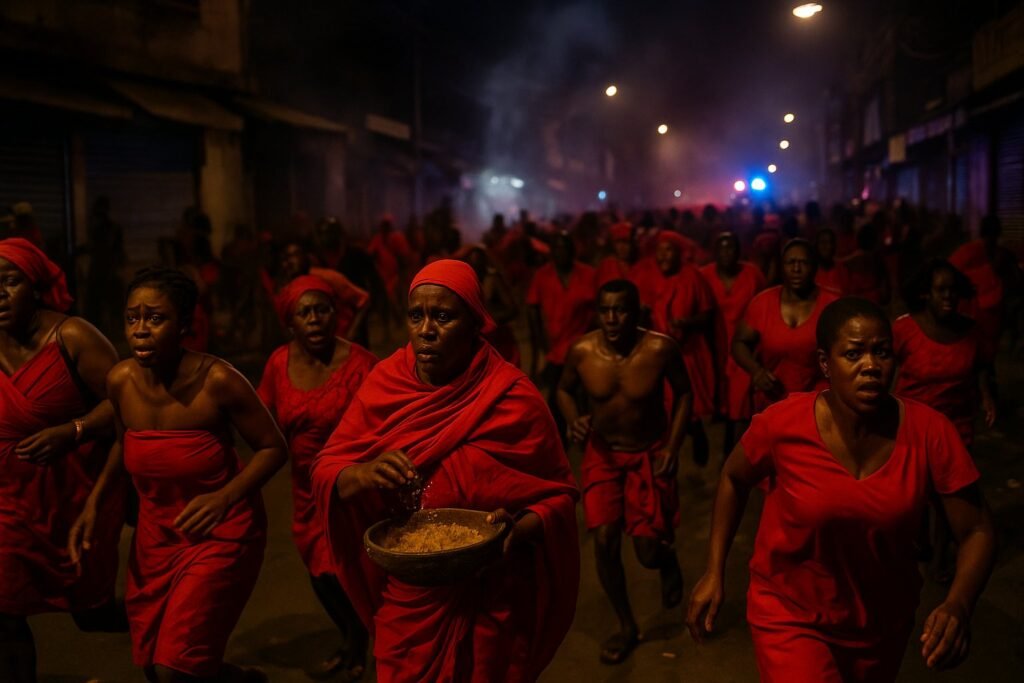
The Sowutuom Homowo Clash has plunged Accra’s western corridor into mourning after a festive ritual spiraled into deadly violence on August 30, 2025. What was meant to be a sacred celebration of thanksgiving by the Ga people instead turned into chaos, leaving two people dead—including the Obrafor of Sowutuom and a chief’s son—and several others injured. The tragedy has renewed national concern about growing tension surrounding Homowo celebrations.
A Festival of Gratitude Now Clouded by Rivalries
Homowo, meaning “hooting at hunger,” is one of Ghana’s oldest festivals, symbolizing triumph over famine and the restoration of abundance among the Ga people. Traditionally, the celebration unites communities through drumming, dancing, and the sprinkling of kpokpoi, a ritual food prepared from maize.
Yet in recent years, disagreements over traditional boundaries and leadership legitimacy have frequently turned the festival into a battleground. The clash fits this troubling pattern, where overlapping claims between Sowutuom and neighboring Dwenewoho sparked friction over who held ritual authority in specific areas.
Cultural historians note that these tensions are rooted in decades of unresolved chieftaincy and land disputes. As Accra expands and settlements merge, ancestral boundaries have become blurred, creating flashpoints during cultural observances like Homowo.
Incident Overview: How the Sowutuom Homowo Clash Erupted
According to eyewitness accounts, the clash began shortly after 5 p.m., when a group of Dwenewoho residents attempted to perform the kpokpoi sprinkling ritual in parts of Sowutuom—an act local leaders considered an encroachment. Arguments quickly escalated into gunfire.
“After the Chelsea game, we suddenly heard heavy gunshots from the main junction. It lasted nearly 30 minutes—everyone was running for their lives,” one eyewitness told Global Standard News (GSN).
Within moments, panic spread throughout Sowutuom. The Obrafor and a young relative of the chief were fatally struck, while several others suffered injuries. Residents took shelter indoors as the sound of bullets echoed across the community.
Shops and schools remained closed the next morning, and local authorities imposed temporary roadblocks to prevent reprisal attacks. Police patrols were visible in key areas, though no immediate arrests were reported.
Security Breach and Escalation: Armed Groups Deepen the Chaos
Residents say heavily armed men stormed the town at the height of the Sowutuom Homowo Clash, firing sporadically and spreading fear. According to multiple accounts, the attackers arrived on motorbikes and vehicles, some wearing traditional war attire. Their presence turned an already volatile situation into a battlefield.
Community members have criticized the delayed police response. “We kept calling for help, but it took almost an hour before officers arrived,” said a local trader who witnessed the violence. “By then, lives were already lost.”
Preliminary reports suggest the weapons used may have included locally manufactured guns. This mirrors similar findings from JoyNews investigations into the earlier Teshie Homowo violence, which revealed that homemade firearms are increasingly used in festival-related clashes.
Security analysts warn that the failure to control illegal weapons inflow could further endanger future cultural events across Accra.
Regional Comparison: Pattern of Homowo-Linked Violence
The Sowutuom Homowo Clash is the latest in a disturbing sequence of Homowo-related confrontations. Just four days earlier, two people died and several were injured in Teshie under nearly identical circumstances. Rival groups clashed over ritual boundaries despite a standing injunction against outdoor celebrations.
In both cases, rituals intended to symbolize unity instead triggered hostility. Following the Teshie incident, the Accra High Court reaffirmed its order banning unauthorized Homowo activities to protect lives and property. Experts now question whether similar preventive measures should have been enforced in Sowutuom before tragedy struck.
“The escalation from verbal disputes to gunfire reflects deeper issues of identity, land ownership, and generational mistrust,” said Dr. Mabel Adjei, a sociologist at the University of Ghana. “Unless there is mediation led by credible traditional councils, such violence may reoccur yearly.”
Community Response: Calls for Peace and Accountability
In the wake of the Sowutuom Homowo Clash, both local elders and civic groups have appealed for calm. The Ga Traditional Council condemned the violence, describing it as a “betrayal of ancestral values” and an affront to the spirit of Homowo.
“We urge all factions to lay down their arms. This festival is a time for thanksgiving, not revenge,” the council stated.
Civil society organizations, including Civic Watch Ghana and Peace Connect, have urged government and traditional authorities to establish a permanent mediation task force to resolve jurisdictional disputes before major cultural events.
Meanwhile, residents remain on edge. Police presence has been strengthened, and investigative teams are expected to submit preliminary findings within weeks. The Interior Ministry has also hinted at reviewing the security framework for public festivals.
Tradition, Law, and the Fragile Social Order
Analysts argue that the Sowutuom Homowo Clash exposes systemic weaknesses in Ghana’s approach to managing traditional conflicts within urban settings.
Accra’s rapid urbanization has merged historically distinct Ga communities, creating overlapping territories where multiple chiefs claim authority. During festivals, these divisions often manifest violently when processions or rituals cross contested lines.
Retired Police Superintendent Benjamin Mensah explained that effective prevention requires “joint planning between traditional councils and municipal security committees months before festivals begin.” He stressed that the police should act on intelligence, not just react to violence.
Cultural anthropologists add that restoring faith in festival governance depends on depoliticizing traditional authority and reinforcing inter-community dialogue. Without such reforms, the symbolic kpokpoi may continue to represent division instead of unity.
Broader Impact: Ghana’s Cultural Reputation and Global Perception
The Sowutuom Homowo Clash reverberates beyond local boundaries, raising questions about Ghana’s image as a peaceful and culturally rich democracy. International observers have taken note. BBC Africa and Reuters both reported on the recent pattern of festival-related unrest, warning that such instability could deter tourism and foreign cultural investment.
Locally, the incident underscores growing frustration among Accra residents who believe authorities have failed to balance respect for tradition with modern public safety standards. Social media discussions show an outpouring of grief but also anger at the perceived impunity of those responsible for the violence.
For many Ga youth, the Homowo festival remains a source of pride. Yet this pride is now tainted by fear. Restoring public confidence will require visible justice, clear communication from traditional councils, and collaboration between law enforcement and local communities.
Restoring Peace and Protecting Cultural Heritage
The Clash stands as a tragic reminder that cultural pride must never justify violence. Homowo’s essence—unity after hardship—has been overshadowed by rivalry and bloodshed. To safeguard the future of Ghana’s festivals, traditional authorities must clearly define ritual jurisdictions, and the government must enforce security protocols without bias.
Peace must return to Sowutuom not only for the memory of those lost but also for the preservation of the Ga people’s cherished identity. Only through mutual respect and dialogue can future Homowo celebrations reclaim their true meaning—victory over hunger, not hostility among kin.
Internal Links
- NPP Flagbearership Race: 5 Aspirants File for Presidential Primary
- Opioid Abuse Ghana Youth: A National Mental Health Concern
- Agona Asafo Truck Accident Leaves 5 in Critical Condition