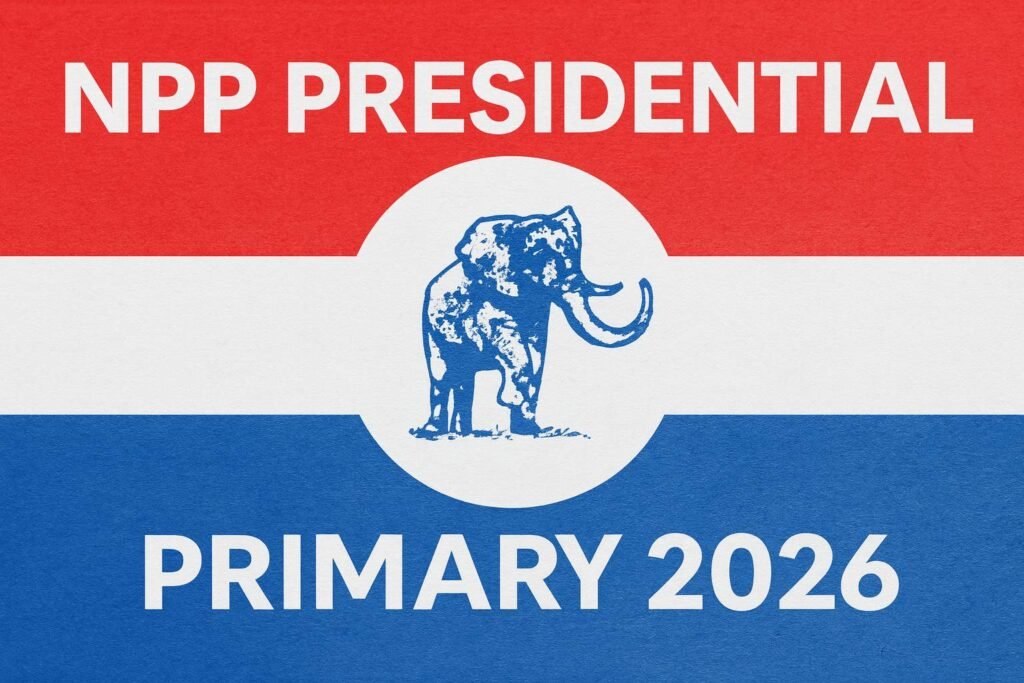
The NPP Flagbearership Race has entered its most decisive phase as five high-profile aspirants have formally filed their nominations to contest for the New Patriotic Party’s presidential slot. Scheduled for January 31, 2026, the contest will determine who leads Ghana’s governing party into the 2028 general elections—an outcome that could reshape the country’s political landscape for years to come.
According to a statement from the NPP Presidential Elections Committee dated August 28, 2025, the nomination process concluded successfully, confirming that all five candidates had met the required conditions. The Committee pledged to deliver a process that is transparent, credible, and constitutionally compliant, reinforcing confidence in the party’s democratic tradition.
NPP’s Tradition of Competitive Leadership Contests
Since its founding, the New Patriotic Party (NPP) has prided itself on internal democracy and competitive leadership selection. The NPP Flagbearership Race continues this legacy, unfolding at a moment when the party faces both internal introspection and external political pressure.
Following the 2024 general elections, the NPP retained power under Vice President Dr. Mahamudu Bawumia, but by a narrower margin than expected. Many within the party view this upcoming primary as an opportunity to renew public confidence, strengthen the grassroots, and chart a fresh path for Ghana’s next phase of governance.
Political analysts argue that this race reflects the NPP’s commitment to open competition while balancing unity. The aspirants represent distinct political identities within the party—from continuity and reform to youth inclusion and institutional renewal—making this contest a defining one.
Profiles of the Five Aspirants
Dr. Mahamudu Bawumia – Continuity and Economic Modernization
Vice President Dr. Mahamudu Bawumia, Ghana’s current second gentleman, enters the NPP Flagbearership Race as the most experienced contender. His message centers on economic continuity, digital transformation, and sustaining Ghana’s recovery under the IMF-supported fiscal reforms.
Dr. Bawumia’s leadership in digitalizing public services, including the Ghana Card system and mobile interoperability, has earned him significant recognition. His filing at party headquarters drew massive national attention, with supporters branding his campaign the “next chapter of Ghana’s transformation.”
Ken Ohene Agyapong – Grassroots Mobilizer and Bold Reformer
Hon. Ken Agyapong, MP for Assin Central, brings a contrasting, populist energy to the NPP Flagbearership Race. Known for his direct and fearless communication style, he positions himself as the grassroots candidate committed to restoring trust and discipline in governance.
Agyapong’s message of bold reform and pragmatic leadership resonates with younger voters and party foot soldiers who feel alienated by establishment politics. His campaign emphasizes honesty, empowerment, and a return to people-centered decision-making.
Bryan Acheampong – Discipline, Loyalty, and Party Unity
Dr. Bryan Acheampong, MP for Abetifi and Minister for Food and Agriculture, has built his campaign on the promise of unity, loyalty, and security-driven leadership. His organizational record and fieldwork experience give him credibility as a strategist capable of managing complex national systems.
He has pledged to prioritize internal discipline and reward commitment at all party levels. For Acheampong, the NPP Flagbearership Race is not merely a contest for power—it is about preserving cohesion within the NPP ahead of 2028.
Kwabena Agyei Agyepong – Integrity and Return to Founding Ideals
Former NPP General Secretary Ing. Kwabena Agyei Agyepong is widely regarded as a symbol of institutional reform. His campaign centers on integrity, accountability, and a return to the Danquah–Busia–Dombo principles that underpin the party’s heritage.
Agyepong argues that the NPP must “rebuild trust through transparency,” calling for a moral renewal in Ghanaian politics. His calm, issue-driven approach has gained respect from long-time party loyalists who believe the NPP Flagbearership Race should be about ideas, not personalities.
Yaw Osei Adutwum – Education and Human Capital Transformation
Dr. Yaw Osei Adutwum, former Minister of Education, offers a technocratic vision focused on education reform, skills development, and job creation. A trained educator and policy reformer, Adutwum positions education as the central pillar of national transformation.
His message, “Building the Future through Learning,” has earned him strong support among youth and first-time delegates. His entrance into the NPP Flagbearership Race underscores the growing influence of education policy in Ghana’s political discourse.
Strategic Significance: Beyond an Internal Contest
The Flagbearership Race carries implications that extend far beyond the party’s internal politics. The winner will not only lead the NPP into the 2028 elections but will also shape the ideological and economic direction of Ghana’s next decade.
Political observers view the contest as a clash of philosophies—continuity versus change, institutionalism versus populism, and technocracy versus charisma. Each candidate’s platform reflects different priorities: Bawumia’s economic continuity, Agyapong’s populist reform, Acheampong’s organizational discipline, Agyepong’s ethical politics, and Adutwum’s educational transformation.
Dr. Kwaku Aning, a political science lecturer at the University of Ghana, noted in an interview with GSN that, “This is one of the most balanced leadership lineups the NPP has ever fielded. Each aspirant embodies a different chapter of the party’s evolution.”
Party Leadership and Institutional Oversight
To ensure credibility, the NPP Elections Committee, chaired by Rev. Prof. Aaron Mike Oquaye, has outlined strict rules governing campaign conduct, funding transparency, and delegate engagement.
The Committee’s recent briefing stressed that no candidate should employ intimidation or inducement tactics. Instead, the NPP Flagbearership Race should serve as a model of civility and democratic maturity. The Electoral Commission is expected to observe the primaries to enhance accountability and ensure the process aligns with national electoral standards.
Public and Member Reactions
Reactions to the filings have been enthusiastic yet cautious. Delegates across regions welcomed the diversity of candidates, seeing it as proof of the NPP’s democratic strength.
One party organizer in Kumasi told Global Standard News: “This race shows the NPP’s openness. But unity after the primary will be critical for victory in 2028.”
Supporters of Dr. Bawumia argue that continuity will stabilize Ghana’s post-recovery growth, while Agyapong’s base insists on radical change to reconnect the NPP with the working class. Adutwum’s campaign has drawn strong youth engagement, particularly on digital platforms, where his educational message resonates widely.
Broader Impact: National and Global Dimensions
The NPP Flagbearership Race also carries international significance. Ghana’s democratic resilience has long been a model in West Africa, and a transparent internal party process would strengthen that reputation.
Diplomatic observers from the U.S. Embassy, ECOWAS, and Commonwealth Secretariat are expected to monitor proceedings closely. A peaceful and credible primary could further solidify Ghana’s image as a stable democracy attractive to investors.
Locally, economists argue that political certainty within the ruling party affects business confidence. A clear and fair outcome in the Race will reduce uncertainty, helping stabilize investor expectations and foreign exchange markets.
Toward the January 2026 Decision
As campaign activities intensify nationwide, the next few months will determine which candidate can unify delegates, inspire trust, and articulate a forward-looking vision.
Party communicators are already crafting thematic debates around governance, economy, agriculture, education, and security—core issues expected to dominate the NPP’s 2028 manifesto.
Ultimately, the NPP Flagbearership Race stands as a defining moment for Ghana’s democracy. It represents not only the search for a flagbearer but also a test of whether political institutions can balance ambition with unity.
Conclusion
With five formidable aspirants in the running, the NPP Flagbearership Race has transformed into a showcase of leadership diversity and democratic discipline. The outcome will influence both Ghana’s political stability and the governing party’s identity.
As Ghana approaches January 2026, one truth remains clear: this race is more than a competition—it is a referendum on leadership, vision, and the NPP’s readiness for a new era.
Internal Links (GSN):
External Links: