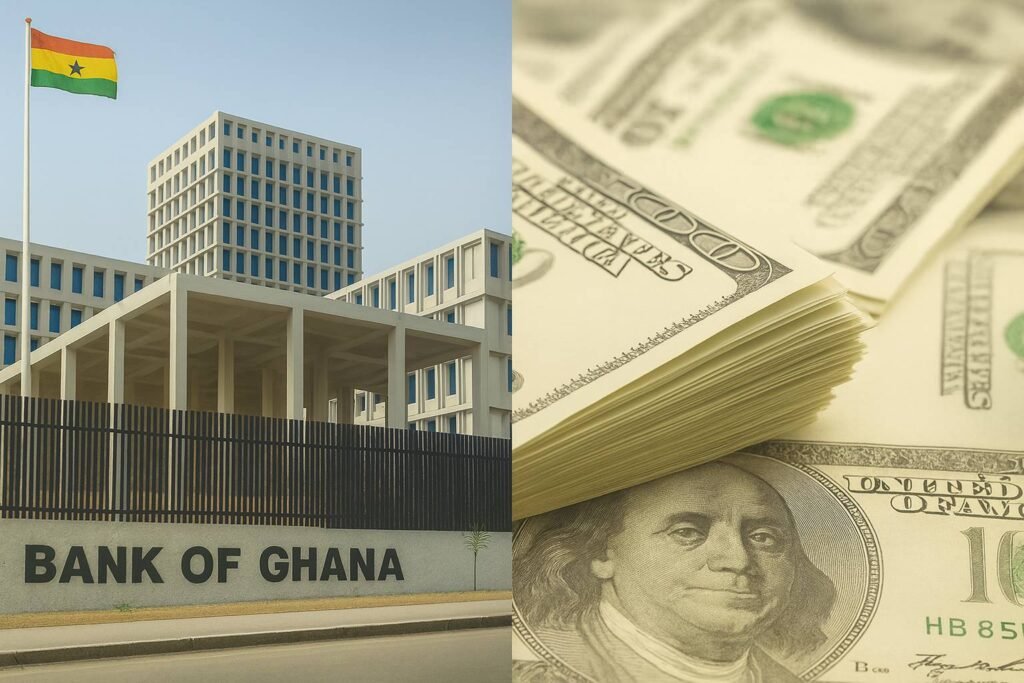
The Bank of Ghana Dollar Ban is reshaping Ghana’s financial landscape. In its latest directive, the central bank has forbidden the use of U.S. dollars and other foreign currencies for local goods and services. Signed by Ms. Aimee V. Quashie for the Secretary, the notice reaffirms the Ghana Cedi as the only legal tender, warning of sanctions under the Foreign Exchange Act, 2006 (Act 723).
Why the Bank of Ghana Dollar Ban Matters
The Ban is designed to stop the widespread “dollarization” of everyday life. By banning U.S. dollar pricing in schools, hotels, real estate, and retail shops, the BoG is trying to restore confidence in the cedi and limit reliance on foreign currency.
Key Details of the Dollar Ban
- Targeted sectors: Schools, real estate, vehicles, airline tickets, online shopping, contracts, retail, hotels.
- Exemptions: Only expatriates or non-residents may be invoiced in foreign currency, and those payments must go through Foreign Exchange Accounts (FEAs) at licensed banks.
- Sanctions: The Ban makes clear that violators will face penalties under Act 723.
Economic Snapshot: Cedi’s Rollercoaster in 2025
- In early 2025, the cedi staged one of the world’s strongest recoveries, appreciating by over 40%, from GH₵15 to nearly GH₵10 per U.S. dollar.
- By mid-2025, it became one of the best performing global currencies.
- As of August 2025, the Ban coincides with renewed pressure on the cedi, which trades around GH₵11.10–11.30 in the market.
- Analysts caution the currency may weaken to GH₵12 by year-end despite the ban.
💱 Rate Check (28 August 2025)
- Market rates: The Ghana Cedi traded between GH₵11.10–11.30 per USD.
- BoG official interbank rate (July 2025): GH₵10.50 per USD.
- The Bank of Ghana Dollar Ban is aimed at closing the gap between official rates and black-market pricing.
Sector-by-Sector Impact of the Bank of Ghana Dollar Ban
| Sector | Impact of Directive | Compliance Steps |
|---|---|---|
| Education | Schools can no longer invoice fees in USD | Issue cedi invoices, adjust contracts |
| Real Estate | Dollar pricing banned for rentals/sales | Update listings in cedis |
| Hospitality | Hotels must bill locals in cedis | Maintain dual pricing for expatriates only |
| Retail/E-commerce | Online stores must stop USD listings | Recode platforms to show cedi values |
| Contracts | Domestic deals strictly in cedis | Renegotiate agreements under the Dollar Ban |
The Bank of Ghana Dollar Ban thus has sweeping consequences across nearly every sector of Ghana’s economy.
On the Record: Stakeholder Reactions
- Bank of Ghana: “The Ghana Cedi remains the only legal tender in Ghana.”
- GUTA (support, May 2025): “We highly commend the Governor of the Bank of Ghana and his team for their efficient management of the forex market.”
- GUTA (concern, Aug 2025): “We trust the Governor, but the question is: when forex goes to the mainstream banks, is it being swallowed by the bigger entities to the detriment of the smaller ones? Why is it that the forex bureaus are having it and the banks are not?”
- Importers & Exporters Association (July 2025): “The rising dominance of black market dealers, or Abokis, who hoard foreign currency and dictate rates, is not only worsening the cost of doing business but also undermining investor confidence and macroeconomic stability.”
- Hotels Association (2019): “…services and products should be quoted in cedis and we are saying we agree on this matter… any hotel quoting in dollars is infringing on the law.”
These reactions highlight both support and skepticism over whether the Bank of Ghana Dollar Ban can be enforced effectively.
Full Official Notice
BANK OF GHANA
NOTICE TO BANKS AND THE GENERAL PUBLIC
NOTICE NO.BG/GOV/SEC/2025/26
UNAUTHORISED FOREIGN EXCHANGE TRANSACTIONS
The Bank of Ghana reminds the public that unlicensed or unauthorized dealings in forex activities (black market transactions), pricing/quoting, advertising, issuing receipts, receiving and/ or making payments for goods and services in foreign currency (particularly the United States Dollars (USD)) in Ghana, are strictly prohibited under the Foreign Exchange Act,2006 (Act 723).
Institutions (both public and private) and individuals engaging in such practices are hereby directed to immediately cease and desist.
The Ghana Cedi remains the only legal tender in Ghana, accordingly, no resident of Ghana, unless duly licensed or authorised by the Bank of Ghana shall price, advertise, invoice, receive or make payment in any foreign currency for goods and/or services including but not limited to:
i. School fees
ii. Sale and rental of vehicles
iii. Sale and rental of real estate
iv. Airline tickets
v. Domestic contracts
vi. Retail shopping
vii. Online sales
viii. Hotel accommodation etc.
Foreign currency invoices may be issued only to expatriates (foreign nationals) or non-residents and proceeds from such transactions shall be paid into a Foreign Exchange Account (FEA) with any licensed bank. Exchange rates quoted and applied on invoices must reflect prevailing market rates of commercial banks and be benchmarked against the Bank of Ghana’s published reference rate and not arbitrarily determined.
The Bank further emphasizes that foreign exchange remains transferable through the banking system for legitimate external payments, subject to applicable regulatory thresholds and commercial banks’ internal processes.
The Bank of Ghana will continue to enforce compliance, and violators will be subject to sanctions and appropriate legal action in accordance with Act 723.
(SGD.)
AIMEE V. QUASHIE (MS.)
FOR: THE SECRETARY
27TH AUGUST 2025
Broader Implications of the Dollar Ban
The Bank of Ghana Dollar Ban is more than a compliance directive; it’s a signal to:
- Consumers: You must pay in cedis for goods and services.
- Businesses: You risk sanctions if you price in USD.
- The Economy: Reducing dollar reliance may stabilize the cedi, if enforcement is strict.
Conclusion
The Bank of Ghana Dollar Ban is both a signal of authority and a test of enforcement. While industry groups like GUTA welcome efforts to stabilize the cedi, concerns remain over forex access and black-market influence. The effectiveness of this dollar ban will depend on strict enforcement, transparency, and nationwide compliance.