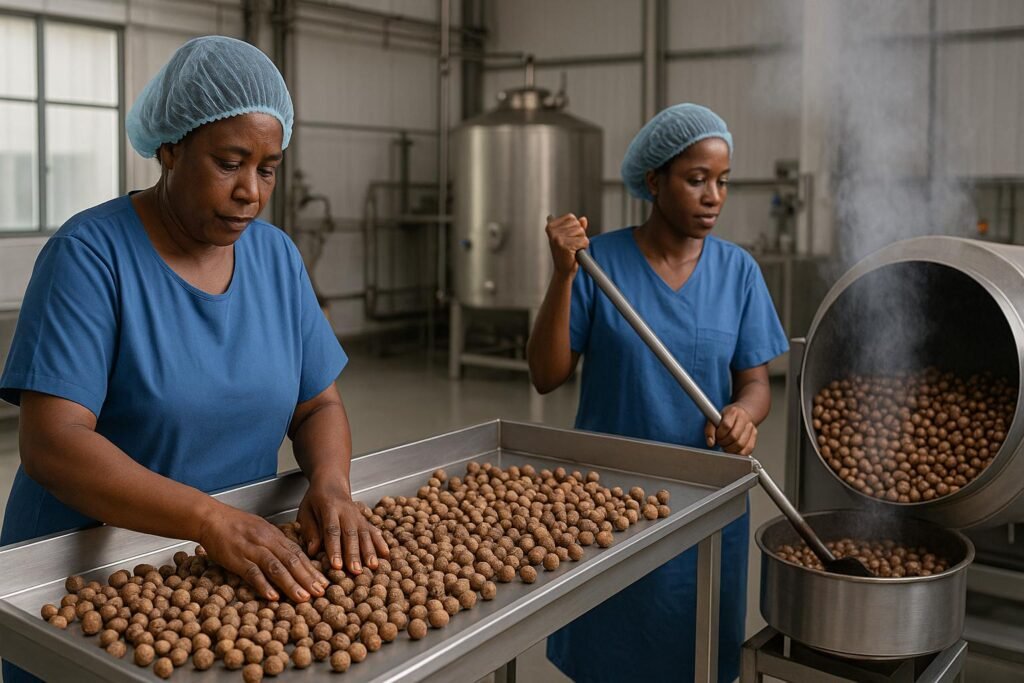
Strategic Pause for National Value Creation
The Nigeria Shea Nut Export Ban has taken effect for six months, representing one of the most decisive policy shifts in the nation’s agricultural and industrial strategy. Approved by President Bola Ahmed Tinubu, the directive halts raw shea exports to encourage domestic processing and unlock greater value in the $6.5 billion global shea market.
Officials say the move seeks to capture more returns from a resource long exported in its raw form, while empowering rural women who dominate Nigeria’s shea belt.
Why the Ban Was Introduced
Nigeria currently supplies nearly 40 percent of the world’s shea nuts yet captures barely 1 percent of global earnings because most exports leave the country unprocessed. The Nigeria Shea Nut Export Ban aims to reverse this imbalance by keeping more raw material within national borders for processing into high-value shea butter, oil, and cosmetics ingredients.
Vice President Kashim Shettima described the decision as “a necessary intervention to build industrial capacity, support women, and stop the silent loss of national wealth through raw exports.”
Expanding Domestic Capacity and Earnings
Authorities expect the ban to raise annual revenue by roughly $300 million in the short term through enhanced local processing. The Ministry of Agriculture and Food Security projects that plants operating at 35–50 percent capacity could reach 70 percent within months as raw nuts are redirected to domestic processors.
Economists say the Nigeria Shea Nut Export Ban supports the government’s broader industrialization plan—reducing import dependency, diversifying exports away from oil, and boosting non-oil foreign exchange earnings. The policy also targets illicit trade estimated at 90,000 tonnes per year, plugging revenue leakages that have cost the economy millions of dollars.
Coordinating Enforcement and Support
Agriculture Minister Senator Abubakar Kyari has confirmed that the six-month moratorium will be implemented in collaboration with customs, exporters’ unions, and women’s cooperatives. A monitoring task force will oversee compliance and report quarterly to the presidency.
Training and concessional loans are being arranged for processors to upgrade machinery and meet international certification standards. The Nigeria Shea Nut Export Ban will also be reviewed in February 2026 to assess progress on production output, job creation, and price stability before any renewal or adjustment.
From Raw Material Exporter to Value-Added Producer
Industry analysts believe the policy could transform Nigeria from a raw material supplier into a leading manufacturer of refined shea derivatives. With growing demand in cosmetics, pharmaceuticals, and food manufacturing, domestic processors are positioned to access premium global contracts.
Dr. Funke Adebayo, an economist at the University of Lagos, explained that “the Nigeria Shea Nut Export Ban is not about protectionism—it is a developmental instrument to retain value, create employment, and enhance Nigeria’s participation in global value chains.”
Gender and Social Impact: Empowering Women Across the Shea Belt
Women play a central role in the collection and preliminary processing of shea nuts across Nigeria’s northern states. By increasing local processing and stabilizing prices, the Nigeria Shea Nut Export Ban directly benefits women’s cooperatives that have long been underpaid for raw nuts.
Development partners, including the UN Development Programme (UNDP) and USAID, have expressed interest in supporting skill development, hygiene standards, and branding initiatives to help women entrepreneurs access higher-value export markets.
Positioning Nigeria Under the AfCFTA
The ban aligns with opportunities offered by the African Continental Free Trade Area (AfCFTA). By focusing on refined exports, Nigeria can supply duty-free shea butter and derivatives to other African markets while competing with regional producers like Ghana, Burkina Faso, and Mali.
Trade specialists note that the Nigeria Shea Nut Export Ban mirrors successful policies in other commodity-dependent economies, such as Indonesia’s temporary ban on crude palm-oil exports, which ultimately boosted domestic refining.
Global Supply-Chain Outlook: Managing Short-Term Disruption
International buyers in Europe, North America, and Asia may initially face tighter raw-nut supply as Nigeria enforces the ban. However, the shift is expected to attract new investment into local refineries, packaging lines, and quality-control systems.
According to analysts at Fitch Solutions, a stable implementation of the Nigeria Shea Nut Export Ban could double Nigeria’s share of global shea butter exports within three years, potentially making the country a top-tier supplier of refined products rather than raw materials.
Industry Response: Support With Caution
The National Shea Processors Association and major agribusiness players have publicly endorsed the ban, describing it as “a correction long overdue.”
Nevertheless, exporters warn that without strong border enforcement, smuggling may increase through informal trade corridors. They urge the government to combine the Nigeria Shea Nut Export Ban with incentives—such as tax reliefs, electricity subsidies, and logistics upgrades—to ensure sustainability.
Lessons for Nigeria’s Commodity Policy
Policy analysts emphasize that the ban must be accompanied by transparent monitoring and data-driven evaluation.
Dr. Uche Okonkwo, an international trade consultant, noted that “value addition policies succeed when governments invest in infrastructure and skills, not when they rely solely on restriction.”
He added that the Nigeria Shea Nut Export Ban could become a template for other agricultural sectors—like cashew, hibiscus, and sesame—if implemented efficiently.
Broader National Benefits: Diversification and Inclusive Growth
Beyond immediate export control, the initiative supports Nigeria’s long-term economic diversification goals. It is expected to generate new employment across processing, logistics, packaging, and certification services while encouraging private-sector participation.
By strengthening rural economies and empowering women, the Nigeria Shea Nut Export Ban contributes to poverty reduction, inclusive growth, and resilience against external commodity shocks.
Conclusion: A Short Ban With Lasting Impact
The six-month Nigeria Shea Nut Export Ban is both a tactical pause and a visionary blueprint. It underscores the government’s resolve to prioritize industrialization over short-term trade gains and to elevate Nigeria’s position within the global shea value chain.
If enforced transparently and complemented by investment in technology and training, the ban could permanently shift Nigeria from exporting raw potential to exporting refined prosperity.
Internal Links
- Cocoa Smuggling Crisis: Ghana Loses ~150,000 Tonnes
- Ghana’s Road Safety Emergency: 1,500 Lives Lost
- Sudan’s Hidden Famine and Civil War