Tokyo Authorities Admit Unlawful Investigation That Led to Tragic Death
In an unprecedented act of accountability, senior Japanese police and prosecutors have formally delivered a Japanese Police Apology at the grave of Shizuo Aishima, a corporate adviser who died in custody after being wrongfully accused of illegally exporting sensitive equipment. The historic gesture is being described as one of the most extraordinary acknowledgments of wrongdoing in Japan’s modern judicial history.
Background of the Case
Shizuo Aishima, an adviser to the machinery manufacturer Ohkawara Kakohki, was arrested in March 2020 along with two colleagues. Authorities claimed the company attempted to export spray-drying equipment that could allegedly be used for developing biological weapons.
From the outset, critics argued that the case lacked substance and was built on speculative assumptions rather than concrete evidence. Despite the seriousness of the allegations, prosecutors eventually admitted they could not establish criminal intent. The charges were dropped, but by that time, Aishima’s health had been fatally compromised.
The failure of the state to protect his rights turned his ordeal into a landmark case of wrongful prosecution. The eventual Japanese Police Apology at his grave acknowledged these failures publicly.
Illness and Denial of Bail
While detained and awaiting trial, Aishima was diagnosed with stomach cancer in October 2020. His legal team immediately sought bail so he could undergo proper treatment. However, prosecutors opposed every request, arguing that he might tamper with evidence or interfere with the investigation.
This stance was criticized by human rights lawyers as inhumane and unjustified, particularly since Aishima had no prior criminal record and had consistently maintained his innocence.
By February 2021, his condition had worsened significantly. Although he was eventually hospitalized, the bail denials meant he spent crucial months in detention rather than receiving specialized treatment. He died before the indictment was formally dropped, leaving behind a family who would later fight to clear his name.
Court Ruling and Compensation
In May 2025, the Tokyo High Court ruled decisively that the investigation, arrests, and indictments were unlawful and lacked evidence. The court awarded ¥166 million (approximately US$1 million) in compensation to Aishima’s family and colleagues.
The ruling was not only financial redress but also an official recognition that the justice system had failed. Legal experts described the court’s decision as a critical turning point, showing how unchecked prosecutorial power could devastate innocent lives.
The Japanese Police Apology that followed was an extension of this acknowledgment, giving moral and symbolic weight to the court’s findings.
The Historic Apology
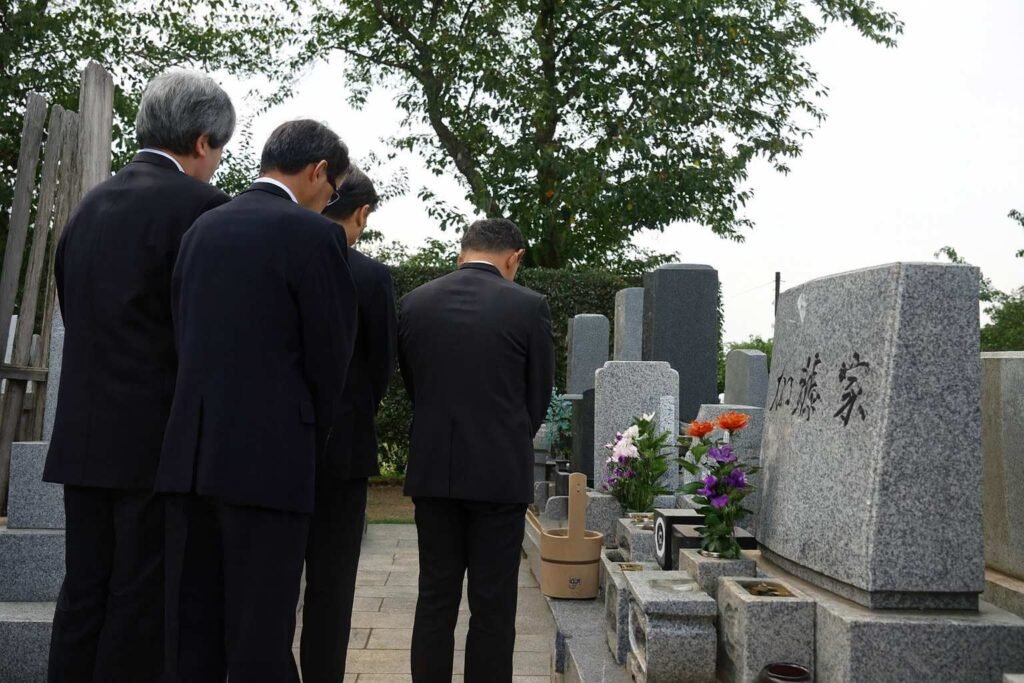
On August 25, 2025, senior law enforcement and prosecutorial officials gathered at Aishima’s grave in Yokohama to issue a direct apology. Among them were:
- Tetsuro Kamata, Deputy Superintendent-General of the Tokyo Metropolitan Police
- Takashi Koike, Head of Public Security at the Supreme Public Prosecutor’s Office
- Hiroshi Ichikawa, Deputy Superintending Prosecutor at the Tokyo District Public Prosecutor’s Office
Speaking before Aishima’s family, Kamata declared:
“We deeply apologize for conducting an unlawful investigation and arrest.”
Ichikawa added:
“Unlawful requests for detention and prosecution resulted in a serious human rights violation. We offer our deepest apologies.”
The Japanese Police Apology was unusual not only for its content but also for its form. Senior officials rarely admit wrongdoing publicly, much less at the grave of a victim. Commentators described the event as a symbolic break from Japan’s rigid tradition of institutional silence.
Family’s Response
Aishima’s eldest son accepted the apology but emphasized that it was only a first step. He stressed that without further accountability, the gesture risked being a symbolic act rather than meaningful justice.
He called for:
- A full reinvestigation into the case, including why prosecutors ignored medical pleas.
- Disciplinary measures for officials who blocked bail despite clear health risks.
- Stronger safeguards to prevent similar miscarriages of justice.
For the family, the Japanese Police Apology acknowledged the wrong, but justice requires systemic change.
Wider Implications for Japan
The incident has reignited debate about Japan’s controversial daiyo kangoku (“substitute prison”) system. Under this system, suspects can be held in solitary confinement for extended periods before trial, with restricted access to legal counsel. Critics argue it amounts to “hostage justice”, designed to pressure suspects into confessions regardless of guilt.
International human rights groups—including Amnesty International and Human Rights Watch—have long criticized Japan for its high conviction rate (over 99%) and practices that appear inconsistent with international standards. The Japanese Police Apology at Aishima’s grave is now being cited by campaigners as proof that reform is urgently needed.
Legal scholars warn that unless Japan reforms pretrial detention rules and introduces stronger safeguards, more innocent people could suffer similar fates.
Historical Context
This is not the first time Japanese authorities have issued an apology for a miscarriage of justice, though such events remain rare. In past decades, wrongful convictions have occasionally been overturned after decades of incarceration. However, the Japanese Police Apology for Aishima stands out because it occurred so soon after the wrongful detention, and because it directly acknowledged how the system contributed to his death.
The apology has drawn comparisons to other high-profile wrongful conviction cases, such as Iwao Hakamada, who spent nearly 50 years on death row before his conviction was overturned. In both cases, critics say the justice system prioritized institutional reputation over individual rights.
International Reactions
The apology has drawn attention beyond Japan. International legal observers and foreign media have highlighted it as a rare act of accountability. Some see it as a potential sign that Japan may be more willing to confront flaws in its justice system under public and international pressure.
Diplomats and legal scholars in Europe and the United States noted that the Japanese Police Apology could influence broader discussions about criminal justice reform, particularly in countries where pretrial detention is a subject of human rights concern.
Path Toward Reform
Reform advocates in Japan have laid out several proposals following the case:
- Limitations on pretrial detention to ensure suspects with medical needs are granted bail.
- Independent oversight of prosecutors and police to prevent abuse of authority.
- Transparency in investigations to guarantee suspects’ rights and prevent wrongful indictments.
- Institutional accountability for wrongful prosecutions, including disciplinary action against responsible officials.
While the Japanese Police Apology has symbolic power, activists argue that change must be codified into law to prevent similar tragedies.
Conclusion
The Japanese Police Apology at Shizuo Aishima’s grave was more than a ceremonial gesture—it was a rare and powerful admission that Japan’s justice system failed. Yet for many, including his family, the apology cannot erase the suffering he endured or the fact that he died an innocent man.
Ultimately, the legacy of this case will depend on whether Japan can transform this tragedy into a catalyst for systemic reform. Without concrete legal changes, critics warn, the apology will remain only symbolic, and the deep flaws within the justice system will persist.
Internal Links
- Gaza Child Starvation Crisis
- Sudan’s Hidden Famine and Civil War
- Interpol Cybercrime Crackdown in Africa