Redrawing the World’s Perspective
For centuries, maps have misrepresented our planet. The Africa Correct The Map movement is rewriting that visual history—revealing that Africa, long diminished on classroom walls and in the global imagination, is vastly larger and more central than most realize. Led by African organizations and endorsed by the African Union, the campaign seeks to restore the continent’s true scale, dignity, and rightful place in global consciousness.
Background: How a Map Shaped Minds for Centuries
The distortion began in 1569, when Flemish cartographer Gerardus Mercator introduced the Mercator projection. While it revolutionized sea navigation, it severely warped continental proportions. Designed to preserve straight-line routes for sailors, the projection inflated landmasses near the poles and compressed those near the equator.
As a result, Greenland appears nearly the same size as Africa, despite being 14 times smaller. North America and Europe seem larger and more dominant, while Africa and South America—home to more than 1.4 billion people and immense natural wealth—appear shrunken and peripheral.
This subtle manipulation of geography fed into centuries of colonial ideology, creating a worldview where Europe appeared central and powerful, while Africa was rendered secondary. Geography, in this sense, became an instrument of power—one that shaped minds, policies, and global perceptions for generations.
The Campaign: Africa Correct The Map Movement Takes Shape
In April 2025, two African advocacy organizations—Africa No Filter and Speak Up Africa—jointly launched the Africa Correct The Map campaign. Their shared mission: to correct centuries of geographic distortion by replacing the outdated Mercator projection with the Equal Earth projection, a modern mapping model developed in 2018 that maintains accurate proportions of landmass while preserving aesthetic balance.
The campaign calls upon:
- Schools to adopt the Equal Earth projection in geography and social studies.
- Media outlets and governments to stop using the Mercator projection in official materials.
- Global institutions such as the UN, World Bank, and Google Earth to display maps using accurate area-based models.
“A distorted map distorts the mind,” said co-founder Mokgadi Khiba at the campaign’s launch. “Africa is not marginal—it is vast, rich, and central to the world.”
By championing Africa Correct The Map, these organizations have turned geography into a movement for psychological and cultural liberation—a step toward reclaiming Africa’s representation on a global scale.
A Landmark Endorsement: The African Union Joins the Movement
The turning point came on August 14, 2025, when the African Union (AU) officially endorsed the Africa Correct The Map initiative. During a historic ceremony in Addis Ababa, AU Deputy Chair Selma Malika Haddadi declared:
“For generations, African children have grown up believing their home continent is small and insignificant. This ends now. Correcting the map corrects the narrative.”
The AU’s backing elevated the movement from an advocacy campaign to a continental policy agenda. Several member states—Ghana, Kenya, and South Africa—have since begun revising school atlases and educational resources to feature the Equal Earth projection, signaling a shift in how future generations will perceive Africa’s true scale.
Global Response: Praise, Debate, and Resistance
The global reaction to Africa Correct The Map has been as enlightening as it has been polarizing.
- The Guardian praised the AU’s leadership, calling for governments worldwide to “embrace a map that reflects reality, not relics of empire.”
- El País wrote that “maps are not innocent drawings—they are political tools that shape identity and dignity.”
- The Week reported that African schools and even international organizations like the World Bank and Google Maps are already piloting Equal Earth projection models.
- CNN International noted the viral global discussion sparked by the campaign, framing it as part of the broader “decolonization of knowledge.”
Not everyone agrees. Some cartographers defend the Mercator projection, arguing it was never intended as propaganda but as a navigation tool. Others contend that no map projection can perfectly balance shape and area. Yet even critics concede that the Map carries immense symbolic power, confronting centuries of visual bias that minimized the world’s second-largest continent.
Why Africa Correct The Map Matters
1. Education and Identity
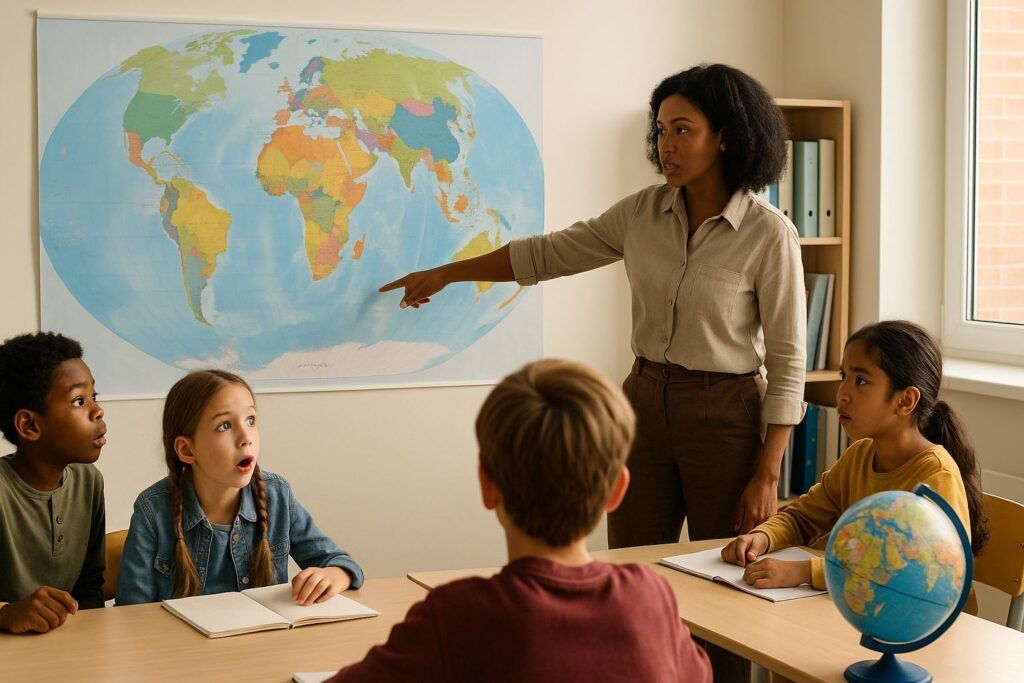
For generations, African students have grown up seeing a distorted version of their world. The visual shrinking of Africa contributes to subconscious feelings of inferiority. By implementing the Correct Map, schools empower young Africans with truth—affirming that their homeland is not just large geographically, but historically and culturally monumental.
2. Global Policy and Perception
Maps influence diplomacy, economics, and even development aid. A continent that looks small may subconsciously be undervalued. The Africa Correct The Map movement ensures that Africa’s physical and geopolitical weight is acknowledged in the world’s boardrooms and summits—an essential correction for equitable global policy.
3. Restoring Historical Balance
The campaign is part of a wider effort to decolonize education and restore narrative balance. From re-evaluating history curricula to repatriating African art, this initiative forms part of a cultural renaissance. By redrawing Africa accurately, Africa Correct The Map helps dismantle inherited biases that have long shaped how the world perceives the Global South.
Analysis: Redrawing the World’s Mental Geography
The movement transcends geography—it’s a cultural awakening. Like the independence movements that reshaped Africa’s politics in the 20th century, The Map seeks a new kind of freedom: freedom from visual distortion.
If Africa has been minimized on maps, it has likewise been marginalized in narratives of progress and innovation. Reclaiming visual accuracy restores intellectual dignity. The Equal Earth projection, when widely adopted, could reshape how generations perceive opportunity, potential, and power.
Students will grow up seeing their continent’s true expanse.
Investors will recognize the scale of African markets.
And global institutions will finally visualize Africa’s central role in climate, energy, and trade networks.
In essence, Africa Map doesn’t merely redraw geography—it redefines global consciousness.
Reactions and Quotes from Around the World
Leading voices have joined the call for truth in representation.
Dr. Sylvia Ndlovu, a cartography expert at the University of Cape Town, told Global Standard News:
“Cartography is storytelling. For too long, Africa’s story was told through distorted lenses. This campaign is about truth, equity, and representation.”
UNESCO’s Education Department commended the initiative, noting that accurate mapping is foundational to equitable learning. Similarly, Google Maps Africa Lead Kwame Odame confirmed the company is “evaluating Equal Earth integration options to ensure Africa’s proportional representation aligns with scientific reality.”
Though resistance remains within academic circles, momentum is unmistakably shifting toward fairness, accuracy, and transparency in global visualization.
Global and Local Impact
If widely implemented, Africa Map could revolutionize education, policy, and perception. Across Africa, ministries of education are reviewing curricula, and universities are recalibrating GIS systems to align with the Equal Earth model.
Globally, this shift influences:
- Media reporting, as visuals begin to portray Africa’s true proportions.
- Diplomatic communication, ensuring equality in global mapping standards.
- Corporate strategy, where market potential is recognized through realistic geographic scale.
As one AU delegate noted, “When you correct Africa’s size, you correct how the world prioritizes it.”
Conclusion: Reclaiming Space, Reclaiming Identity
The Map campaign is more than a call for cartographic justice—it’s a declaration of truth. It challenges outdated perceptions, inspires a new generation of Africans, and reminds the world that representation shapes reality.
By redrawing the map, Africa seeks not exaggeration, but accuracy. And in doing so, it reclaims not just its rightful space on paper—but its rightful place in human history.
Internal Links
- Mahama Removes Investor Capital Requirement
- Africa Single Currency Push Gains Momentum
- M23 Congo Massacre Report
External Links