The Crackdown That Shook Academia
The US Student Visa Ban has ignited international uproar after the U.S. State Department revoked more than 6,000 student visas in 2025. Officials cited national security threats, criminal activity, and alleged terrorism support. However, universities, civil rights groups, and foreign governments say the move marks the most aggressive and discriminatory action against international students in recent memory.
This controversial crackdown—unfolding amid political polarization and heightened security measures—has exposed deep rifts between American institutions and their global academic partners.
Immigration and Education Collide
The United States has long been the world’s top destination for international students, hosting over one million foreign scholars annually. Student visas have traditionally symbolized America’s soft power—facilitating cultural exchange, innovation, and global leadership.
Yet in recent years, political tensions, cyber-security fears, and ideological clashes have strained these relationships. From Trump-era travel bans to pandemic-era border restrictions, each administration has tightened oversight. The US Student Visa Ban continues this trajectory—but on a much broader scale.
In 2025, Secretary of State Antony Blinken announced a “zero-tolerance enforcement” of student visa conditions, following reports of visa misuse, campus protests, and alleged extremist sympathies among some international enrollees. The decision, insiders say, came after an inter-agency review involving the Department of Homeland Security (DHS)and Federal Bureau of Investigation (FBI).
Breakdown of the Ban: Crimes, Allegations, and Data
According to an internal State Department memorandum reviewed by major outlets, nearly 4,000 students lost their visas over “criminal activity,” including DUI, assault, and property theft. Another 200 to 300 students were flagged for alleged “support for terrorism”—with many reportedly linked to pro-Palestinian activism or online dissent.
Officials defend the mass cancellations as a matter of national security, but human rights advocates argue the ban conflates legitimate political speech with extremism.
| Category | Details |
|---|---|
| Total Visas Revoked | Over 6,000 |
| Crime-Related Revocations | ~4,000 (DUI, assault, theft) |
| Terror-Linked Revocations | 200–300 (some activism-related) |
| Key Universities Impacted | Columbia, Harvard, NYU, MIT |
| New Screening Tools | AI surveillance, social media monitoring |
| Global Fallout | Diplomatic protests from China & EU |
| Criticism | Racial profiling, suppression of free speech |
Civil rights organizations, including the American Civil Liberties Union (ACLU) and the National Immigration Law Center, say the data reveal disproportionate targeting of students from Middle Eastern, African, and South Asian nations.
Surveillance and Expression: The AI Factor on Campus
A defining feature of the US Student Visa Ban is its reliance on AI-driven surveillance tools. The State Department now requires all international applicants to submit public social-media accounts for content analysis.
Machine-learning systems reportedly scan for keywords deemed “antisemitic,” “radical,” or “anti-American.” Critics argue that such tools can misinterpret political discourse, satire, or activism as extremist behavior.
Under the new system:
- Students’ Twitter, TikTok, and Instagram accounts are monitored before and during study.
- Algorithms flag posts referencing Gaza, Palestine, or controversial political issues.
- A flagged account can trigger visa review or revocation without prior notice.
Civil rights experts warn this technology may “punish dissent by automation.” Amnesty International and Human Rights Watch have both condemned the move, calling it “a digital witch-hunt against free speech.”
Impact on Universities: Academic Freedom on Trial
The repercussions of the US Student Visa Ban extend beyond individuals—it has upended U.S. higher education.
Columbia University’s Costly Settlement
In a landmark decision, Columbia University agreed to pay $200 million to settle federal investigations into compliance failures under the new visa rules. In exchange, the government reinstated $400 million in suspended federal research funding. Columbia also committed to revising its international admission policies and implementing advanced vetting systems for foreign students.
Harvard’s Legal Resistance
Harvard University, meanwhile, filed a lawsuit in federal court arguing the ban violates constitutional rights and undermines academic freedom. Harvard President Claudine Gay stated, “We cannot allow federal agencies to dictate which students are worthy of intellectual exchange.”
Several other Ivy League and public universities have joined the suit, citing chilling effects on campus diversity and research collaboration.
Global Reactions: Diplomatic and Educational Fallout
The US Student Visa Ban has sparked diplomatic protests and new policy shifts worldwide.
- China lodged a formal complaint, accusing Washington of “politically motivated discrimination.”
- European Union leaders called the mass cancellations “contrary to international educational values.”
- Canada, Germany, and France have since introduced “academic refuge programs” to absorb displaced students from the U.S.
- India urged Washington to provide “clarity and fairness” for thousands of its nationals affected by the revocations.
Analysts warn the episode may accelerate a global reshuffling of academic power, with non-U.S. universities benefiting from diverted international talent.
Students Speak Out: Fear, Loss, and Uncertainty
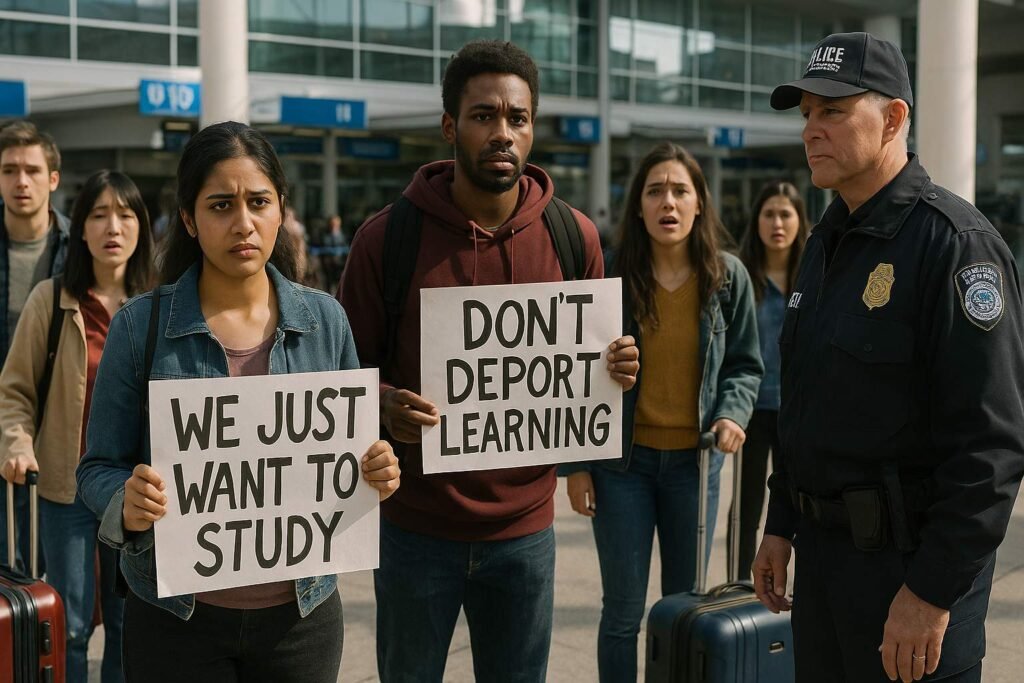
For the students affected, the US Student Visa Ban has been devastating. Many were locked out of programs mid-semester, faced deportation threats, or lost scholarships and housing.
“I never broke the law. I just went to a protest,” said Abdulrahman Musa, a Nigerian engineering student, in an interview with The Washington Post.
Some students say they discovered their visa revocation only when their university login stopped working or campus housing was deactivated. Others describe being escorted off campus by security or immigration officials with no prior warning.
Organizations like Students Without Borders (SWB) and Scholars at Risk (SAR) are offering legal aid and temporary placements abroad. Yet many face the prospect of unfinished degrees and shattered dreams.
Legal Framework: Power vs. Due Process
The federal government defends its authority under Section 221(i) of the Immigration and Nationality Act (INA), which permits visa revocation “at any time, for any reason.”
Legal precedent supports this wide discretion—most notably in Bouarfa v. Mayorkas (2024), where a U.S. court upheld the State Department’s unilateral revocation powers. However, civil rights lawyers argue that such authority lacks transparency and violates fundamental due process.
Attorney Rachel Levinson-Waldman of the Brennan Center for Justice remarked:
“This ban expands the government’s reach into private belief and expression. It’s a First Amendment issue masquerading as a national security measure.”
Several ongoing lawsuits, including Harvard et al. v. Blinken, could determine whether the courts will finally set limits on executive visa powers.
Global Impact: Academic Mobility at a Crossroads
The ripple effects of the US Student Visa Ban are already visible across continents.
- Enrollment Decline: U.S. universities report up to 30% drops in new foreign applications for 2026.
- Shift to Europe & Asia: Institutions in Germany, the Netherlands, Australia, and Singapore are witnessing a surge in international student interest.
- Economic Impact: The U.S. higher education sector, which earns over $40 billion annually from international students, faces potential multi-billion-dollar losses.
- Research Collaboration: Joint research programs between U.S. and Middle Eastern universities are being suspended over “compliance risks.”
Global education experts describe this as the “great academic decoupling”—a long-term decline in the U.S.’s influence over global education and talent pipelines.