Accountability at the Heart of Ghana’s Mining Crisis
The President of the National House of Chiefs, Ogyeahohoo Yaw Gyebi II, has issued one of the boldest calls yet in Ghana’s ongoing war against illegal mining — urging that Galamsey Chiefs and Politicians complicit in the act be publicly named and shamed. His statement has reignited a national conversation about whether Ghana’s leadership truly has the will to end the environmental destruction caused by illegal mining.
This renewed debate underscores a key truth: the fight against galamsey will never succeed if powerful individuals who enable it remain untouchable.
The Rise of Galamsey and the Role of Influential Actors
Illegal small-scale mining, popularly called galamsey, has evolved from small artisanal practices into a full-scale industrial menace. Once driven by poverty and unemployment, the activity is now financed and shielded by powerful networks that include financiers, chiefs, and politicians. Reports suggest that several mining concessions were awarded illegally or under political influence, allowing galamsey to thrive even in restricted zones.
Over the past decade, Ghana has launched multiple task forces — including Operation Vanguard and Operation Halt— yet the results remain disappointing. Experts say this failure stems largely from the involvement of Galamsey Chiefs and Politicians, who use their influence to obstruct arrests and investigations.
Civil society organizations such as OccupyGhana, WACAM, and the Media Coalition Against Galamsey have repeatedly insisted that naming these enablers is the only way to restore public confidence in the law.
Environmental Catastrophe: Forests and Rivers Under Threat
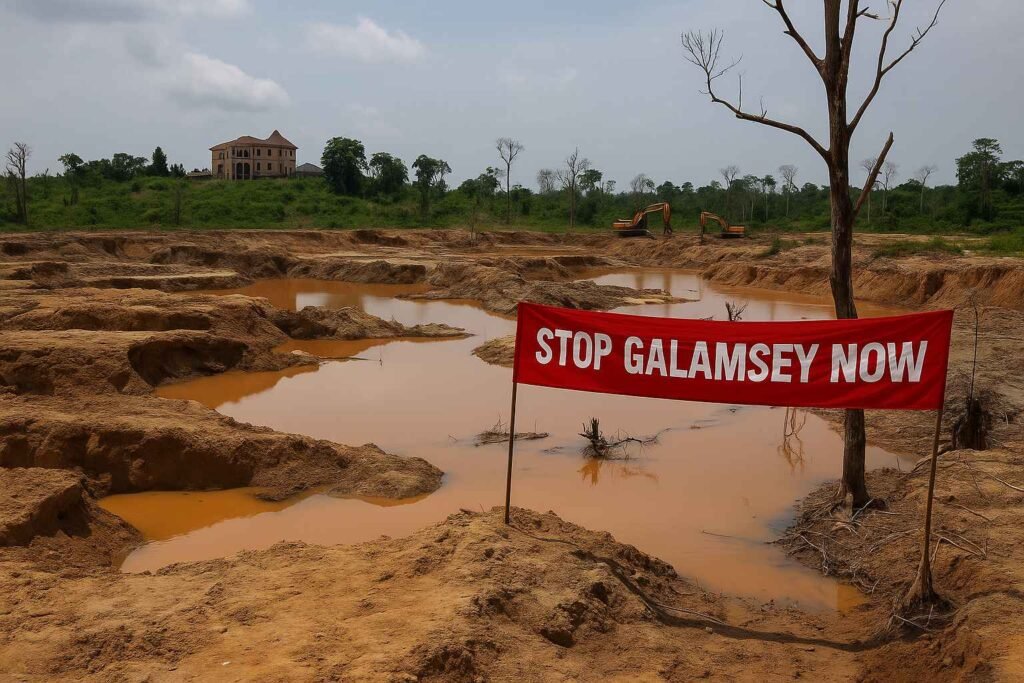
The environmental consequences of illegal mining are staggering. According to the Ministry of Lands and Natural Resources, 44 forest reserves out of Ghana’s 288 have already been ravaged, with 5,252 hectares of protected lands destroyed. This large-scale devastation is linked to the networks of Galamsey Chiefs and Politicians who allegedly facilitate mining permits or shield illegal operators.
Toxic chemicals such as mercury and cyanide are routinely discharged into major rivers — including the Pra, Offin, and Ankobra — rendering them unsafe for domestic and agricultural use. In areas like Wassa Amenfi, Dunkwa-on-Offin, and Tarkwa, the water once used for fishing and irrigation now flows with a brownish hue of death.
Forestry Commission data confirm that the deforestation rate in mining regions has doubled since 2017. The biodiversity loss includes endangered species and vital vegetation that regulate rainfall and carbon absorption.
Legal Accountability: Enforcing the Rule of Law Without Fear or Favour
Legal experts argue that Ghana already has robust frameworks to tackle illegal mining — if enforced. The Minerals and Mining Act, 2006 (Act 703) and its subsequent amendments make no exemptions for social status or traditional office. The law explicitly criminalizes anyone who authorizes, finances, or participates in unlicensed mining.
Yet, enforcement remains selective. No prominent Galamsey Chiefs and Politicians have been successfully prosecuted in the last five years, despite overwhelming evidence. The Attorney General’s Office and the Ministry of Justice are under increasing pressure to ensure that justice applies equally to all.
Environmental lawyer Kwame Boateng Mensah remarked,
“When enforcement is skewed, citizens lose faith. Justice must not recognize crowns or titles — the environment cannot wait.”
Public naming and prosecution, analysts note, would send a clear message that the government is serious about environmental protection and anti-corruption reform.
Public Outcry: Civil Society Calls for Transparency and Reform
Ghana’s civil society landscape has grown more vocal. The Media Coalition Against Galamsey, OccupyGhana, and WACAM have renewed calls for full disclosure of individuals involved. These groups demand that the government publish the names of Galamsey Chiefs and Politicians cited in intelligence reports or seized concessions.
They propose four key measures:
- Immediate public disclosure of implicated persons.
- Swift prosecution under environmental and anti-corruption laws.
- Creation of an online monitoring portal to track mining prosecutions.
- Whistle-blower protection for citizens exposing illegal operations.
If implemented, these steps could mark a turning point in Ghana’s environmental governance, restoring trust in law enforcement and reinforcing democratic accountability.
Community Impact: Health, Agriculture, and Livelihoods in Decline
The ripple effects of illegal mining extend beyond deforestation. Communities living near galamsey zones face rising cases of waterborne diseases, soil infertility, and loss of livelihoods. Rivers such as the Pra, Offin, and Tano — once lifelines for entire districts — are now heavily contaminated.
Farmers report declining crop yields due to soil pollution and land degradation. The Ghana Cocoa Board has warned that galamsey, often backed by Galamsey Chiefs and Politicians, could reduce cocoa output by 30% within the next five years. This threatens Ghana’s position as the world’s second-largest cocoa producer.
Health experts further highlight increased mercury levels in fish and crops consumed by local communities, posing long-term neurological and reproductive risks. Schools and hospitals in mining regions have been affected as infrastructure crumbles under the strain of unregulated mining traffic.
Political and Ethical Responsibility: Leadership on Trial
Ogyeahohoo Yaw Gyebi II’s declaration has become a moral test for Ghana’s leadership. For decades, politicians have pledged to end galamsey, yet enforcement stalls once influential figures are implicated. His statement challenges all branches of government — the Executive, Parliament, Judiciary, and the Chieftaincy Institution — to prove that the law truly applies to everyone.
Political will is now the missing ingredient. Without decisive action, the phrase “zero tolerance for galamsey” risks becoming another hollow slogan. Observers believe that the exposure and prosecution of Galamsey Chiefs and Politicians would mark the beginning of a genuine environmental revolution.
Comparatively, countries like Indonesia and Brazil successfully curbed illegal logging by publicly naming complicit officials and traditional leaders. Ghana can replicate these models through open data, judicial independence, and sustained community monitoring.
Economic Costs: Billions Lost and Futures Jeopardized
Illegal mining drains Ghana’s economy of nearly $2 billion annually in lost revenue, environmental rehabilitation, and reduced agricultural output. Beyond financial loss, it damages investor confidence in legitimate mining operations that follow environmental standards.
The World Bank and the UN Environment Programme have both warned that nations tolerating elite-backed environmental crimes risk losing access to international climate and biodiversity funding. Ghana’s ability to attract green finance could depend on whether it acts decisively against Galamsey Chiefs and Politicians.
Moreover, the government’s flagship Green Ghana Project, aimed at planting 10 million trees annually, is undermined by continued deforestation. Reforestation efforts cannot succeed when forests are simultaneously destroyed under political protection.
Global and Local Implications: Ghana’s Reputation at Stake
Globally, Ghana is viewed as a stable democracy with strong institutions. However, the ongoing destruction caused by Galamsey Chiefs and Politicians threatens that image. International environmental partners, including the European Union and United Nations, have expressed concern about the country’s failure to curb the menace.
Locally, the issue fuels public resentment. Many Ghanaians feel that environmental justice is applied selectively — strict for the poor, lenient for the powerful. This perception erodes national unity and faith in leadership. Addressing it through transparent action could restore public confidence and attract responsible investment in the mining sector.
Conclusion: Justice Must Confront Power
Ghana stands at a crossroads. The words of Ogyeahohoo Yaw Gyebi II represent more than outrage — they are a call to conscience. The country cannot save its environment while protecting those who destroy it. Justice, if it is to mean anything, must pierce the veil of privilege.
The government, Parliament, and the Attorney General must rise above politics and act decisively. The naming, shaming, and prosecution of Galamsey Chiefs and Politicians would mark a historic shift — proving that the rule of law is stronger than status and that Ghana values its natural heritage more than political comfort.
Internal Links:
External Links: