A Disturbing Episode Amid Opening Weekend Excitement
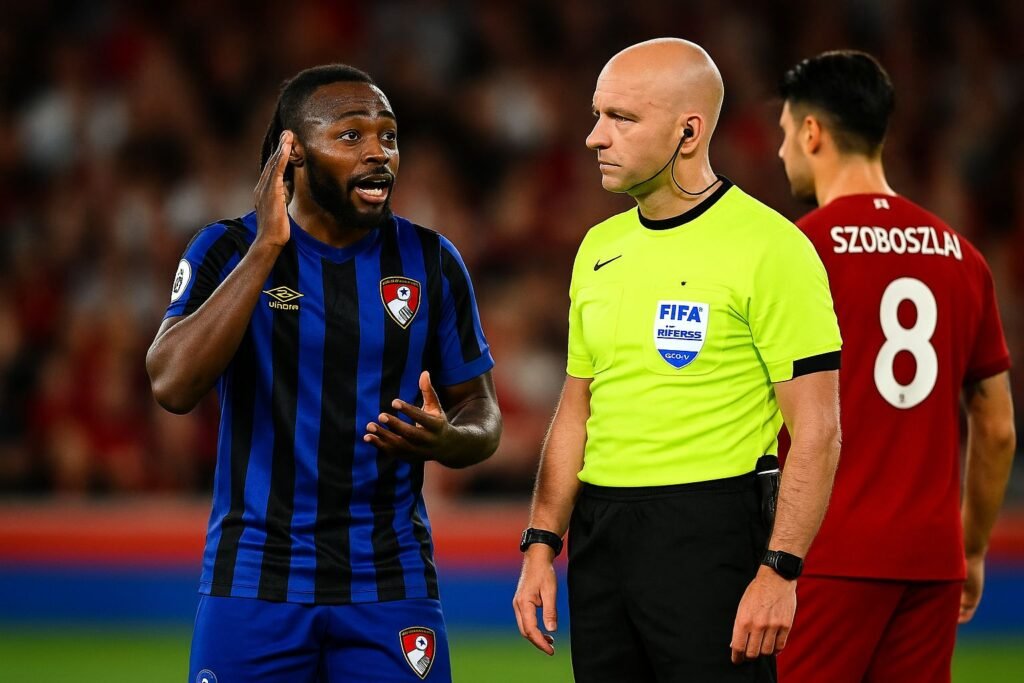
The Premier League Racist Abuse scandal that unfolded at Anfield on the opening weekend of the 2025/26 season has reignited global conversations about racism in football. What began as a thrilling clash between Liverpool and Bournemouth turned emotional when Bournemouth’s Ghanaian forward, Antoine Semenyo, reported racist remarks from a spectator during the 29th minute.
Referee Anthony Taylor promptly stopped the match as stewards and Merseyside Police identified and removed the perpetrator — a 47-year-old Liverpool man later arrested for a racially aggravated public order offense. The match eventually resumed, but the mood at Anfield had shifted from celebration to introspection, reminding football that the fight against hate remains unfinished.
Football’s Enduring Struggle With Discrimination
Despite decades of progress, the Premier League Racist Abuse incident underscores how racism persists across Europe’s top leagues. From verbal taunts in stadiums to online harassment, Black players and players of color continue to endure abuse that mirrors wider social prejudices.
Campaigns like Kick It Out and No Room for Racism have become cornerstones of the English football calendar. Clubs feature anti-racism armbands, pre-match banners, and social media pledges. Yet, as shown by Semenyo’s ordeal, even well-established frameworks cannot completely eliminate fan misconduct.
Experts point to a cultural shift where players feel empowered to act immediately. Semenyo’s swift reporting — and the referee’s decisive response — demonstrates football’s evolution from silent tolerance to active resistance.
Incident Review: How the Anfield Scene Unfolded
As Liverpool led Bournemouth 2–1, Semenyo heard racist insults directed from the crowd near the Main Stand. He alerted his teammates, who signaled to referee Taylor. Following the established three-step protocol for racism in football, Taylor halted the match and notified stadium control.
Within minutes, Anfield stewards pinpointed the suspect using CCTV and radio communication. Merseyside Police escorted the man out, drawing applause from nearby supporters. The Premier League Racist Abuse response was swift, coordinated, and transparent — setting an example for how such incidents should be handled.
After the game, Merseyside Police confirmed the arrest, stating:
“A 47-year-old man has been detained on suspicion of a racially aggravated public order offense following an incident at Anfield. Investigations remain ongoing.”
The professionalism with which the situation was managed prevented escalation, turning potential chaos into a moment of collective unity.
Emotional Fallout: Semenyo’s Message of Strength
Hours after the final whistle, Semenyo took to Instagram to share a reflective statement that quickly went viral:
“Last night at Anfield will stay with me forever — not because of one person’s words, but because of how the football family stood together.”
The Premier League Racist Abuse survivor’s post resonated deeply across the global football community. Fans, players, and pundits flooded his comment section with messages of solidarity.
Liverpool’s captain Virgil van Dijk and Bournemouth skipper Adam Smith both praised Semenyo’s composure and courage. “He handled it with dignity, and the Liverpool players showed real class in supporting him,” Smith told Sky Sports.
Their reactions, echoed by thousands online, reaffirmed that footballers today are not only athletes but symbols of social resistance.
Zero Tolerance in Action
The FA, Premier League, and Kick It Out jointly released statements denouncing the abuse.
Kick It Out declared:
“We stand with Antoine Semenyo and commend the rapid actions of the referee, the clubs, and Merseyside Police. This is how the game must respond — swiftly and decisively.”
The Premier League Racist Abuse case prompted the FA to reaffirm its disciplinary mandate: lifetime bans for convicted offenders, mandatory inclusion workshops for clubs, and greater coordination with local authorities.
Liverpool FC, in its own release, said:
“There is no place for racism in our club or our sport. We thank those who acted quickly and stand with Antoine Semenyo and Bournemouth.”
Bournemouth’s official statement added that the club is “working with the FA and Premier League to ensure this investigation results in accountability.”
Broader Perspective: Why Racism in Football Persists
While most English football fans strongly reject racism, experts argue that isolated extremists exploit the passion of the game to channel hate. Sociologist Dr. Amira Grant of King’s College London notes:
“Football has always mirrored society. When racial tensions rise, the stadium can become a stage for social frustration. The key is rapid deterrence — and Anfield’s response did exactly that.”
The Premier League Racist Abuse case also highlights the psychological toll on players. Sports psychologists emphasize that racism disrupts concentration, mental health, and performance. Semenyo’s ability to continue playing — and score a goal later in the match — exemplifies extraordinary mental resilience.
This moment, experts say, should guide future education and awareness programs to focus not just on punishment but on empathy and inclusion.
Public and Political Reactions: From Parliament to Pitch
Within 24 hours, several MPs raised questions about the incident during parliamentary discussions on sports conduct. The UK’s Sports Minister reiterated government backing for lifetime stadium bans and technology-assisted identification of offenders.
In Ghana, the Premier League Racist Abuse case triggered widespread outrage. Ghana’s Minister for Youth and Sports, Mustapha Ussif, publicly condemned the abuse and wrote to the FA expressing full support for Semenyo.
“This must strengthen global efforts to protect African players abroad,” Ussif said in Accra.
Ghanaian fans and journalists launched online campaigns celebrating Semenyo’s courage under hashtags like #StandWithSemenyo and #KickOutRacism — demonstrating the global resonance of his stand.
Cultural Resonance: A Night That Tested Anfield’s Spirit
The emotional weight of the Premier League Racist Abuse incident was magnified by the evening’s pre-match tribute to Diogo Jota’s late brother. Fans held a mosaic spelling “Forever Jota” and observed a minute’s silence.
Liverpool manager Arne Slot reflected:
“It was a beautiful night tarnished by one ugly moment. Yet how the fans and players reacted gave me hope for the game’s humanity.”
After the match, both clubs released joint imagery of Semenyo shaking hands with Van Dijk — a symbolic gesture that quickly trended worldwide. Analysts say it captured football’s capacity for compassion, proving that unity can overshadow hate.
Comparative Insight: Europe’s Evolving Anti-Racism Framework
The Premier League Racist Abuse investigation adds to a growing list of similar cases across Europe. In Spain, Vinícius Jr.’s repeated targeting led to major legal reforms allowing swift stadium expulsions. Italy, Germany, and France have followed with stricter regulations on fan behavior.
UEFA recently launched a Pan-European Racism Task Force, calling for consistent punishments across leagues. The Premier League’s handling of the Semenyo case is now being hailed by continental observers as a model response.
Football analysts believe that the speed and transparency shown at Anfield could redefine procedural expectations for racial incidents in major competitions worldwide.
Long-Term Impact: Turning Words Into Structural Change
While justice for the offender remains pending, the Premier League Racist Abuse aftermath could reshape football governance. The Premier League is reviewing steward training, matchday reporting systems, and fan education programs. Clubs will be required to submit annual anti-discrimination reports to the FA starting next season.
Kick It Out is also expanding its grassroots education outreach, focusing on school and academy levels to tackle racial bias early.
These steps signal a future where equality isn’t just a slogan — it’s a mandatory operational standard for clubs, sponsors, and broadcasters.
Expert Analysis: The Human Power of Solidarity
Sports psychologist Dr. Kwaku Mensah, speaking to GSN, observed:
“What makes the Premier League Racist Abuse case unique is not just the offense itself, but how unity defused it. When teams, officials, and fans act as one, it changes the emotional script.”
He added that Semenyo’s bravery “transformed victimhood into leadership,” inspiring countless young athletes to speak up rather than suffer in silence.
For many, that is the lasting legacy of Anfield’s painful but powerful evening — a moment when football’s soul reasserted itself.
The Beautiful Game’s Unbreakable Spirit
The Premier League Racist Abuse case involving Antoine Semenyo is more than a headline; it’s a watershed moment in football’s moral evolution. What could have been an evening marred by hate became a story of courage, solidarity, and justice in motion.
As investigations continue, Semenyo stands as a symbol of resilience — a reminder that while racism may still exist in corners of the sport, unity is now the dominant voice echoing across stadiums.
Internal Links
-
Ghana Debt Restructuring: Bold $256M UK Deal Unlocks 5 Projects
-
France Hit by Protests and Disruption as New Prime Minister Takes Office
External Links (Authoritative Sources)