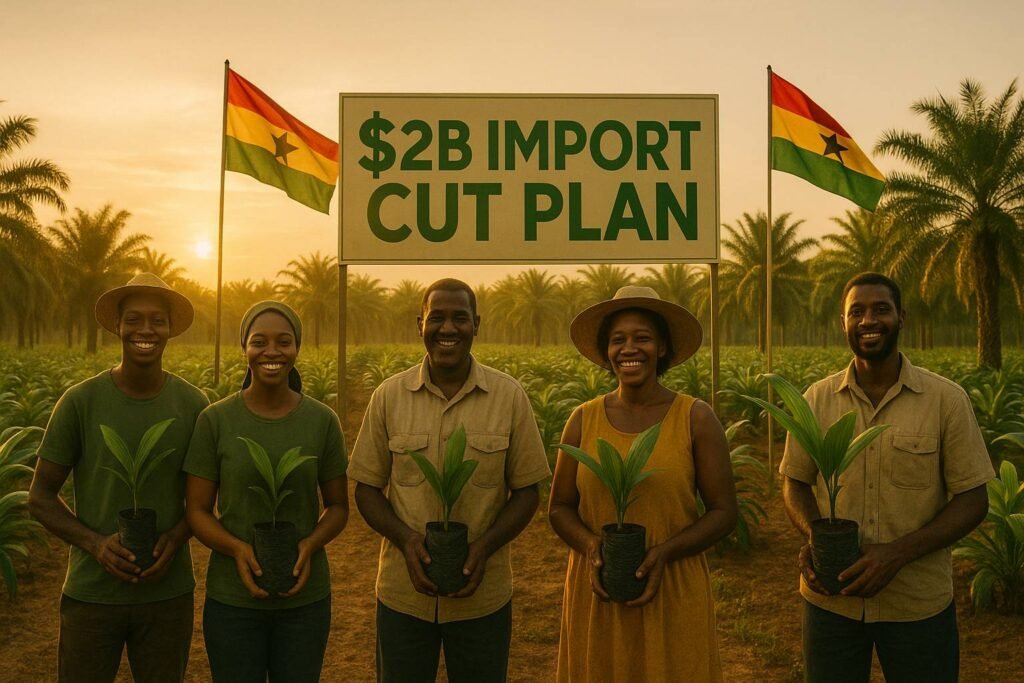
Reviving a Strategic Crop for Economic Resilience
The Ghana oil palm policy represents a cornerstone of government efforts to strengthen agribusiness and reduce the nation’s costly edible-oil imports. Through the distribution of 1.5 million improved seedlings, technical support for farmers, and incentives for processors, officials expect to save as much as $2 billion annually on the import bill. The initiative is also designed to boost rural incomes, generate jobs, and position Ghana as a sustainable palm-oil hub in West Africa.
From Early Pioneers to Modern Revival
Oil palm has deep roots in Ghana’s agricultural history, tracing back to the 19th century when the country was a major regional supplier. Over time, however, inconsistent policies, limited research investment, and competition from Southeast Asia caused domestic output to stagnate.
The new Ghana oil palm policy builds on past programs such as Planting for Food and Jobs and the Tree Crop Development Act 2019, aligning them under a coherent industrial framework. It prioritizes large-scale cultivation, smallholder aggregation, and value-chain modernization to reclaim Ghana’s competitiveness in global edible-oil markets.
Implementation Blueprint: 1.5 Million Seedlings and Structured Out-Grower Networks
At the heart of the plan is a mass-distribution campaign of 1.5 million high-yield seedlings across Eastern, Western, and Ashanti Regions. These areas account for nearly 70 percent of Ghana’s palm-growing potential. The Ministry of Food and Agriculture (MoFA), working with the Tree Crop Development Authority (TCDA), will coordinate registration of out-grower cooperatives and enforce transparent import-permit guidelines.
Key components include:
- Seedling Quality & Traceability: Certified varieties to ensure consistent yields.
- Farmer Capacity Building: Training on agronomic practices and sustainable harvesting.
- Credit Access: Soft loans through the Ghana EXIM Bank and partner micro-finance schemes.
- Mill Expansion: Public-private partnerships to upgrade existing facilities and attract green investment.
Officials say that full execution of the Ghana oil palm policy could save the economy approximately $2 billion per year while creating over 300,000 direct and indirect jobs.
Market Dynamics: Closing the Structural Supply Gap
Ghana currently imports more than half of its palm-oil needs, a paradox given its favorable climate. The Ghana oil palm policy aims to reverse this imbalance by stabilizing supply chains and improving feedstock reliability for domestic processors.
The policy also introduces a more transparent import-permit system intended to prevent dumping of sub-standard oil and to protect local producers. Industry experts project that if output meets local demand by 2027, Ghana could even re-enter niche export markets in West Africa, thereby strengthening its foreign-exchange reserves.
Economic Outlook: Linking Productivity to Value Addition
Analysts view the Ghana oil palm policy as an integrated economic tool rather than a stand-alone agricultural project. The initiative links productivity on farms to value-addition in factories, promoting a full circular economy around palm derivatives such as soap, cosmetics, margarine, and biodiesel.
Economist Dr. Kwaku Asante notes,
“Sustained success will depend on infrastructure and pricing. The policy’s impact must reach smallholders, not just large processors.”
To achieve long-term results, the government is also promoting local fabrication of processing machinery to reduce import dependence on industrial equipment—a complementary step that could keep more value within Ghana’s borders.
Stakeholder Perspectives: Farmers, Processors, and Officials
Smallholder farmers form the backbone of the industry, accounting for roughly 80 percent of raw fruit production. Under the new scheme, their participation will be scaled up through organized cooperatives that guarantee offtake agreements with mills.
Kwame Darko, a farmer in the Akyemansa District, expressed optimism:
“The seedlings are welcome, but continuous extension services and better farm-gate prices will decide if the Ghana oil palm policy truly benefits farmers.”
Private millers, represented by the Oil Palm Association of Ghana, highlight the importance of predictable fruit supply to justify investment in additional processing lines. The Association says steady FFB volumes will help boost plant utilization rates from the current 45 percent to 80 percent within three years.
Infrastructure and Logistics: The Road to Efficiency
Even with improved yields, poor transport and storage networks threaten profitability. Many growing zones rely on feeder roads that become impassable during the rainy season, inflating costs and lowering quality.
The Ghana oil palm policy therefore integrates infrastructure coordination with the Ministries of Roads and Trade to ensure new plantations are supported by warehouses, silos, and cold-chain facilities. Investment incentives for private logistics companies are also being considered to streamline movement from farms to processing centers.
Sustainability and Environmental Stewardship
To secure long-term competitiveness, the Ghana oil palm policy embeds sustainability at its core. Environmental guidelines emphasize:
- Prevention of deforestation and protection of community forests.
- Adoption of Roundtable on Sustainable Palm Oil (RSPO) standards.
- Fair-labor enforcement, especially in seasonal harvest cycles.
- Integration of women and youth in value-addition clusters.
Aligning with EU traceability rules will enable Ghanaian palm products to access premium markets. This step reflects a global shift toward ethical sourcing, positioning Ghana as a responsible supplier rather than merely a low-cost producer.
Comparative Insights: Lessons from Regional and Global Leaders
Countries such as Malaysia and Indonesia have leveraged public-private partnerships to build vertically integrated palm-oil industries. Nigeria’s own revival strategy also offers parallels in out-grower engagement and local refining. Ghana’s policymakers studied these examples while crafting the Ghana oil palm policy, ensuring that institutional coordination and land-use planning remain central to its success.
Economists believe the policy could outperform earlier agricultural reforms if implemented with strict monitoring and minimal bureaucratic delays. An inter-ministerial task force will track metrics such as seedling survival rates, out-grower enrollment, and mill utilization percentages every quarter.
Macroeconomic Impact: Saving Foreign Exchange and Strengthening Rural Economies
Palm-oil imports cost Ghana roughly $2.3 billion annually. Replacing even two-thirds of this with domestic output would ease pressure on foreign reserves and help stabilize the cedi. The initiative also complements the IMF-supported recovery plan by stimulating non-traditional exports and rural manufacturing.
The Ghana oil palm policy aligns with the government’s broader industrialization drive—particularly One District One Factory (1D1F)—by supplying feedstock to edible-oil processors and cosmetics manufacturers. Each additional tonne of locally processed palm oil creates multiplier effects across packaging, transport, and retail sectors.
Outlook and Accountability: Measuring Success Through Results
Transparency and measurable milestones will determine public confidence in the rollout. Key indicators include:
- Seedling distribution and survival rates.
- Enrollment of smallholders in registered out-grower schemes.
- Expansion of milling and storage infrastructure.
- Enforcement of import-permit reforms to protect local markets.
- Increase in certified sustainable palm-oil exports.
MoFA officials insist quarterly progress reports will be published online to enhance accountability. Development partners such as UNDP and the African Development Bank have expressed interest in supporting digital monitoring systems to track field performance in real time.
From Policy Vision to Tangible Prosperity
If fully executed, the Ghana oil palm policy could become one of the country’s most impactful agribusiness transformations in decades. It combines environmental responsibility with economic logic, social inclusion, and industrial ambition.
The challenge now lies in disciplined implementation—ensuring that farmers, investors, and processors all benefit equitably. Success will not only save $2 billion in imports but also prove that strategic agricultural policies can drive national prosperity when guided by Truth, Depth, and Global Reach.
- Internal (GSN):
Ghana Military Helicopter Crash - Elon Musk Apple lawsuit: xAI to sue over App Store ranking ·
Africa Single Currency: Zuma Calls for Economic Independence - External (context):
MyJoyOnline — Government announces plans to cut oil palm import by $2bn ·
MyJoyOnline — Policy background (Feed Ghana) ·