Global Focus Returns to Gaza
The Gaza humanitarian crisis continues to intensify as civilians—particularly children—face hunger and danger around aid points, even while Israel advances a controversial Gaza City military plan. Amid the violence, Liverpool star Mohamed Salah’s public rebuke of UEFA over a tribute to Palestinian footballer Suleiman al-Obeid has reignited a global debate on truth, accountability, and human suffering in wartime reporting.
Background: The Roots of the Gaza Humanitarian Crisis
The Gaza humanitarian crisis has persisted for over a year, following Israel’s massive military campaign launched after the October 2023 Hamas attacks. The densely populated enclave, home to more than two million people, has been reduced to rubble in many areas, leaving civilians with minimal access to food, clean water, medicine, and electricity.
International organizations like the World Health Organization (WHO) and UNICEF warn that humanitarian indicators are crossing catastrophic thresholds. According to WHO, nearly 12,000 children under five are now acutely malnourished, with aid workers describing clinics overwhelmed by severe wasting and dehydration cases.
The ongoing blockade and restricted entry of aid convoys continue to exacerbate what the United Nations Office for the Coordination of Humanitarian Affairs (OCHA) calls “a full-scale humanitarian collapse.”
Israel’s Gaza City Plan and International Reactions
Israel’s latest campaign centers on a renewed Gaza City plan, described by military officials as necessary to “complete the defeat of Hamas.” Israeli leaders insist it is not a move to re-occupy the Strip but a final stage of dismantling militant networks. However, global observers—including the European Union, the Arab League, and UN envoys—express alarm over rising civilian deaths and blocked humanitarian access.
On the same day Israel defended its Gaza City strategy, humanitarian agencies documented fresh casualties near food-aid lines, where desperate families queued for rations under sporadic shellfire. Field reports describe fatal stampedes and sniper incidents at aid points, underlining how the Gaza humanitarian crisis has blurred the line between combat zones and survival zones.
“No one should die while waiting for food,” a UN spokesperson said. “This is not just a war; it’s a war on human dignity.”
Mohamed Salah’s Stand: Demanding Truth in Tributes
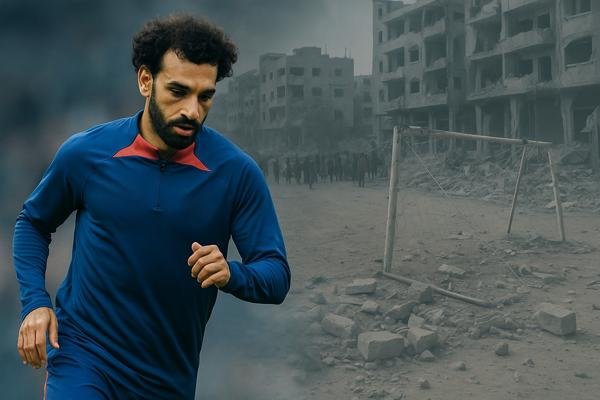
Football became an unlikely focal point in the Gaza humanitarian crisis when Mohamed Salah, one of the world’s most influential athletes, publicly challenged UEFA over its brief tribute to Suleiman al-Obeid, known as the Palestinian Pelé. Salah wrote on X (formerly Twitter):
“Can you tell us how he died, where, and why?”
His pointed question criticized UEFA for omitting the circumstances of al-Obeid’s death, which reports suggest occurred when Israeli tank fire struck near an aid queue in southern Gaza. The exchange transformed what might have been a routine condolence post into a moment of global reflection on selective empathy and the politics of silence in sport.
“Salah’s words cut through the noise,” said sports analyst James Holder. “They remind us that footballers have platforms powerful enough to confront moral blind spots.”
Who Was Suleiman al-Obeid? The “Palestinian Pelé”
Suleiman al-Obeid, 41, was a celebrated football icon in Gaza and across the Arab world. Over his career, he scored more than 100 club goals and represented Palestine 24 times. His flair, humility, and leadership earned him the nickname “the Palestinian Pelé.”
In the midst of the Gaza humanitarian crisis, his death became symbolic of the countless civilians killed while performing ordinary acts—waiting for food, searching for water, or protecting their families. His relatives described him as “a father, mentor, and hope-bearer in a hopeless land.”
The Palestinian Football Association (PFA) reported that over 400 athletes and staff have been killed since the conflict began, with dozens of stadiums, gyms, and community pitches destroyed.
Hunger and Aid Lines: A Humanitarian Collapse
Field reports from the UN World Food Programme (WFP) and Médecins Sans Frontières (MSF) document widespread starvation as aid deliveries struggle to cross border points. Queues at food distribution sites often stretch for hours; children collapse from exhaustion, and gunfire or crowd surges turn some locations into deadly zones.
UNICEF warns that “famine conditions are being met in parts of northern Gaza,” though formal declaration is hindered by data gaps. In clinics, acute malnutrition cases have tripled in six months. WHO describes mothers arriving with infants who have not eaten in days.
Meanwhile, Israel disputes famine claims, arguing that aid delivery is obstructed by Hamas diversion and internal mismanagement. However, independent observers note that even authorized convoys face lengthy inspections and limited corridor access, prolonging the Gaza humanitarian crisis and fueling desperation.
“We can’t keep saying it’s complicated,” said WHO spokesperson Margaret Harris. “Children are dying from hunger. That’s not complicated—it’s unacceptable.”
Diplomatic Stalemate and Humanitarian Appeals
Global powers remain divided on next steps. The United States maintains its stance on Israel’s right to self-defense but urges restraint, while European and Arab leaders push for a sustained humanitarian ceasefire.
The United Nations Security Council continues to debate aid resolutions, many vetoed or watered down by political divisions.
Regional analysts argue that Israel’s Gaza City plan cannot achieve lasting security without a parallel humanitarian surge. “No counter-insurgency can succeed amid famine,” said analyst Lina Khoury of the Carnegie Middle East Center. “The Gaza humanitarian crisis has become both a symptom and a weapon in this war.”
The Power of Global Sports Voices
Mohamed Salah’s intervention resonated beyond football. Within hours, his post trended worldwide, prompting millions of interactions. Advocacy groups hailed his stance as a reminder that global sports figures can amplify humanitarian accountability when institutions fail to tell the full story.
Fans across the Arab world and Europe have since shared tributes to al-Obeid alongside appeals for Gaza relief efforts. Salah’s post, while brief, helped reframe a sports tribute into a conversation about conscience, underscoring how cultural platforms can challenge sanitized narratives of war.
Global and Local Implications
The Gaza humanitarian crisis exposes the fragility of international humanitarian law when geopolitical interests overshadow civilian protection. It also highlights the psychological toll of long-term siege conditions, particularly on children.
From London to Cairo, solidarity protests call for greater transparency in Western media coverage and corporate accountability for silence on wartime suffering. Within Gaza, however, hope dwindles as aid becomes scarcer and communication networks collapse.
At a broader level, the tragedy underscores an urgent truth: humanitarian crises demand not only food and medicine but also honesty and moral courage—values echoed by Salah’s global appeal.
Conclusion: Truth, Context, and Accountability
The Gaza humanitarian crisis remains one of the most pressing moral tests of our time. As Israel’s Gaza City plan advances and famine conditions deepen, the world confronts a painful paradox—unprecedented awareness, yet insufficient action.
Mohamed Salah’s question—“Can you tell us how he died?”—captures the heart of the matter. Beyond statistics, policies, and military objectives, this crisis is about individual lives, lost dreams, and the duty to bear witness truthfully.
INTERNAL LINKS
- African Migrants Yemen Tragedy: 140 Feared Dead in Worst Shipwreck of 2025
- Student Mental Health 2025: Coping with Anxiety and Burnout
- Ghana Military Helicopter Crash: 8 Top Officials Killed in Devastating Tragedy