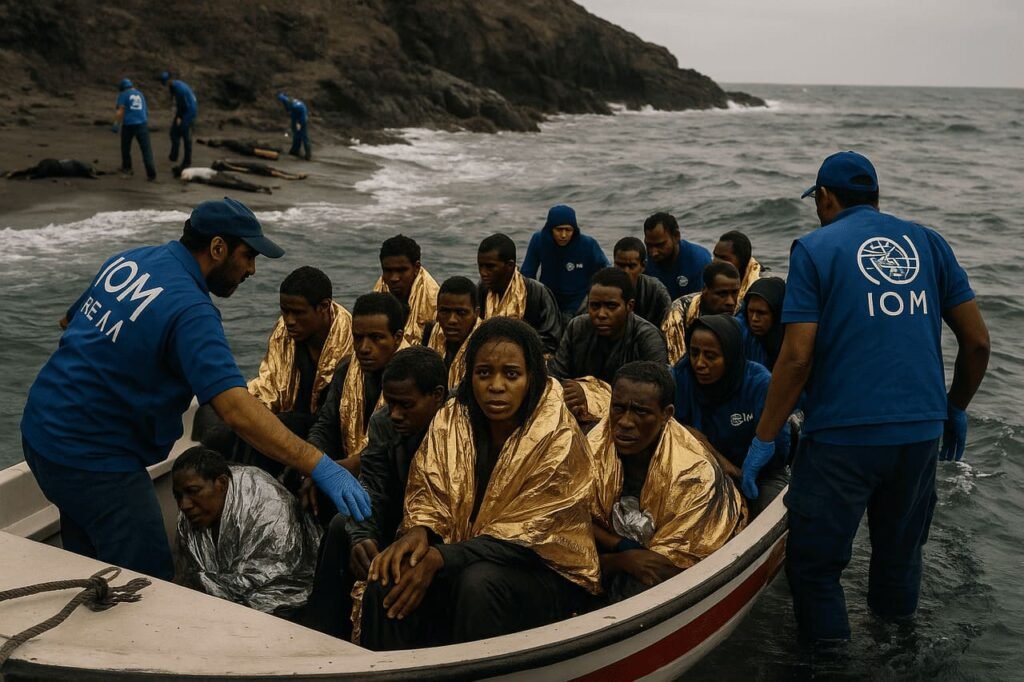
The African Migrants Yemen Tragedy has become one of the deadliest maritime disasters of 2025, shaking humanitarian agencies and governments alike. As of August 5, the death toll has climbed to 140, with only 12 survivorsand dozens still missing, according to the UN’s International Organization for Migration (IOM) and reports from AP, CNN, and The Guardian.
The incident underscores the perilous conditions endured by thousands of African migrants risking their lives across the Gulf of Aden, seeking hope in a region torn by conflict.
Background: Desperate Voyage Turns Deadly
The African Migrants Yemen Tragedy unfolded on July 30, 2025, when a wooden boat carrying about 200 African migrants, mostly Ethiopians and Somalis, capsized off Yemen’s southern coast.
The migrants had departed from the Horn of Africa, hoping to reach Saudi Arabia or other Gulf nations for work and stability. Many were unaware that the voyage across the Gulf of Aden is among the world’s most dangerous sea routes.
Driven by poverty, drought, and conflict, these migrants—some as young as 16—embarked on a journey that ended in catastrophe. The African Migrants Yemen Tragedy illustrates the growing desperation among Africa’s youth, who see migration as their only escape from hardship.
Confirmed Deaths and Missing Migrants
Figures from humanitarian agencies reveal the scope of the tragedy:
- 56–140 confirmed dead
- 132 still missing and presumed dead
- 12 survivors rescued by Yemeni coastguards and local fishermen
While reports from The Guardian and CNN indicate similar numbers, HuffPost Español and El País estimate as many as 140 fatalities. Many victims were buried in mass graves along the coast after decomposition made identification impossible.
UN officials confirm that most passengers were Ethiopian and Somali nationals, including women and children fleeing hunger and political instability.
Human Faces Behind the Numbers
Behind every statistic in the African Migrants Yemen Tragedy lies a human story.
“The boat filled with water. People started screaming. I tried to hold onto a wooden plank. That’s all I remember,” said Dawit, an 18-year-old survivor now recovering in Lahj province.
Aid workers describe the rescued migrants as exhausted, traumatized, and severely dehydrated. The IOM and Médecins Sans Frontières (MSF) are providing emergency medical care, shelter, and psychosocial support.
Photos shared by field teams show survivors huddled on the beach under foil blankets, some too weak to speak. These haunting scenes have reignited calls for urgent regional coordination to prevent more deaths at sea.
Analysis: The Gulf of Aden’s Deadly Route
The Gulf of Aden—a narrow stretch of water between Yemen and Somalia—has long been a death corridor disguised as a gateway. Despite war and instability in Yemen, the route remains active due to its proximity to the Arabian Peninsula, where migrants hope for job opportunities.
Between January and June 2025, the UNHCR recorded over 30,000 crossings, mostly from Ethiopia. Many are unaware of the abuse, detention, and trafficking that await them upon arrival.
The African Migrants Yemen Tragedy reveals systemic failures that continue to claim lives:
- Absence of safe migration pathways
- Lack of regional rescue infrastructure
- Ongoing human smuggling operations exploiting desperate travelers
Recurring Maritime Disasters
This catastrophe is part of a tragic pattern:
- June 2025: 49 migrants drowned off Yemen’s coast.
- March 2025: Another 80 African migrants perished in similar conditions.
Each time, global outrage fades within days.
“Human smugglers are making a business from death,” said IOM Director General António Vitorino, condemning the exploitation of vulnerable migrants.
Without intervention, the African Migrants Yemen Tragedy will not be the last such headline.
UN and IOM Demand Urgent Regional Action
In the wake of the African Migrants Yemen Tragedy, the UN and IOM have renewed calls for coordinated international action, urging governments in Ethiopia, Somalia, Yemen, and Gulf States to:
- Strengthen maritime search-and-rescue capacity
- Dismantle smuggling and trafficking networks
- Launch awareness campaigns across the Horn of Africa
- Establish legal migration routes for labor seekers
- Support repatriation and reintegration programs
Experts warn that failure to act will mean more African migrants risking the same fate.
Yemen’s Conflict Intensifies the Crisis
Yemen’s decade-long civil war amplifies the human cost. The country lacks resources for rescue operations, medical care, or safe shelters for survivors.
“Migrants in Yemen are living in limbo — stateless, voiceless, and often invisible,” said an MSF field coordinator in Aden.
The war has destroyed infrastructure, crippled governance, and created what the UN calls one of the world’s worst humanitarian emergencies.
Bodies from the African Migrants Yemen Tragedy continue washing ashore daily — some unrecognizable, others discovered by fishermen miles away from the original site.
Global and African Implications
The African Migrants Yemen Tragedy is not an isolated incident but part of a broader continental crisis.
It raises urgent questions about youth unemployment, climate displacement, and migration governance in Africa. Governments in Ethiopia, Somalia, and Kenya face mounting pressure to create sustainable livelihoods that deter risky journeys.
For Gulf States, the tragedy exposes moral responsibilities in managing labor demand ethically. For the international community, it underscores the need for human-centered migration policies rather than reactive border controls.
Conclusion: A Crisis the World Cannot Ignore
The African Migrants Yemen Tragedy is a grim warning to the world. Unless governments, humanitarian organizations, and regional blocs act collectively, the sea between Africa and the Middle East will remain a graveyard.
Hundreds of families in Ethiopia and Somalia will never see their loved ones again. Migration is an enduring reality — but death must never be its cost.
Global leaders must replace indifference with action, ensuring that tragedies like this one are not repeated.