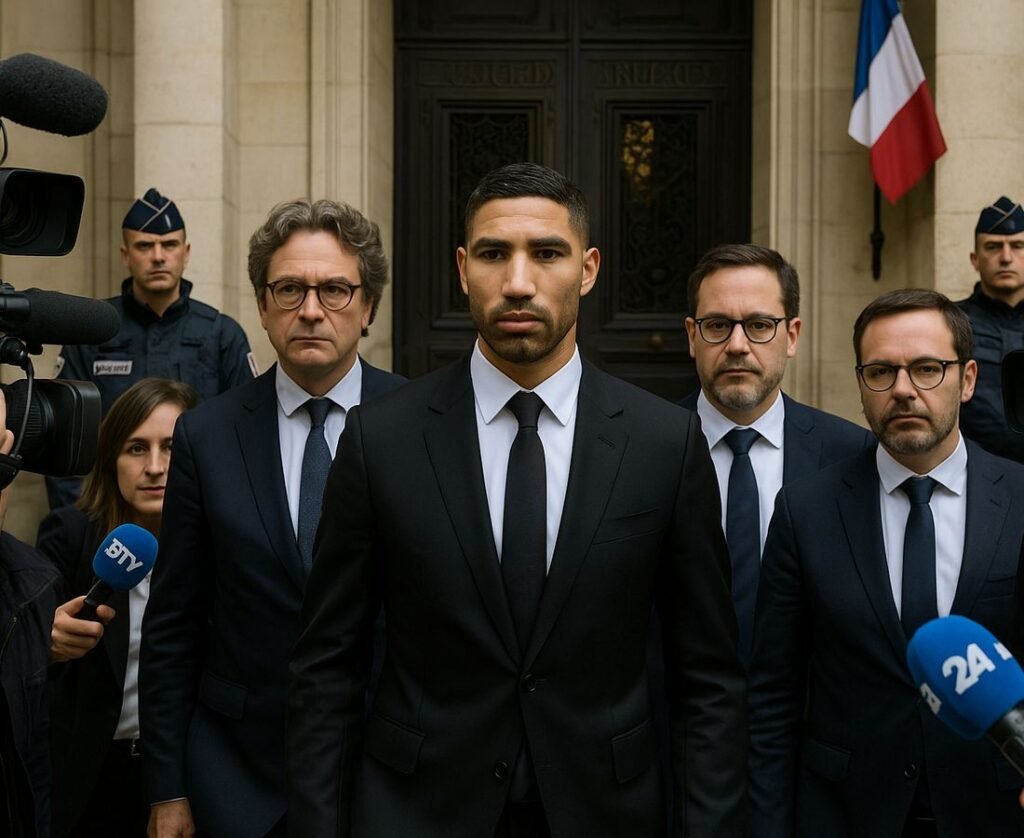
France Advances Toward Criminal Proceedings
The Achraf Hakimi rape trial has reached a critical juncture after French prosecutors officially requested that the Paris Saint-Germain (PSG) and Morocco defender be tried before a criminal court. Announced on August 1, 2025, the move signals a major escalation in a case that has drawn global attention for over two years.
The allegations stem from February 2023, when a 24-year-old woman accused Hakimi of non-consensual sexual acts at his residence in Boulogne-Billancourt, near Paris. Hakimi, 26, has firmly denied the accusations, calling them baseless and defamatory. Yet prosecutors’ decision to proceed suggests confidence in the evidence compiled through the prolonged judicial inquiry.
How a Social Media Encounter Became a Legal Battle
Court documents indicate that the woman met Hakimi via Instagram, where conversations quickly turned personal. On the night of the alleged assault, Hakimi reportedly sent a taxi to collect her and bring her to his home. According to the complaint, she was sexually assaulted upon arrival.
The alleged victim filed a report the same evening, prompting immediate police involvement. Within weeks, Hakimi was placed under judicial supervision—a restrictive measure allowing him to continue professional duties but under close observation.
Over two years, investigators gathered digital records, forensic samples, and witness statements. By mid-2025, the prosecutor’s office concluded that the evidence justified referral to a full court hearing, reigniting public debate over how France’s justice system treats high-profile defendants.
The Achraf Hakimi rape trial now stands as one of France’s most anticipated cases, representing both a test of judicial impartiality and the cultural reckoning surrounding sexual violence allegations.
Denial, Counterclaims, and Legal Strategy
Hakimi’s attorney, Fanny Colin, has firmly denied the allegations and described the complaint as “an attempt at extortion.” In statements to Le Parisien and AFP, she said her client “is calm and trusts justice to reveal the truth.” Colin insisted that the investigation lacks material proof and that inconsistent testimony weakens the prosecution’s case. She also argued that extensive media coverage has unfairly affected Hakimi’s reputation and his right to presumption of innocence.
Despite the ongoing proceedings, Hakimi has continued to play for PSG and the Moroccan national team, remaining active in both domestic and international competitions. However, if the Achraf Hakimi rape trial proceeds to a full hearing, insiders say PSG management could reassess contractual terms and travel permissions to comply with legal requirements.
A Long-Awaited Step Toward Accountability
The woman’s attorney, Rachel-Flore Pardo, hailed the prosecutors’ move as a milestone in her client’s pursuit of justice. “For my client, this is not about fame or football—it is about truth,” she said in a statement to AFP. “The decision to advance the Achraf Hakimi rape trial restores hope that victims can be heard even when powerful interests are involved.”
Over the past two years, the complainant has faced intense online harassment and public scrutiny. Advocacy organizations such as Nous Toutes have urged authorities to ensure her safety and emotional wellbeing throughout the proceedings.
Legal experts note that the move from investigation to potential trial marks a “rare but significant leap” in France’s often slow-moving sexual assault cases—especially those involving influential figures.
The French Legal Path to a Rape Trial
Under French criminal procedure, rape cases are first investigated by a magistrate who assesses whether the evidence meets the threshold for trial before the Cour d’assises—a mixed jury of citizens and professionals.
If the Achraf Hakimi rape trial is approved, the proceedings will be conducted behind partially closed doors, as French law protects the anonymity of sexual assault victims. Conviction could carry up to 15 years in prison, depending on aggravating factors.
Observers have compared Hakimi’s case with previous high-profile French trials, including those of Gérard Depardieuand former minister Damien Abad, both accused of sexual misconduct. Together, these cases reflect the shifting expectations of accountability in French public life amid the ongoing #MeTooFrance movement.
Public and Institutional Reaction: Silence, Division, and Support
Public opinion on the Achraf Hakimi rape trial remains sharply divided. Supporters, including many Moroccan fans, emphasize his presumption of innocence and highlight his philanthropic efforts, while critics accuse them of defending celebrity privilege.
PSG has remained silent since the August announcement, issuing no new statements. Club insiders told France 24 that management is “monitoring developments closely” but prefers not to interfere with judicial matters.
Meanwhile, the Moroccan Football Federation has refrained from public comment, a move analysts interpret as an attempt to avoid diplomatic tension with France. In Morocco, the case has been covered with caution, reflecting Hakimi’s near-iconic status as one of Africa’s top footballers.
Expert Analysis: The Intersection of Fame, Power, and Justice
Criminologist Dr. Hélène Moreau from the University of Lille suggests that the Achraf Hakimi rape trial may redefine how France navigates sexual assault allegations against celebrities. “Justice systems must show that fame cannot purchase immunity,” she said.
The case has also sparked ethical debate across the sports world. Should teams and sponsors take preventive action when allegations emerge, or should they wait for judicial verdicts? Organizations like UEFA and FIFA have been urged to establish clearer athlete-conduct protocols to prevent reputational crises that can destabilize clubs and fans alike.
For human rights groups, the Hakimi case underscores how cultural reverence for athletes can hinder accountability—echoing international parallels from Spain’s Luis Rubiales scandal to the U.S. gymnastics abuse cases.
Cultural and Global Implications: A Mirror for Society
Beyond the courtroom, the Achraf Hakimi rape trial represents a broader reflection on global attitudes toward consent and gender equity in elite sports. French sociologist Dr. Marion Lefèvre told Reuters that “celebrity status often warps public empathy—turning justice into a popularity contest.”
The case has amplified calls for better education on sexual consent and power dynamics, especially within sports academies and entertainment industries. Across social media, hashtags like #JusticeForAll and #NoOneAboveTheLawhave trended following the announcement, indicating public appetite for accountability regardless of status or nationality.
Magistrate’s Decision Could Define the Case
The investigating magistrate will now review the prosecution’s file before deciding whether to commit Hakimi to a full criminal trial. Legal experts predict a decision by late 2025, with proceedings possibly extending into early 2026.
If approved, the Achraf Hakimi rape trial would proceed as one of France’s most high-profile criminal cases involving a global athlete. A guilty verdict could result in up to 15 years in prison, while an acquittal might still leave lasting reputational scars.
Regardless of outcome, the case has already catalyzed a crucial dialogue on how modern societies reconcile due process, celebrity, and justice.
Justice System Faces Its Defining Test
As France’s judiciary deliberates, the Achraf Hakimi rape trial remains a defining test of how the country’s institutions balance law, fame, and fairness. Whether it leads to conviction or acquittal, the case has exposed deep tensions within both the sports industry and the public’s conscience.
What unfolds next will not only determine Hakimi’s fate but also shape global perceptions of how democracies administer justice in the era of celebrity influence.
Internal Links