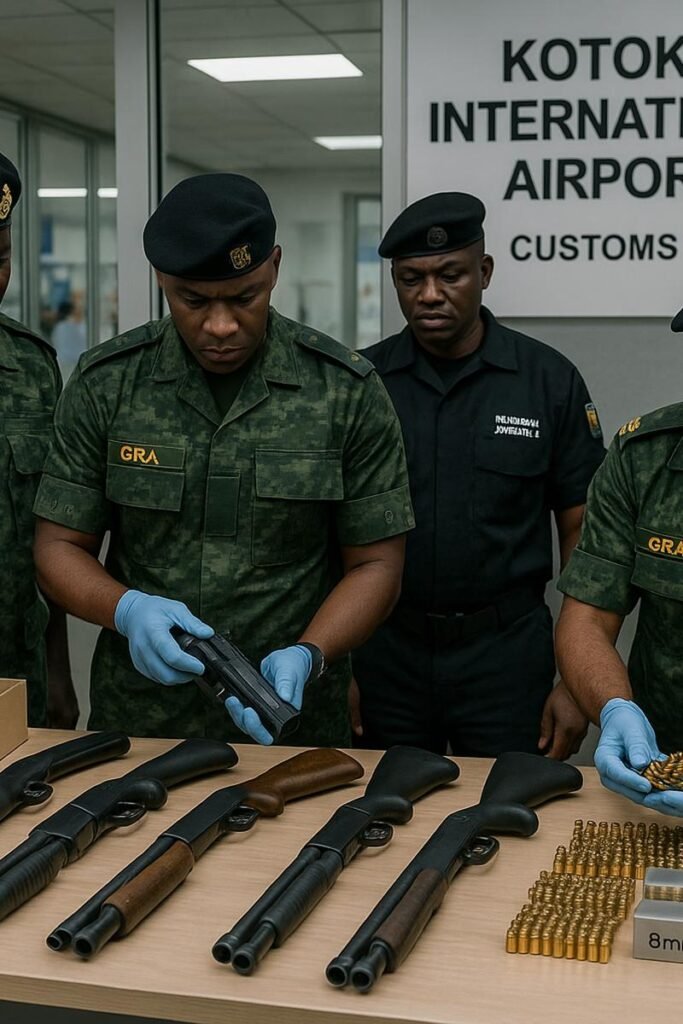
A Shockwave Through Ghana’s Security Network
The Kotoka Airport Firearms Seizure has stunned the nation and raised alarms over Ghana’s aviation and border control systems. On July 29, 2025, security personnel at Kotoka International Airport in Accra intercepted over 2,000 rounds of ammunition and 20 high-grade firearms hidden in passenger luggage. The dramatic operation, led by a joint security task force, resulted in the arrest of two suspects and triggered a broad probe into possible transnational arms trafficking networks operating through West Africa’s busiest aviation hub.
This high-profile discovery not only exposed weaknesses within the airport’s multilayered screening system but also forced a reckoning over how Ghana—often praised for its relative stability—manages the growing threat of cross-border arms smuggling.
Ghana’s Strategic Role and Security Concerns
Ghana’s reputation as a peaceful and politically stable country has long made it a regional gateway for commerce, diplomacy, and migration. Yet, the Kotoka Airport Firearms Seizure underscores how even established aviation hubs can become conduits for organized crime.
In recent years, Interpol and ECOWAS have repeatedly warned that arms traffickers are increasingly exploiting civilian air and maritime corridors to supply insurgent groups in the Sahel, northern Nigeria, and Burkina Faso.
Between 2022 and 2025, Ghana’s National Security Secretariat documented more than 170 smuggling incidentsinvolving weapons, narcotics, and counterfeit goods. Security analysts note that this latest seizure ranks among the largest in Ghana’s modern history and could have easily fueled violent groups across the region had it not been intercepted.
How the Kotoka Airport Firearms Seizure Unfolded
The breakthrough occurred when aviation security scanners flagged suspicious luggage aboard an inbound flight from the United States. Upon manual inspection, officers from the Ghana Airport Company Limited (GACL) discovered hidden compartments concealing AK-47 rifles, Glock pistols, and semi-automatic weapons.
Authorities catalogued 2,043 live rounds of ammunition, primarily 9mm and 7.62mm calibers. Early reports indicate that the firearms had been disassembled and wrapped in metallic foil in an attempt to evade X-ray detection. The swift response of Aviation Security (AVSEC) personnel prevented the weapons from entering circulation.
A GACL spokesperson commended the officers, emphasizing that “alertness at every checkpoint remains the strongest line of defense against modern smuggling tactics.”
Two Suspects in Custody After Kotoka Airport Firearms Seizure
The Ghana Police Service, through its Criminal Investigations Department (CID), confirmed the arrest of two Ghanaian nationals connected to the smuggling operation. Both suspects reportedly have ties to logistics and ground-handling services at the airport—positions that may have given them insider access to restricted zones.
According to CID Director-General COP Faustina Andoh-Kwofie, investigations are ongoing to identify potential accomplices both locally and abroad. Intelligence sources suggest the suspects could be part of a broader arms-for-profit network spanning Accra, Lagos, and New York.
They are expected to be charged under Ghana’s Arms and Ammunition Act, 1972 (NRCD 9) for illegal possession, smuggling, and conspiracy to commit a felony. The CID has also hinted that more arrests could follow as investigators examine the logistics trail and shipping manifests tied to the consignment.
Weapon Types Found During Kotoka Airport Firearms Seizure
The Kotoka Airport Firearms Seizure produced a comprehensive catalog of military-grade weapons. Officials confirmed the following items were confiscated:
- 7 AK-47 assault rifles (5.56mm and 7.62mm calibers)
- 5 Glock handguns (9mm)
- 3 Sig Sauer pistols
- 5 semi-automatic carbines
- 2,043 rounds of assorted ammunition
Security experts say the variety and scale of these weapons indicate a coordinated trafficking operation rather than isolated criminal activity. The smuggling technique mirrors similar cases uncovered in Lomé, Cotonou, and Abidjan, raising concerns about the emergence of a West African arms corridor connecting major ports and airports.
Security Gaps Exposed by the Kotoka Airport Firearms Seizure
Aviation and customs specialists have identified several systemic weaknesses that may have enabled the breach:
- Inconsistent baggage profiling for returning citizens and dual nationals.
- Overreliance on human inspection instead of advanced AI-based scanning analytics.
- Limited data integration among GACL, Customs, and CID databases.
The Ghana Civil Aviation Authority (GCAA) has launched an urgent review of all screening procedures and initiated refresher training for over 400 airport security personnel.
Aviation consultant Kwesi Adum observed that, “The Kotoka Airport Firearms Seizure demonstrates how creative concealment can outsmart outdated manual systems. Ghana must adopt automation and accountability if it wants to prevent a repeat.”
Government and Security Agency Response
During a closed-door session in Parliament, National Security Coordinator Prosper Bani briefed lawmakers, assuring them that “airport safety remains paramount.” He announced intensified collaboration with Interpol, the U.S. Department of Homeland Security, and ECOWAS intelligence units to trace the source and destination of the seized arms.
In response, the Ministry of National Security unveiled the Airport Safety Enhancement Initiative (ASEI-2025)—a program set to revolutionize Ghana’s airport security through:
- AI-driven baggage scanners for advanced threat detection
- Drone-assisted surveillance to monitor tarmacs and cargo zones
- Enhanced biometric systems for staff and vendors
- Comprehensive background checks for all airport personnel with restricted access
Interior Minister Ambrose Dery added that a Joint Operations Command Center will be established at Kotoka to ensure real-time coordination among Customs, Immigration, and the Police.
Regional and Global Implications
The Kotoka Airport Firearms Seizure has reverberated throughout West Africa. Regional security analysts warn that the incident exposes how fragile aviation and customs systems remain across ECOWAS states, even in countries regarded as stable.
With Mali, Burkina Faso, and Niger struggling to contain insurgencies, the flow of arms through civilian routes has intensified. Ghana’s status as a UN peacekeeping contributor and aviation gateway for humanitarian missions amplifies the stakes. A single breach could compromise international confidence, affecting airline insurance premiums and cargo inspection protocols.
Security researcher Dr. Kwame Appiah-Mensah cautioned that, “The Kotoka Airport Firearms Seizure, if not addressed transparently, risks undermining Ghana’s credibility as West Africa’s security anchor.”
Public Reaction and Media Coverage
Public reaction to the Kotoka Airport Firearms Seizure has been fierce. Across social media platforms, hashtags such as #KotokaFirearmsSeizure and #AirportSecurityGhana trended for days. Many Ghanaians called for greater transparency, while others demanded a complete overhaul of the country’s airport management system.
Civil society groups like the Ghana Integrity Initiative (GII) and Africa Centre for Security Studies (ACSS) have urged an independent review of airport security contracts and vendor access. Opposition lawmakers have requested a bipartisan parliamentary committee to ensure no political interference compromises the probe’s integrity.
Editorials in leading newspapers—including the Daily Graphic and The Chronicle—have described the event as a “wake-up call” for national vigilance, warning against complacency and overconfidence in the country’s “security image.”
Analysis: What the Kotoka Airport Firearms Seizure Reveals
Analysts agree that the Kotoka Airport Firearms Seizure is not an isolated event—it reflects the intersection of organized crime, global logistics, and institutional gaps.
Three key lessons emerge from the incident:
- Vigilance Over Routine: Security personnel must balance efficiency with scrutiny, especially when screening frequent flyers.
- Technology as Force Multiplier: Artificial intelligence, pattern recognition, and automated data sharing can dramatically reduce human error.
- Regional Intelligence Fusion: Ghana must strengthen coordination with ECOWAS and Interpol to detect arms movements across borders.
Comparatively, nations like Kenya and Nigeria have introduced real-time customs intelligence sharing, cutting smuggling incidents by nearly 40% in two years. Experts suggest Ghana’s ASEI-2025 initiative could replicate these successes if properly funded and independently monitored.
Global Standard News Editorial Perspective
As Ghana positions itself to become West Africa’s premier aviation hub, the Kotoka Airport Firearms Seizure serves as both a warning and an inflection point. The incident challenges the perception of Ghana as a regional fortress of security and governance.
Global Standard News maintains that progress will depend on three pillars:
- Transparency in how investigations unfold.
- Technology adoption to close the intelligence gap.
- Institutional accountability to ensure that reforms outlast political cycles.
Rather than scapegoating individuals, Ghana must confront structural issues—procurement flaws, outdated scanning equipment, and insufficient background checks—that have plagued airport security for years.
Conclusion: Lessons from the Kotoka Airport Firearms Seizure
The Kotoka Airport Firearms Seizure will remain a defining episode in Ghana’s national security narrative. As investigations expand, citizens and global observers alike await the outcome as a test of Ghana’s credibility.
The incident underscores that in an age of technological threats and transnational networks, safety begins not at the border—but at the scanner.
For Ghana, the path forward lies in modernization, vigilance, and transparency—principles that can transform crisis into reform.
Internal Links
- UN Warns of Hunger Crisis in Nigeria
- Trump AI Action Plan Sparks Global Debate
- Davido Timeless UK Silver Certification
External Links: