Landmark Victory for Constitutional Rights
The Trump Birthright Citizenship Ban was officially struck down on July 25, 2025, by a unanimous panel of the Ninth Circuit U.S. Court of Appeals. The federal court ruled that former President Donald Trump’s 2019 executive order attempting to restrict birthright citizenship violated the 14th Amendment of the U.S. Constitution.
The decision has been widely hailed as a landmark win for constitutional integrity, civil liberties, and immigration justice, reaffirming that citizenship rights cannot be altered by presidential decree. For millions of Americans and immigrants alike, this ruling has reasserted faith in the balance of powers that underpin U.S. democracy.
The Origins of the Trump Birthright Citizenship Ban
The origins of the Ban date back to October 2019, when then-President Trump announced his intention to revoke automatic U.S. citizenship for children born to undocumented parents. The executive order claimed that the 14th Amendment had been “misapplied for decades,” arguing that only children born to legal residents should qualify for citizenship.
Trump justified the move as part of his broader “America First” immigration agenda, promising to curb what he called “birth tourism” and unauthorized immigration. However, the proposal sparked immediate backlash from civil-rights organizations, constitutional scholars, and bipartisan lawmakers, who denounced it as unconstitutional and discriminatory.
The American Civil Liberties Union (ACLU), along with several immigrant families and advocacy groups, promptly filed lawsuits challenging the order, setting off a five-year legal battle that culminated in the 2025 appeals court ruling.
External Link: Read ACLU’s Full Statement on the Case
Federal Appeals Court Invalidates the Executive Order
In its unanimous decision, the Ninth Circuit U.S. Court of Appeals declared that the Birthright Citizenship Ban constituted “a clear and impermissible breach” of constitutional authority. The judges emphasized that no president has the power to reinterpret the Constitution through executive order.
Presiding Judge Marsha Berzon, writing for the court, cited the 14th Amendment’s Citizenship Clause, which declares that “All persons born or naturalized in the United States, and subject to the jurisdiction thereof, are citizens of the United States.” The panel ruled that the Trump order directly conflicted with this clause, and therefore, could not stand.
The court further referenced the landmark 1898 Supreme Court case United States v. Wong Kim Ark, which affirmed that a child born in the U.S. to foreign parents is automatically a citizen. Judge Berzon also cited Plyler v. Doe (1982), which extended constitutional protections to undocumented immigrant children, reinforcing that the rights of individuals cannot be subject to arbitrary executive interpretation.
External Link: 14th Amendment – National Constitution Center
The judgment concluded that any effort to amend or reinterpret the 14th Amendment must be pursued through a constitutional amendment, not an executive directive. Legal observers described the opinion as “surgical,” “foundational,” and “a critical reminder that the Constitution supersedes politics.”
Legal and Constitutional Analysis: Reinforcing Judicial Independence
Legal experts have described the overturning of the Birthright Citizenship Ban as one of the most significant constitutional rulings in modern U.S. history. Harvard Law Professor Laurence Tribe called it “a necessary reaffirmation of judicial independence in an era of executive overreach.”
“The Constitution is not a menu of policy preferences,” Tribe stated. “The court’s decision restores equilibrium by affirming that the 14th Amendment cannot be rewritten by presidential opinion.”
Similarly, legal analyst Maya Wiley noted that the ruling serves as a critical precedent limiting future executive immigration actions. “It’s a message to all future administrations that constitutional boundaries exist — and they are not optional,” she said.
External Link: SCOTUSblog Analysis
The ruling also strengthens the judiciary’s credibility at a time when courts face accusations of partisanship. By striking down the Trump Birthright Citizenship Ban on purely constitutional grounds, the appellate court reaffirmed the judiciary’s role as a neutral guardian of civil liberties.
Election-Year Shockwaves Across Washington
Politically, the decision has sent shockwaves through Washington just months before the 2025 midterm elections. Democrats have praised the verdict as a triumph for constitutional justice and inclusivity, while Republicans condemned it as judicial interference in matters of national sovereignty.
President Joe Biden called the ruling a “victory for the American promise that all are equal under the law.” In contrast, Florida Governor Ron DeSantis accused the judiciary of “handcuffing America’s right to define its borders.”
Civil-rights advocates argue that the Trump Birthright Citizenship Ban had already inflicted social and psychological harm on immigrant communities, creating fear and uncertainty over citizenship rights. Many have called for Congress to codify the 14th Amendment’s citizenship guarantee into federal statutory law, preventing future executive reinterpretation.
Internal Link: Trump’s AI Action Plan Draws Global Criticism
The ruling is also reshaping the 2025 campaign discourse. Candidates across both parties are being forced to clarify their stance on immigration reform, birthright citizenship, and executive authority — issues that now sit at the heart of the national conversation.
Civil Society and Legal Advocacy: A Collective Victory
Civil-rights organizations celebrated the court’s ruling as a collective victory for democracy and due process. The American Immigration Lawyers Association (AILA) described the decision as “a monumental defense of American constitutionalism.”
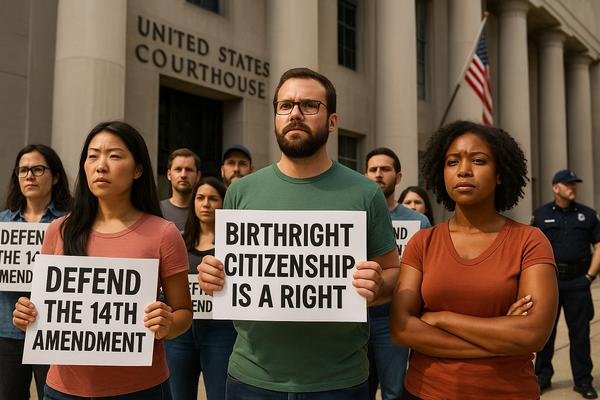
The Trump Birthright Citizenship Ban, they argued, would have disenfranchised thousands of children born in the U.S. and risked creating a generation of stateless minors. The ACLU emphasized that the outcome was not just a legal triumph but a moral one, preserving the principle that citizenship is a birthright, not a privilege.
Legal groups across the United States have pledged to continue monitoring executive actions that threaten civil rights. Many are now pushing for Congressional legislation that would explicitly reaffirm birthright citizenship, ensuring it cannot be eroded by future administrations.
International Applause for U.S. Judiciary
Global reactions to the Trump Birthright Citizenship Ban ruling were overwhelmingly positive. The United Nations Human Rights Council (UNHRC) and Amnesty International both applauded the judgment, noting its consistency with international law on non-discrimination and statelessness prevention.
Amnesty’s U.S. Director, Paul O’Brien, described the verdict as “a beacon for nations struggling with xenophobia and populism.” He added that the decision repositions the U.S. as a model for upholding human rights in constitutional democracies.
External Link: Amnesty International’s Position
In Latin America, where similar debates about citizenship-by-birth have emerged, legal scholars cited the U.S. court’s ruling as a model precedent for protecting inclusive citizenship. European academics similarly pointed to the verdict as an example of judicial resilience in an era of political polarization.
This global recognition underscores how the Trump Birthright Citizenship Ban decision has transcended domestic politics, shaping international conversations about democracy and constitutionalism.
A Turning Point for U.S. Immigration Law
From a policy standpoint, the defeat of the Trump Birthright Citizenship Ban signals a turning point for immigration law in the United States. The decision effectively restricts future presidents from issuing immigration-related executive orders that contradict constitutional text.
Policy experts suggest that the ruling will reinvigorate calls for comprehensive immigration reform through bipartisan legislation, focusing on pathways to citizenship, visa modernization, and humane enforcement.
It also sets a judicial boundary against excessive executive interference in individual rights — a principle likely to influence cases involving surveillance, digital privacy, and reproductive freedom in the years ahead.
The verdict not only restores constitutional balance but also reinforces public trust in judicial institutions at a time when American democracy faces deep ideological division.
Constitutional Clarity Restored
The overturning of the Trump Birthright Citizenship Ban is more than a judicial ruling — it is a moral and constitutional milestone. By upholding the 14th Amendment, the U.S. Court of Appeals has restored the principle that citizenship, once conferred by birth, cannot be revoked or redefined through political expediency.
For many, this case represents the resilience of the American Constitution — a document that continues to shield individuals from the excesses of power. As the nation heads toward a new election season, the ruling stands as a resounding reminder: in the United States, the Constitution remains the ultimate law of the land.
Internal Links
- Nigeria Hunger Crisis: UN Warns of Aid Collapse
- UK Immigration Rules 2025
- NPP Minority Budget Walkout
Related Story: Assam Muslim Evictions Crisis: 3,400 Families Left Homeless