Introduction
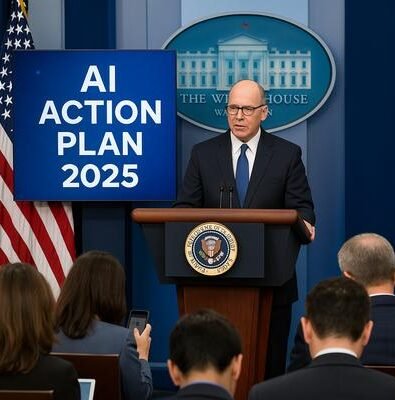
The White House AI Action Plan is a landmark strategy unveiled in July 2025, setting out over 90 coordinated federal actions to define the next chapter of artificial intelligence in the United States. By aligning innovation with regulation, the plan aims to make the U.S. a global AI superpower, strengthening ethical frameworks, research infrastructure, and economic competitiveness.
Its release marks a turning point in global tech policy — one that will influence how nations develop and deploy artificial intelligence for decades to come.
Background: America’s AI Leadership Crossroads
For years, the United States has been both a pioneer and a cautious regulator of AI. Tech giants like Google, Microsoft, and OpenAI have led breakthroughs, yet fragmented federal oversight often created friction for startups and institutions.
The White House AI Action Plan brings much-needed coherence by consolidating oversight across 15 federal agencies, including the Department of Commerce, FDA, Department of Labor, and the Office of Science and Technology Policy (OSTP).
At its core, the plan represents a national commitment to responsible innovation, balancing safety with progress and ensuring that AI benefits every sector — from health and defense to education and manufacturing.
1️⃣ Removing Regulatory Barriers for AI Development
The White House AI Action Plan launches a sweeping deregulation effort to empower innovators. Each participating agency must publish updated AI frameworks by Q4 2025, ensuring uniform national standards.
Key reforms include:
- FDA fast-tracks for AI-driven diagnostics and medical imaging.
- FTC guidelines on ethical algorithm use.
- Labor Department protocols for transparent AI-based hiring.
Importantly, the plan introduces AI sandbox environments, allowing startups to test systems without immediate legal exposure. These controlled zones mirror global best practices and could make the U.S. a safer, faster place for AI innovation.
2️⃣ Building National AI Infrastructure
The White House AI Action Plan earmarks billions to expand the nation’s AI backbone. Its flagship initiative — the National AI Research Resource (NAIRR) — will receive $4.2 billion to provide cloud-based compute access and shared data resources to underserved institutions.
Beneficiaries include:
- Historically Black Colleges and Minority Institutions
- Public research universities and community colleges
- Small and mid-sized AI startups
The plan also calls for standardized data-sharing frameworks across healthcare, education, and defense, ensuring interoperability and cybersecurity in federally funded AI projects.
3️⃣ Workforce Upskilling and AI Job Access
A major pillar of the White House AI Action Plan is workforce inclusion. The Department of Labor will fund 250,000 AI training grants annually between 2025 and 2027, partnering with community colleges and bootcamps to prepare Americans for AI-driven jobs.
The focus is on equipping workers in logistics, healthcare, and manufacturing with AI literacy and coding skills. The plan also emphasizes diversity, providing special grants for veterans, women in STEM, and mid-career professionals.
By creating clear reskilling pathways, the plan ensures that AI enhances — rather than replaces — human labor.
4️⃣ Ethical Guardrails for AI Safety
At the ethical core of the White House AI Action Plan is the establishment of a Federal AI Ethics Board — a watchdog body that will vet all high-risk AI tools used in law enforcement, defense, and public administration.
Priority areas include:
- Facial recognition systems
- Predictive sentencing tools
- Autonomous military technologies
These guidelines aim to reduce bias, improve transparency, and ensure that AI development aligns with human rights. The plan draws inspiration from Europe’s AI Act, but with a stronger focus on public accountability.
5️⃣ Promoting AI Research and Education
Education remains central to the White House AI Action Plan, with over $900 million allocated to expanding AI literacy and research.
Initiatives include:
- AI Labs of the Future in every U.S. state by 2026
- AI fellowships and student exchange programs
- Nationwide AI curricula for K–12 schools
These efforts aim to democratize access to advanced learning and ensure that America’s youth become future-ready AI innovators.
6️⃣ International AI Diplomacy
The White House AI Action Plan extends its influence abroad by promoting a Global AI Bill of Ethics in collaboration with the EU, Japan, South Korea, and the Africa AI Alliance.
This global partnership focuses on harmonizing rules for:
- Data governance and privacy
- Algorithmic fairness
- AI security in cross-border systems
Through diplomacy, the U.S. seeks to establish shared ethical norms and position itself as a stabilizing force in the evolving AI geopolitics landscape.
7️⃣ Reforming Federal AI Procurement
The White House AI Action Plan also modernizes how the U.S. government acquires emerging technology. A $2.5 billion Federal AI Marketplace will open new opportunities for certified ethical AI vendors.
This marketplace will:
- Streamline procurement for AI startups
- Ensure transparency in government contracts
- Encourage domestic innovation over imports
It’s a forward-looking model that could inspire governments worldwide to adopt AI responsibly while boosting local entrepreneurship.
Expert Reactions and Industry Analysis
Experts across academia and industry praise the White House AI Action Plan as a milestone for the U.S. technology sector.
“This framework finally unites innovation with accountability,” says Dr. Amy Zhang of MIT. “It provides clarity for developers and reassurance for citizens.”
Investors, too, view it as a green light for responsible AI growth. Analysts estimate that the plan could unlock billions in private capital, strengthening America’s position in the global AI race.
Global and Local Implications
The White House AI Action Plan is already influencing other nations. India, Ghana, and Germany are reviewing its framework as a model for national AI governance.
Globally, it signals that ethical AI and innovation can coexist — and that U.S. leadership in AI is far from over.
Conclusion
The White House AI Action Plan is more than a domestic blueprint — it’s a global manifesto for responsible AI. Combining ethics, innovation, and international collaboration, it positions the U.S. at the forefront of the AI era.
As implementation unfolds, the world will closely observe how America balances technological ambition with human values — a test that will define the digital century ahead.
🔗 Internal Links (GSN)
- Elon Musk Apple lawsuit: xAI to sue over App Store ranking
- AI Antibiotic Breakthrough: New Solutions for Gonorrhoea & MRSA