A Controversial Blueprint for the AI Age
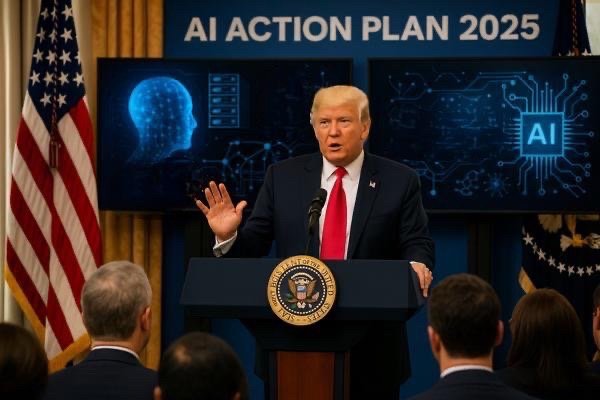
The Trump AI Action Plan has ignited intense debate worldwide after the White House unveiled it on July 25, 2025. The strategy outlines over 90 federal actions intended to redefine how the United States governs, develops, and deploys artificial intelligence.
At its core, the initiative merges strict ideological controls, massive infrastructure investments, and expanded global exports — signaling a new era in how Washington intends to lead the AI revolution.
America’s Strategic Pivot in Artificial Intelligence
Artificial intelligence has become the world’s most valuable strategic asset, influencing warfare, education, healthcare, and the economy.
For years, U.S. administrations have tried to balance innovation with ethics. Previous policies centered on transparency and human-rights safeguards, but the Trump AI Action Plan takes a different approach — prioritizing American dominance and ideological neutrality over consensus.
According to senior officials, the initiative unifies 15 federal agencies, including the Departments of Commerce and Defense, creating a single national AI framework. Analysts compare this centralization to the Space Race—only this time, the competition is fought with algorithms and chips.
Internal Link: White House Releases AI Action Plan)
Regulating Ideology: The Ban on “Woke AI”
The most controversial element of the Trump AI Action Plan is the proposed federal ban on “woke AI.”
This rule would prevent any agency or contractor from using AI systems designed to enforce progressive social values on issues such as gender, race, or climate activism.
Supporters claim the measure protects neutrality and freedom of speech. Critics, however, call it a form of digital censorship, arguing that removing ethical parameters risks reinforcing bias rather than reducing it.
Civil-rights advocates have already petitioned Congress to review the legality of such a ban, warning it could echo early internet speech restrictions.
External Link: TechCrunch – AI Bias and Regulation
Building the Digital Backbone: Expanding U.S. AI Infrastructure
Another key pillar of the Trump AI Action Plan is a historic expansion of AI infrastructure across the United States.
The government plans billions in incentives for data centers, semiconductor plants, and AI-ready cloud networks.
Tech leaders including NVIDIA, Oracle, and Microsoft have already pledged cooperation. Companies meeting federal standards will receive tax credits and fast-tracked permits, particularly for new “AI clusters” in the Midwest—an area dubbed America’s emerging “Silicon Heartland.”
Economists estimate this could generate 250,000 jobs over ten years. Environmental experts, however, warn that without renewable energy scaling, AI’s growing data demand could increase national electricity consumption by 15 percent.
External Link: Microsoft AI Infrastructure
Internal Link: Meta Invests in AI Data Centers)
Exporting Intelligence: America’s New Tech Diplomacy
The Trump AI Action Plan also launches an AI export acceleration program designed to project U.S. influence abroad.
Under this system, export licenses will be streamlined for allied nations—Japan, South Korea, Israel, and the U.K.—while embargoes tighten on China, Russia, and Iran.
The Department of Commerce says the reform will speed shipments of AI chips, robotics, and language models to “trusted partners,” mirroring Cold War-era tech alliances.
Analysts caution, though, that it may widen the global AI divide, leaving developing nations behind and fueling competition rather than collaboration.
External Link: New York Times – U.S. AI Export Controls
Securing Borders and Data: AI in National Security
Security is another focal point of the Trump AI Action Plan.
It calls for enhanced AI-powered surveillance across borders, prisons, and military operations.
Federal agencies will use machine learning to monitor drones, detect illegal crossings, and predict high-risk crime zones.
Advocacy groups like the Electronic Frontier Foundation (EFF) warn these technologies could enable mass surveillance and erode privacy rights.
The administration defends the approach as essential to combating terrorism, human trafficking, and cybercrime.
Military strategists suggest it could accelerate the Pentagon’s AI-driven modernization, improving battlefield logistics and situational awareness.
External Link: EFF – Surveillance Concerns
Preparing Public Servants: Federal AI Workforce Training
To close the public-sector skills gap, the Trump AI Action Plan introduces mandatory AI literacy programs for all government employees.
Beginning in 2026, civil servants will complete modules on machine learning fundamentals, data ethics, and cybersecurity risks.
The Office of Personnel Management, working with AI.gov, aims to create a culture of technological competence within the federal workforce.
Experts say this initiative could align government capacity with private-sector innovation, ensuring that future AI regulations are informed by technical understanding rather than political rhetoric.
External Link: AI.gov – Workforce Initiative
Policy Analysis: Balancing Innovation and Ideology
Analysts describe the Trump AI Action Plan as a hybrid of technological ambition and ideological control.
Its critics view it as AI protectionism that could limit international collaboration, while supporters hail it as a patriotic framework safeguarding U.S. interests.
The plan’s rejection of “values-based AI” contrasts sharply with the European Union’s rights-centric model. Yet its heavy investment in infrastructure and training could keep the United States at the forefront of AI leadership.
Ultimately, the plan reframes AI as not merely a scientific tool but a strategic instrument of national power.