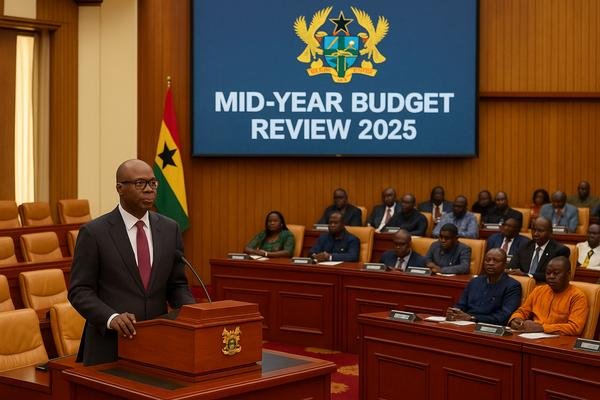
The NPP Minority Budget Walkout of July 25, 2025, remains one of Ghana’s most defining political moments in recent years. Moments before Finance Minister Dr. Cassiel Ato Forson began delivering the mid-year budget review, the NPP Minority caucus staged a dramatic exit from Parliament in protest. The walkout was triggered by allegations of state-sponsored intimidation and electoral violence during the Ablekuma North by-election, an episode that has since raised serious concerns about Ghana’s democratic stability ahead of the 2026 general elections.
The NPP Minority Budget Walkout not only disrupted a key national event but also deepened divisions within Parliament, reflecting broader discontent with the government’s approach to governance, security, and accountability.
Political Tensions Before the NPP Minority Budget Walkout
In the weeks leading to the NPP Minority Budget Walkout, tensions had escalated following violent incidents in the Ablekuma North by-election. The re-run, ordered after reports of irregularities, was marred by allegations of police brutality, ballot-box theft, and intimidation of polling agents.
Minority Leader Osei Kyei-Mensah-Bonsu accused the government of “weaponizing state institutions against its opponents.” The caucus argued that their walkout was not an act of defiance but a principled stand for democracy and the rule of law.
Political historians note that Ghana’s Parliament has seen similar moments of dissent before, but the NPP Minority Budget Walkout stands out for its timing—occurring just as the Finance Minister was about to present crucial economic updates amid IMF program implementation. The gesture signaled how political polarization now directly intersects with fiscal policymaking.
1. Parliamentary Protest Against Electoral Irregularities
The NPP Minority Budget Walkout was chiefly a response to what opposition MPs described as “unprecedented electoral misconduct” in Ablekuma North. According to reports from independent monitors, some polling stations experienced interference from uniformed officers, raising suspicions of political bias.
Speaking on the floor before the walkout, Kyei-Mensah-Bonsu declared:
“Our democracy is under siege when state power is used to intimidate voters. The NPP Minority Budget Walkout is a message to the nation that we will not endorse injustice.”
The caucus called on the Electoral Commission of Ghana, civil society, and international observers to intervene to prevent further deterioration of democratic norms.
External Link: Electoral Commission of Ghana
2. Finance Minister Proceeds Despite Empty Opposition Benches
Despite the tension, Finance Minister Dr. Cassiel Ato Forson went ahead with his mid-year budget presentation in the absence of the opposition. His speech, delivered to a half-empty chamber, emphasized macroeconomic progress, including inflation control, debt restructuring, and renewed engagement with global creditors under the IMF Extended Credit Facility.
Dr. Forson stated confidently,
“Ghana is back on the international scene, regaining trust through fiscal discipline and economic reforms.”
Yet, the NPP Minority Budget Walkout left a visible void in the chamber, symbolizing political division at a time when national unity was needed most. Some analysts argued that proceeding without bipartisan engagement undermined the spirit of parliamentary accountability.
External Link: IMF – Ghana Program
3. Economic Outlook and Policy Commitments Under Scrutiny
In his address, Dr. Forson projected a 4.2% GDP growth rate for 2025 and a fiscal deficit cap of 7.5%, pledging to strengthen domestic revenue mobilization through tax reforms and digital payment systems.
However, economists expressed skepticism. Some warned that the optimistic outlook ignored ongoing challenges such as sluggish exports, high debt servicing costs, and weak private-sector expansion.
Dr. Priscilla Mensah, a lecturer in Development Economics at the University of Ghana, noted that “the NPP Minority Budget Walkout drew attention to a deeper issue: the credibility of Ghana’s fiscal projections amid political uncertainty.”
Her analysis reflects broader investor concerns that political tensions could affect macroeconomic stability and investor sentiment, especially as Ghana works to rebuild confidence after its 2022 debt crisis.
External Link: World Bank Ghana Overview
4. Mixed Reactions from Civil Society and the Public
The NPP Minority Budget Walkout triggered nationwide debate across traditional and social media. While many Ghanaians commended the Minority for standing up for electoral justice, others criticized the timing of their protest during an important fiscal address.
Civil society organizations such as CDD-Ghana and the African Election Observers Network released statements calling for restraint and transparency. CDD-Ghana urged the government to commission an independent investigation into electoral violence allegations, warning that “failure to act decisively will erode trust in Ghana’s democratic processes.”
Meanwhile, hashtags like #BudgetWalkoutGH and #AblekumaNorthViolence trended for days on X (formerly Twitter), reflecting both public frustration and support. Some users saw the event as a wake-up call to address democratic backsliding, while others urged collaboration between parties to focus on Ghana’s economic recovery.
External Link: CDD-Ghana Reports
5. Broader Political and Diplomatic Implications
Beyond domestic politics, the NPP Minority Budget Walkout drew attention from diplomatic missions in Accra, including the EU Delegation and the U.S. Embassy, both of which emphasized the need for peaceful political engagement ahead of the 2026 elections.
Observers note that Ghana’s reputation as a model democracy in West Africa could be at stake if political tensions continue to escalate. The United Nations, ECOWAS, and the African Union are all expected to play monitoring roles in future electoral exercises to ensure fairness and transparency.
Dr. Kobby Mensah, a political communication expert, remarked:
“The NPP Minority Budget Walkout may prove to be a defining test of Ghana’s democratic maturity. How the government responds will shape international perceptions of its commitment to political tolerance.”
External Link: United Nations Electoral Assistance
Analysis: What the Walkout Means for Ghana’s Governance
The NPP Minority Budget Walkout underscores growing friction between governance and democratic accountability. It has exposed cracks within Ghana’s political establishment—where the line between executive influence and parliamentary independence appears increasingly blurred.
Analysts argue that such walkouts, while disruptive, remain a legitimate tool of protest in parliamentary democracy. They serve to dramatize dissent and draw public attention to institutional weaknesses. Yet, the frequency of these incidents also highlights a deeper problem: an erosion of dialogue between the majority and minority benches.
In an editorial published by Global Standard News, analysts emphasized that unless reforms in electoral management, policing conduct, and parliamentary transparency are implemented, Ghana risks losing its democratic edge.
Global and Local Economic Ramifications
The NPP Minority Budget Walkout also carries economic implications. Investor confidence often hinges on political stability, and Ghana’s recent volatility could deter capital inflows. Foreign partners such as the IMF and World Bank are likely to monitor these developments closely when evaluating disbursement schedules and program compliance.
Domestically, the walkout has reignited debate over priorities: citizens are demanding that leaders focus on inflation control, youth employment, and cost of living instead of political theatrics. Analysts warn that prolonged partisanship could slow down the legislative approval of key economic policies, including tax incentives and public spending frameworks critical to recovery.
Conclusion: A Defining Moment for Ghana’s Fourth Republic
The NPP Minority Budget Walkout of July 25, 2025, will remain a historic moment in Ghana’s Fourth Republic—a moment that captured the clash between politics and principle. As the 2026 elections approach, this event serves as both a caution and a call to action: for government to protect democratic institutions, and for the opposition to engage constructively in parliamentary discourse.
In the end, the future of Ghana’s democracy depends on restoring trust—between citizens, Parliament, and the state. The NPP Minority Budget Walkout may have been a single day’s protest, but its echoes will shape the nation’s political conscience for years to come.