Introduction: A Nation on the Edge of Famine
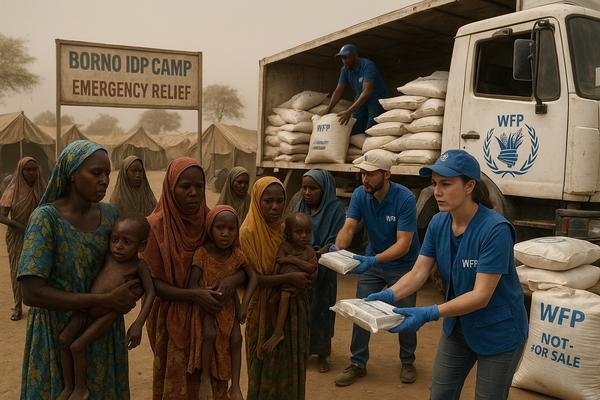
The Nigeria Hunger Crisis has entered an unprecedented phase of humanitarian emergency. On July 25, 2025, the United Nations World Food Programme (WFP) announced the suspension of emergency food and nutrition assistance to 1.3 million people across northeast Nigeria due to an acute funding shortfall. The decision pushes an estimated 31 million Nigerians toward starvation, cementing this as one of West Africa’s worst food crises in decades.
Context and Causes: Conflict, Climate, and Chronic Instability
The Hunger Crisis is the cumulative outcome of years of compounding shocks. For over a decade, violent insurgencies led by Boko Haram and the Islamic State West Africa Province (ISWAP) have devastated communities, destroyed infrastructure, and displaced millions.
Intensifying climate shocks—including repeated droughts, flash floods, and unpredictable rainfall—have further eroded livelihoods in the Lake Chad Basin, where agriculture sustains over 80% of the population.
According to the UN Office for the Coordination of Humanitarian Affairs (OCHA), more than 5.5 million people in Borno, Yobe, and Adamawa States rely entirely on aid. However, humanitarian financing has dropped by nearly 45%since 2023, forcing agencies to downscale life-saving operations.
Critical Shortfall: WFP Suspends Aid for 1.3 Million Nigerians
The WFP’s funding depletion has had devastating effects. Food distributions have ceased across internally displaced persons (IDP) camps in Bama, Dikwa, and Mafa, leaving thousands of families without daily meals.
In Borno State, reliance on aid is absolute. “We have no farms, no jobs, and no markets,” said Fatima Musa, a widow displaced by insurgent attacks. “Without WFP food, we starve.”
David Stevenson, WFP Country Director for Nigeria, stated:
“We are prioritizing children, pregnant women, and the elderly, but the gaps are enormous. Without immediate funding, millions more will slip into hunger.”
The suspension marks a grim milestone in the Hunger Crisis, reflecting the global decline in donor funding amid competing emergencies in Gaza, Sudan, and Ukraine.
Funding Appeal: UN Seeks $130 Million to Prevent Collapse
The United Nations and partner agencies have launched an urgent $130 million appeal to sustain food and nutrition programs through the end of 2025. Without this, OCHA warns, food pipelines across the northeast could collapse entirely by November 2025, triggering widespread famine conditions.
Mohamed Malick Fall, UN Resident and Humanitarian Coordinator for Nigeria, cautioned:
“We are running out of time. The cost of inaction will be measured in human lives.”
To date, less than 40% of the 2025 Nigeria Humanitarian Response Plan has been funded. While donors such as USAID, the European Union, and the UK’s FCDO remain engaged, shifting global priorities have left Nigeria’s hunger crisis dangerously underfunded.
Insecurity and Displacement: The Human Toll of Conflict
Persistent violence remains the primary driver of the Hunger Crisis. Recent extremist attacks in Konduga, Gwoza, and Damboa have displaced over 25,000 people, adding to the 3 million already uprooted by years of conflict.
Insurgents frequently torch farmlands, seize grain stores, and block trade routes. The price of staple foods like maize and millet has surged by 60% in Borno and Yobe States. Transporting goods between towns now costs twice as much due to fuel shortages and armed roadblocks.
“This is not only a humanitarian emergency—it’s an economic meltdown,” explained Dr. Hassan Usman, agricultural economist at the University of Maiduguri. “Without secure access to land and trade, no recovery is possible.”
Health Emergency: Malnutrition Among Children Soars
Healthcare systems in the northeast are overwhelmed. More than 300,000 children under five in Borno State are now acutely malnourished, many suffering from severe wasting and related infections.
Frontline workers report clinics struggling to manage cases. “We’re seeing toddlers too weak to stand,” said Aisha Garba, a nurse in Maiduguri. “Mothers mix flour with water just to keep their children alive.”
The UNICEF Nutrition Cluster estimates that up to 2 million children could face life-threatening malnutrition by year’s end. Supplies of therapeutic food and vaccines are running low, while insecurity limits outreach in remote communities.
Economic Fallout and Social Strain
Beyond immediate hunger, the Nigeria Hunger Crisis carries long-term socioeconomic consequences. Economists project that persistent food insecurity could shave 1.5% off GDP growth in 2025. As livelihoods vanish, migration to urban centers and neighboring countries is accelerating.
Experts warn that hunger is fueling recruitment into armed groups. “When hunger becomes a weapon, conflict becomes inevitable,” said Professor Abubakar Monguno, a conflict analyst. “Extremists exploit desperation by offering food, protection, and belonging.”
Regional Dimensions: A Threat to West African Stability
The Nigeria Hunger Crisis reverberates far beyond its borders. West Africa already faces one of the world’s fastest-growing displacement rates, with over 10 million refugees and IDPs across the Sahel.
“If Nigeria falls deeper into famine, it will destabilize the region,” warned Chris Nikoi, WFP Regional Director for West Africa. Neighboring Niger, Chad, and Cameroon—already battling food insecurity—lack the capacity to absorb another wave of refugees.
In response, ECOWAS and the African Development Bank (AfDB) are advancing long-term strategies including climate-smart farming, water management systems, and regional grain reserves to strengthen resilience.
Root Causes and Structural Challenges
At its core, the Nigeria Hunger Crisis exposes a chronic disconnect between short-term humanitarian relief and long-term development planning. Emergency food aid, while essential, cannot replace sustained investment in agriculture, irrigation, infrastructure, and governance.
Systemic corruption and weak policy enforcement continue to undermine trust among international donors. In 2024, auditors discovered that $7 million in agricultural recovery funds for Borno State went missing.
“The humanitarian system can only do so much,” said Dr. Ngozi Ekeoma of the Centre for Humanitarian Studies. “Without accountability and sustainable rural investment, the crisis will repeat itself year after year.”
Reactions and Diplomatic Mobilization
Civil society organizations and faith-based groups have intensified calls for urgent action. Caritas Nigeria, Oxfam, and ActionAid have jointly urged the federal government to declare a national hunger emergency.
The Nigerian Red Cross expressed “deep concern” over the deteriorating situation and appealed for unrestricted humanitarian access. Meanwhile, President Bola Ahmed Tinubu has directed the Ministry of Humanitarian Affairs to convene an emergency donor conference in Abuja.
However, humanitarian groups caution that promises must be matched with speed. “Every delay costs lives,” said Yemi Adesina, spokesperson for OCHA Nigeria.
Outlook: A Race Against Time to Avert Famine
The Nigeria Hunger Crisis now stands as a defining test of both domestic governance and international solidarity. With 31 million Nigerians facing acute hunger, the window for action is rapidly closing.
“Hunger should never be politicized,” said Mohamed Malick Fall. “The lives of millions depend on what we do in the next few weeks.”
If immediate funding and coordinated response fail to materialize, experts warn that the Nigeria Hunger Crisis could evolve into one of the deadliest famines of the 21st century.