A Diplomatic Rift Reopened
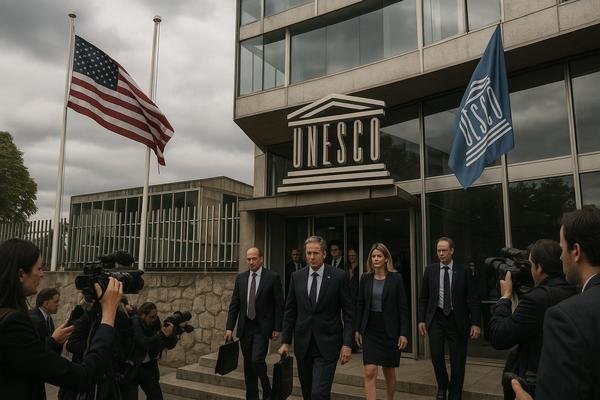
On July 21, 2025, the US withdraws from UNESCO again—marking its second full exit and reigniting a decades-long debate over America’s commitment to multilateral cultural diplomacy. The administration cited “irreparable ideological influence” within the United Nations Educational, Scientific and Cultural Organization (UNESCO). Supporters described it as a principled stance; critics warned it risks isolating the U.S. from global institutions that shape education, heritage preservation, and scientific cooperation.
Historical Context: A Fractured Partnership Revisited
The US withdraws from UNESCO decision represents the latest chapter in a volatile four-decade relationship defined by alternating periods of engagement and withdrawal.
- 1984: President Ronald Reagan led the first withdrawal, alleging mismanagement and anti-Western bias.
- 2003: President George W. Bush rejoined after governance reforms.
- 2011: Congress suspended funding after UNESCO admitted Palestine as a full member.
- 2017: President Donald Trump again pulled out, citing anti-Israel resolutions.
- 2023: President Joe Biden restored membership, emphasizing reform and arrears repayment.
- 2025: President Jonathan Greene’s administration announced that the US withdraws from UNESCO once more, citing ideological drift and financial inefficiency.
Each departure diminishes U.S. influence in UNESCO’s decision-making processes and creates openings for geopolitical rivals to expand their presence.
Global Reactions: Allies, Rivals, and Institutions Respond
UNESCO Appeals for Reconsideration
Director-General Audrey Azoulay expressed deep regret over the decision, urging Washington to “reaffirm its long-standing leadership in education and culture.” She warned that critical projects—especially those involving disaster-risk mapping and digital heritage archives—could slow significantly without U.S. technical input.
European Diplomats Denounce the Exit
France and Germany jointly described the move as “short-sighted and divisive,” arguing that global cooperation depends on sustained U.S. participation. Officials cautioned that because the US withdraws from UNESCO, countries with more strategic or ideological motives—such as China and Russia—may dominate policy debates.
China Steps Forward
China quickly framed the US withdraws from UNESCO step as “an abdication of international responsibility.” Beijing pledged increased funding for education technology and cultural preservation programs, signaling its readiness to fill the leadership vacuum and expand its soft-power influence.
U.S. Scholars and Institutions Raise Alarm
American universities, museums, and research bodies warned that long-standing partnerships under UNESCO’s educational chairs and fellowships could collapse. The Smithsonian Institution and Harvard’s Belfer Center noted potential barriers to joint archaeological work and scientific data sharing.
Mixed Reactions from the Middle East
While Israel welcomed the move—citing persistent bias in heritage resolutions—Jordan and Egypt urged renewed dialogue, emphasizing regional cooperation in protecting ancient and religious sites.
Financial Fallout: UNESCO Faces a 22% Budget Deficit
Because the US withdraws from UNESCO, the organization loses a funding share historically amounting to up to 22 percent of its regular budget. The resulting gap has immediate and far-reaching effects:
- Postponed field missions in fragile heritage zones.
- Delays in global literacy and teacher-training initiatives.
- Deferred upgrades to tsunami and earthquake early-warning systems.
- Administrative hiring freezes in UNESCO’s regional offices.
Even if new donors emerge, non-governmental organizations warn of a months-long shortfall that could disrupt continuity, particularly in developing and conflict-affected regions.
Sectoral Impacts: Education, Science, and Culture Under Strain
Educational Cooperation Weakens
American educators have historically contributed to UNESCO’s “Education for Sustainable Development” agenda. With the US withdraws from UNESCO decision, U.S. policymakers may lose leverage over international curriculum design, allowing competing frameworks from the EU and China to dominate.
Scientific Collaboration Slows
U.S. agencies such as NOAA and USGS have relied on UNESCO-affiliated networks for marine research and open-data exchange. The absence of American participation will likely constrain cooperation on oceanography, seismology, and climate modeling.
Cultural Heritage at Risk
Institutions overseeing sites like Yellowstone, Mesa Verde, and Statue of Liberty benefit from UNESCO restoration funding and technical expertise. As the US withdraws from UNESCO posture continues, access to those emergency resources could diminish.
Media Literacy and Press Freedom Programs
UNESCO’s global journalism and media-ethics initiatives—frequently adopted by U.S. universities—may experience declining use, potentially weakening international collaboration on combating disinformation and digital manipulation.
Analytical Insight: Strategic Costs of Disengagement
Founded in 1945, UNESCO’s core mission is to advance peace through education, culture, science, and communication. By choosing withdrawal, the United States forfeits influence over international norms in areas such as AI governance, cultural restitution, and climate education.
Analysts emphasize that each time the US withdraws from UNESCO, Washington yields ideological and diplomatic space to emerging powers. China, with its expanding digital-heritage programs, and the European Union, through standardized education frameworks, are rapidly assuming the roles the U.S. once held.
Domestic Debate: Sovereignty Versus Engagement
Within the United States, the US withdraws from UNESCO policy has intensified political division.
- Proponents argue the move reinforces sovereignty, prevents taxpayer waste, and challenges “anti-American” sentiment in multilateral bodies.
“America must not bankroll bias,” said Senator Lisa Montgomery (R-TX). - Opponents insist that disengagement weakens U.S. leadership at a time when global standards on technology, climate, and culture are being set elsewhere.
“Leaving the table doesn’t stop the conversation—it only stops us from speaking,” countered Representative Caleb James (D-NY).
Experts also note that UNESCO’s initiatives in digital literacy, STEM education, and misinformation prevention directly serve U.S. interests, making withdrawal a strategically costly gesture.
Global Dynamics: A Shifting Cultural Power Landscape
As the US withdraws from UNESCO, the global cultural balance tilts further toward new actors.
- China’s Belt and Road culture hubs are expanding partnerships across Asia and Africa through digital museum projects.
- The European Union’s Global Gateway initiative increasingly supports heritage preservation and media-literacy training—domains once dominated by U.S. programs.
This redistribution of influence reflects the broader realignment of power where cultural, economic, and digital diplomacy intertwine.
Outlook: Potential Pathways to Re-Engagement
Although the US withdraws from UNESCO policy is now active, previous precedents suggest eventual return scenarios:
- Observer Status – Limited participation without voting rights.
- Partial Re-Engagement – Voluntary support for select programs.
- Private Sector Partnerships – U.S. foundations financing aligned initiatives.
- Future Restoration – Full reinstatement by a subsequent administration.
For now, UNESCO operations continue but with a visibly reduced American presence and growing competition among alternative power centers.
Conclusion: The Cost of Absence
The US withdraws from UNESCO once again, but the decision’s long-term cost may exceed immediate political gains. Each retreat leaves a leadership void in global education, science, and cultural preservation. Whether this marks a temporary pause or a sustained disengagement will define not only UNESCO’s future—but America’s place in the architecture of global cooperation.