Moon Day 2025 commemorates one of humanity’s most defining achievements: the 1969 Apollo 11 mission, when Neil Armstrong and Buzz Aldrin walked on the lunar surface for the first time. More than half a century later, this annual celebration has evolved from a historical remembrance into a global movement promoting science, exploration, and imagination. With thousands of events across continents, Moon Day 2025 connects people of all ages to the past, present, and future of space exploration.
Why Moon Day Matters
Moon Day is observed every year on July 20 to honor the moment when humans first landed on the Moon. The Apollo 11 mission, led by NASA with astronauts Neil Armstrong, Buzz Aldrin, and command module pilot Michael Collins, changed our understanding of what humanity could achieve. Armstrong’s iconic words—“one small step for man, one giant leap for mankind”—still echo across generations.
In the decades that followed, space exploration expanded dramatically. Countries like China, India, and members of the European Space Agency have established advanced lunar programs. NASA’s return-to-the-moon initiative, the Artemis program, aims to send humans back to the lunar surface and eventually establish a sustainable presence.
Moon Day 2025 arrives at a critical moment as nations accelerate space exploration efforts, private companies expand lunar technologies, and global discussions intensify around space cooperation, planetary defense, and future missions to Mars. It is not just a commemoration—it is a reminder of how collective effort and innovation push humanity forward.
Current Developments: Global Activities Making Moon Day 2025 Unforgettable
1. NASA Broadcasts and Virtual Experiences
NASA is leading the global celebration of Moon Day 2025 with an immersive livestream event. The program includes:
- Original Apollo 11 archival footage
- Live discussions with retired astronauts and current Artemis mission engineers
- Behind-the-scenes tours of NASA facilities
- Virtual lunar simulations using interactive 3D environments
Thanks to improved streaming technology, millions across the world can participate. NASA also announced partnerships with YouTube, Twitch, and social learning platforms, making the Moon Day 2025 broadcast accessible to students and families globally.
2. Educational Workshops and Exhibits
Schools, universities, and science centers are marking Moon Day 2025 with hands-on educational programs. These include:
- Lunar geology workshops
- Exhibits on the history of the space race
- Interactive displays showing how space suits, rovers, and rockets evolved
- STEM challenges where students design mock lunar habitats
Major cities such as Washington D.C., Berlin, Tokyo, Nairobi, and São Paulo are hosting interactive moon-focused exhibitions, expected to draw thousands of visitors.
3. Community Stargazing Events
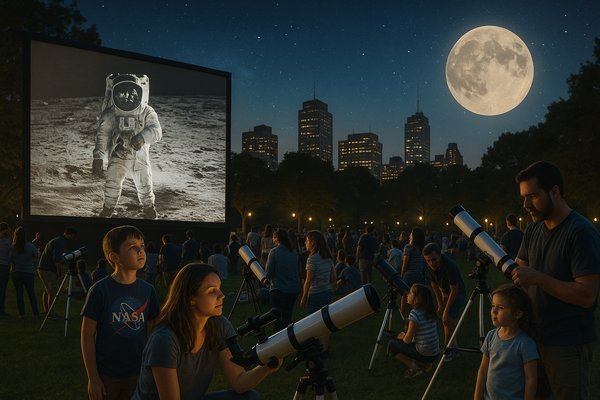
Perhaps the most popular celebration of Moon Day 2025 is the global wave of community stargazing parties. Astronomy clubs and observatories are organizing guided moon observations with high-powered telescopes. Experts will explain lunar phases, surface features, and the science behind future exploration.
In Accra, Cape Town, New York, and Sydney, stargazing events are expected to reach record attendance. Families, hobbyists, and photographers gather under the night sky to experience the Moon like never before.
4. Planetarium Shows Around the World
Planetariums worldwide—from London’s Royal Observatory to the Cape Town Planetarium—have prepared special Moon Day 2025 presentations. These new shows integrate:
- Immersive 360° projections
- Narrated journeys through the history of lunar exploration
- Previews of Artemis III and future lunar base concepts
- Real-time simulations of the Moon’s orbit and geology
The cutting-edge digital displays make lunar science accessible and visually striking for audiences of all ages.
5. Museum Collaborations and Moon Exhibits
Museums are unveiling exclusive Moon Day 2025 exhibits in collaboration with space agencies. Displays include:
- Actual moon rock samples
- Replicas of Apollo-era spacecraft
- Interactive robotic rover models
- Historical letters, photographs, and mission logs
Institutions such as the Smithsonian Air and Space Museum and the Science Museum in London have confirmed limited-time exhibits commemorating the Moon landing and the evolution of space technology.
6. Artistic and Cultural Celebrations
Moon Day 2025 is not only about science—it is also a global cultural event. Cities like Paris, Buenos Aires, Accra, and Seoul are hosting lunar-inspired festivals featuring:
- Concerts themed around the Moon
- Moon-themed street art installations
- Dance performances and interactive light shows
These events highlight how space continues to influence art, culture, and creativity.
7. Calls to Action for the Future of Space
Advocacy organizations and scientific institutions are using Moon Day 2025 to promote:
- Expanded STEM education
- Funding for space research
- International cooperation in lunar missions
- Public awareness on the future of space stations and Mars missions
Panels and conferences emphasize achieving long-term goals such as lunar settlements and Mars exploration.
What Moon Day 2025 Means for Humanity
(200–300 words)
Moon Day 2025 comes at a transformational moment for global space policy. Nations are reassessing space as a strategic domain, private spaceflight companies are growing rapidly, and interest in lunar resources is intensifying. This year’s celebrations symbolize more than nostalgia—they reflect a shift toward the next era of space exploration.
NASA’s Artemis program aims to land the first woman and first person of color on the Moon, signaling a new level of inclusivity in space missions. At the same time, China’s Chang’e program, India’s Chandrayaan missions, and Japan’s SLIM mission demonstrate rising international competition and collaboration.
The stargazing events and educational activities highlight the significant role public enthusiasm plays in shaping national space priorities. These programs inspire a new generation of scientists, engineers, and innovators. Moon Day 2025 thus fuels global conversations about space governance, sustainable lunar exploration, and the shared responsibility to advance science peacefully.
Reactions & Quotes
NASA Administrator Bill Nelson stated during the pre-event briefing:
“Moon Day 2025 is not only about looking back—it’s about preparing humanity for its next giant leap.”
ESA astronaut Samantha Cristoforetti emphasized global cooperation:
“The Moon belongs to all of us. Celebrating Moon Day 2025 reminds the world that space exploration is a shared human endeavor.”
Participants in community stargazing events echoed similar sentiments. A young astronomy student in Accra remarked:
“Seeing the Moon up close made me realize that space is not far away. It’s something we can all explore in our lifetimes.”
The widespread excitement captured on social media shows a renewed appetite for space exploration, science education, and international collaboration.
Global & Local Impact
(150–300 words)
Moon Day 2025 creates ripple effects far beyond celebration. Economically, renewed interest in space leads to growth in satellite technology, robotics, and STEM-based industries. Governments around the world are increasing investments in space infrastructure and scientific research, stimulated by public support highlighted during Moon Day events.
Educationally, workshops, planetarium shows, and museum exhibits inspire millions of young learners. The increased demand for STEM programs directly contributes to workforce development in fields such as aerospace engineering, programming, renewable energy, and artificial intelligence.
Culturally, Moon Day 2025 reinforces the Moon’s role as a symbol of unity and imagination. Artistic events blend science with creativity, showing that space exploration influences global culture just as much as technology.
For countries like Ghana, South Africa, India, and Brazil, Moon Day 2025 strengthens interest in local space initiatives, satellite development, and regional astronomy projects. The global celebration proves that space exploration is no longer limited to superpowers—it is a shared frontier for all nations.
Conclusion
Moon Day 2025 is more than a commemoration; it is a global awakening to the power of exploration, science, and human curiosity. As the world honors past achievements and looks toward future missions, Moon Day reinforces the message that humanity’s journey into space is just beginning. The legacy of Apollo 11 continues to inspire new generations to dream, innovate, and reach for the stars.
🔗 Internal & External Links
Internal:
External: