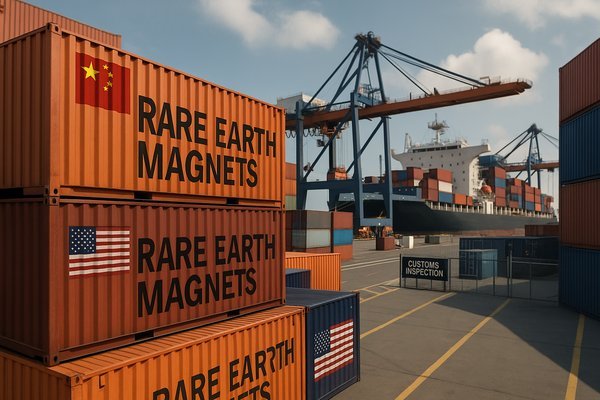
A Trade Shock That Turned Heads
In a stunning turn of events, China rare-earth exports to the United States surged by 660% in June 2025, rising from just 46 metric tons in May to 353 metric tons. The leap — one of the sharpest monthly increases ever recorded — has captivated global markets, policymakers, and economists alike, signaling both opportunity and uncertainty in a sector vital to modern technology.
The figures highlight how a single month of data can reshape trade dynamics in the global race for critical minerals and strategic influence.
Strategic Metals Powering the Modern World
Rare-earth elements (REEs) — including neodymium, praseodymium, and dysprosium — form the backbone of smartphones, electric vehicles (EVs), wind turbines, and military equipment. These metals enable miniaturization and efficiency in devices that define the 21st century.
For more than a decade, China rare-earth exports have dominated the supply chain, controlling roughly 60% of global mine output and over 85% of refining capacity. This control has given Beijing extraordinary leverage over industries from energy to defense. Trade restrictions imposed by China in past years often sparked panic buying and supply shortages in the West.
In response, Washington and its allies in Australia and Canada have sought to build independent processing chains. However, June’s data revealed that dependence on Beijing remains stubbornly entrenched — a reality underscored by this year’s dramatic surge in China rare-earth exports.
Diplomatic Thaw and Supply Shock
According to Reuters, customs data show that shipments to the U.S. jumped from 46 to 353 metric tons in June, marking a 660% month-over-month increase. Most of the cargo consisted of magnet-grade alloys used in electric motors and wind turbines.
Analysts trace this export boom to renewed diplomatic engagement under the Critical Minerals Framework Agreement, signed earlier this year to simplify licensing and customs clearance. The agreement appears to have unlocked a wave of pending orders and restored confidence among exporters.
Economists view the surge as a carefully timed signal of goodwill from Beijing ahead of the G20 Summit and as a market recalibration after months of trade tension.
Dr. Rachel Menendez of Georgetown University observed, “The 660% increase underscores how deeply the U.S. remains entangled in a China-centric rare-earth ecosystem.”
Analysis: Economic and Strategic Implications
China’s decision to expand exports so dramatically appears multifaceted.
1. Testing Global Demand and Pricing:
By temporarily flooding the market, Beijing can gauge how Western manufacturers react and how quickly inventories absorb surplus materials. Such data help China refine its pricing leverage in future negotiations.
2. Diplomatic Messaging:
The spike aligns with broader efforts to cool tensions with Washington and project a more cooperative stance on climate-linked supply chains. It also positions China as a responsible stakeholder amid Western efforts to “de-risk” without decoupling.
3. Industrial Strategy:
By exporting refined magnet alloys rather than raw ore, Beijing captures higher value while signaling its move up the manufacturing ladder — a key goal of its Made in China 2035 agenda.
For the United States, the temporary supply relief is welcome but problematic. It reinforces a long-term dependency on China rare-earth exports, making diversification both urgent and politically sensitive.
Reactions from Washington and Industry Leaders
Commerce Secretary Gina Raimondo called the spike “a wake-up call,” adding that it “reinforces the need for resilient domestic processing and refining capacity.”
Major U.S. manufacturers such as Tesla, General Motors, and Apple saw brief stock gains as magnet prices fell by 5%. However, traders remained cautious. Commodity analyst Andrew Lowe of Global Metals Watch warned that “the surge in China rare-earth exports could prove short-lived if Beijing tightens controls again once strategic objectives are met.”
Industry voices echo similar concerns: without stable policy signals from China, long-term pricing and investment remain volatile.
Global Ramifications: Allies React and Adjust
The impact of June’s export jump extends far beyond Washington. Japan, South Korea, and Australia, key U.S. allies in critical-minerals diversification, are re-evaluating their own stockpiles and supply agreements.
Australia’s Lynas Rare Earths and Canada’s Vital Metals may face short-term price competition but could benefit from new joint ventures with U.S. defense contractors. The Japanese government has already hinted at doubling its rare-earth reserves to cushion against future shocks.
Masaru Ito of Nikkei Business Daily described June’s surge as “a reset, not a reversal.” He noted that one month of high-volume China rare-earth exports will not derail the long-term goal of building independent supply chains among U.S. partners.
U.S. Counter-Moves: Building Self-Reliance
Washington’s push to reduce dependence on China rare-earth exports is already under way. The Defense Production Act and new Department of Energy grants fund projects by Lynas USA in Texas and MP Materials in California, both intended to create a closed-loop supply for EV and defense applications.
Experts estimate that if fully operational by 2030, these initiatives could trim U.S. reliance on Chinese sources by about 30%. Yet, given the scale of China’s refining dominance, complete independence remains a distant goal.
Market Outlook: Volatile but Vital
Following the June announcement, neodymium-iron-boron (NdFeB) magnet prices fell 5%, easing cost pressures for manufacturers but sparking debate over long-term sustainability. Traders expect continued volatility through late 2025 as markets digest the surge and watch for further policy signals from Beijing.
Some analysts predict that China may soon rebalance exports to prevent domestic shortages as its own EV and wind industries expand. Others believe the country will use rare-earth flows as a strategic tool in ongoing trade negotiations — a tactic consistent with its historical use of resource diplomacy.
A Calm Before the Next Storm
The 660% spike in China rare-earth exports to the United States represents more than just a trade anomaly — it signals a temporary detente in an intensifying strategic contest. While U.S. manufacturers enjoy short-term supply relief, the episode reinforces a stark truth: in the age of electrification and AI, control of rare-earth materials means control of technological power.
As markets stabilize, both sides are already preparing for the next phase of the race to secure the minerals that will define the future.
Internal:
- White House AI Action Plan: 7 Powerful Changes Shaping America’s Tech
- 2nm Semiconductor Breakthrough: 5 Big Tech Gains Coming Soon
External Links
- Reuters – China’s Rare-Earth Exports Soar 660%
- BBC – U.S. Moves to Cut China Dependence in Critical Minerals