Introduction: Britain Confronts a Crisis of Trust
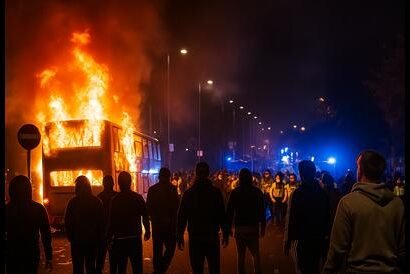
The Leeds child removal riot has sent shockwaves across the United Kingdom, forcing a national reckoning over how state institutions engage with minority communities. What began as a seemingly routine child-protection intervention in the Harehills district escalated within hours into one of Britain’s most intense public disturbances in years. Flames engulfed buses, police vehicles were overturned, and emergency responders faced violent crowds—turning a neighborhood into a flashpoint for social discontent.
The Spark: What Triggered the Leeds Child Removal Riot
Eyewitnesses recount that the Leeds child removal riot erupted when social services, accompanied by police, removed several Romani children from their family home without prior notice or explanation. For many in the community, the action felt abrupt, heavy-handed, and culturally insensitive. Videos circulating online showed distressed parents pleading as officers escorted children away—footage that rapidly went viral and ignited outrage both locally and nationally.
For Romani families long accustomed to marginalization, this event was not viewed in isolation but as part of a broader pattern of discrimination. Human-rights organizations such as Amnesty International UK and the Traveller Movementhave repeatedly criticized the lack of cultural training among child-protection officers handling sensitive family cases.
Escalation: From Peaceful Demonstration to Urban Chaos
What began as a small, emotional protest outside a Leeds social-services office quickly transformed into large-scale unrest. Within hours, crowds filled the streets of Harehills, chanting, blocking traffic, and confronting police cordons. Social media amplified calls to “stand up for our families,” accelerating what authorities later described as a spontaneous and uncontrolled uprising.
As tensions grew, sporadic violence erupted—storefronts were smashed, rubbish bins set ablaze, and makeshift barricades appeared on residential roads. According to West Yorkshire Police, at least 15 officers were injured and 12 individuals arrested during the Leeds child removal riot. Firefighters worked through the night to contain blazes, while local councillor Salma Arif urged residents to remain calm, reminding them that “healing cannot come through destruction.”
Official Reaction: Condemnation Without Accountability
Government officials swiftly condemned the violence, labeling it “unacceptable” and emphasizing the priority of public safety. However, critics argue that this response failed to confront the deeper grievances underlying the Leeds child removal riot. The Home Office refrained from commenting on whether child-protection protocols were followed appropriately, further fueling perceptions of evasion and insensitivity.
In Parliament, several MPs—including Alex Sobel of Leeds North West—demanded a transparent, independent review of the case. “Accountability is essential if trust is to be rebuilt,” Sobel stated. Advocacy groups likewise urged the government to examine how institutional biases and poor communication can escalate already-fragile community relations.
Societal Underpinnings: Lessons from the Leeds Child Removal Riot
Experts warn that the Leeds child removal riot exposes systemic weaknesses in Britain’s approach to multicultural governance. Sociologist Dr. Maya Sanders notes that similar unrest has occurred in European cities where minority communities perceive public institutions as unresponsive or discriminatory. “When families feel invisible or disrespected, enforcement actions become symbolic battles over dignity,” she explained.
Analysts emphasize that structural reforms are urgently needed. These include mandatory cultural-competency training for child-protection staff, community-liaison frameworks during sensitive interventions, and improved crisis-communication strategies. Without such reforms, observers fear the Leeds tragedy could serve as a grim template for future conflicts.
Public Sentiment: Empathy, Division, and Reflection
Reactions among Britons remain sharply divided. While many denounce the destruction, others express empathy for the pain that fueled it. “I don’t condone the rioting,” said a Harehills shopkeeper, “but I understand why people snapped—we’ve been ignored too long.”
On social media, hashtags such as #HarehillsRiot and #JusticeForTheChildren dominated national trends. Candlelight vigils were held in Leeds and Manchester, reflecting a blend of mourning and solidarity. Religious leaders from multiple faiths issued joint statements calling for reconciliation, while mental-health charities offered trauma support to affected families and first responders alike.
European Parallels: A Wider Pattern of Exclusion
The Leeds child removal riot is not an isolated episode. Across Europe, Romani and Traveller communities continue to face disproportionate interventions by social-welfare agencies. In Hungary, mass child removals from Romani settlements have drawn EU scrutiny, while in Slovakia, local councils have been accused of bypassing parental rights under vague welfare provisions.
According to Human Rights Watch, these recurring clashes underscore a lack of cultural literacy within social institutions. Analysts argue that the UK, as a mature democracy, must lead in establishing ethical standards that combine safeguarding with respect for cultural identity. If neglected, the consequences witnessed in Harehills could echo across borders.
Path Forward: Rebuilding Trust and Preventing Future Unrest
Experts and activists agree that preventing another Leeds child removal riot will require a shift from punitive oversight to participatory engagement. Community mediators have proposed creating a Romani Advisory Council to serve as a formal bridge between families and government agencies. Educational initiatives focusing on cultural awareness, translation support, and early-intervention communication could transform how authorities respond to crisis situations.
Grassroots organizations are also calling for a truth-and-reconciliation-style forum in Leeds to address grievances openly. “Acknowledgment is the first step to peace,” said community advocate Jelena Petrova. “If this tragedy leads to real reform, those nights of fear may yet yield a lesson in unity.”
Conclusion: Lessons for an Uneasy Nation
The Leeds child removal riot stands as a sobering reminder of the fragile line between protection and alienation. Beyond the broken glass and burned vehicles lies a deeper question: how can a modern democracy ensure both child safety and cultural respect? Britain’s answer will define not only its domestic harmony but also its reputation as a society committed to equality, justice, and human dignity.
🔗 Suggested Internal Links (GSN)
- British Soldiers Kenya Inquiry: Sex-Work Ban Breached at BATUK
- US Student Visa Ban: 6,000 Visas Revoked Over Crimes, Terror Links