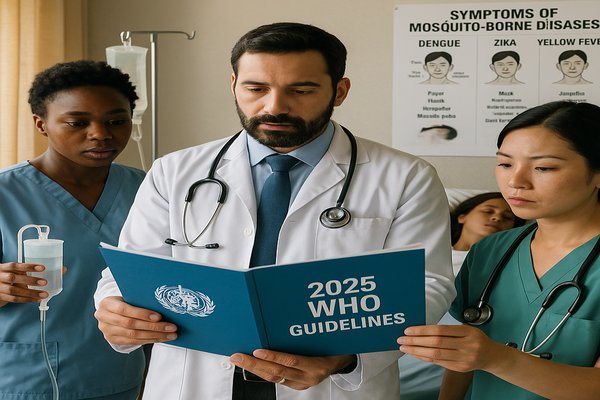
The WHO mosquito guidelines released in 2025 mark a historic shift in how doctors, nurses, and health workers approach mosquito-borne diseases. For the first time, the World Health Organization has created a unified clinical rulebook for dengue, chikungunya, Zika virus, and yellow fever—diseases that collectively affect billions of people each year. With the Aedes aegypti mosquito now thriving across nearly every tropical and subtropical region, the guidelines arrive at a critical time.
A Growing Global Health Emergency
Mosquito-borne illnesses are escalating at an alarming pace. Climate change has extended mosquito breeding seasons, rapid urbanization has created stagnant-water habitats, and global travel has made it easier for viruses to spread across continents. The numbers tell the story: in 2023, more than 4.2 million dengue infections were recorded worldwide, the highest on record. Outbreaks of chikungunya have surged in Asia and South America, while West and Central Africa remain highly vulnerable to yellow fever. Zika virus, though quieter since the 2016 epidemic, still threatens pregnant women in many parts of the world.
Until now, treatment practices varied widely from country to country. Some nations lacked clear guidelines, while others relied on outdated methods that risked worsening patient outcomes. The WHO mosquito guidelines 2025 are designed to replace this patchwork with a single, evidence-based standard.
What’s New in the WHO Mosquito Guidelines?
The new protocols emphasize supportive care, accurate diagnostics, and safe medication use. For dengue, WHO discourages the use of NSAIDs such as ibuprofen and aspirin due to bleeding risks and recommends intravenous fluid therapy for severe cases. Frequent blood monitoring is also stressed to detect early plasma leakage, a leading cause of death.
For chikungunya, the guidelines recommend acetaminophen for fever control and highlight the need for rehabilitation services to address the long-term joint pain that often follows infection.
In the case of Zika virus, particular attention is given to pregnant women. The guidelines call for immediate referral and recommend regular ultrasound monitoring to track fetal development, given the risk of congenital Zika syndrome.
For yellow fever, WHO reiterates that vaccination is the ultimate prevention tool but also underscores the importance of early supportive care when outbreaks occur.
To make these protocols actionable, WHO is rolling out field-ready tools such as flowcharts, checklists, and mobile apps. Simple hemoconcentration tests, which can be done even in under-resourced clinics, are recommended to guide life-saving decisions.
Why Standardized Care Matters
The new WHO mosquito guidelines address one of the biggest challenges in outbreak management: inconsistency. In past epidemics, frontline health workers often faced uncertainty over best practices, leading to dangerous delays or inappropriate treatments. Standardization ensures that whether a patient is in rural Brazil, urban Manila, or a clinic in West Africa, they will receive the same evidence-based care.
Dr. Soumya Swaminathan, WHO’s Chief Scientist, explained the urgency:
“We’re seeing explosive epidemics in regions previously unaffected. We need standard care protocols now more than ever.”
By setting a global standard, WHO is helping countries not only save lives but also build resilience into their health systems.
Real-World Reactions
The response to the guidelines has been swift. Governments in Brazil, India, and the Philippines have already signaled plans to integrate the recommendations into national policies. In Brazil, where dengue cases reached record levels in 2024, public health officials believe standardized IV therapy protocols could drastically reduce hospital overcrowding. In India, where chikungunya has re-emerged in major cities, rehabilitation guidance is seen as vital for reducing long-term disability.
On the frontlines, health workers welcome the clarity. Dr. Marisela Gómez, a WHO field coordinator in Colombia, noted:
“This makes the difference between life and death in remote areas.”
The U.S. Centers for Disease Control and Prevention (CDC) echoed WHO’s findings, publishing a parallel report that highlighted the same need for IV therapy in severe dengue cases and rapid recognition of early warning signs.
Regional Case Studies
In Latin America, countries like Peru and Colombia are grappling with back-to-back outbreaks of dengue and chikungunya. Here, the new WHO mosquito guidelines provide step-by-step checklists that rural clinics can use without advanced equipment.
In Africa, where yellow fever vaccination drives are already underway, the guidelines strengthen the case for sustained immunization campaigns. The Democratic Republic of Congo and Nigeria, which have faced recurring yellow fever emergencies, are expected to benefit from the dual focus on vaccination and supportive care.
In South Asia, the integration of Zika virus protocols is expected to enhance maternal care. Hospitals in India and Sri Lanka are preparing to train obstetric staff in early referral and ultrasound monitoring practices recommended by WHO.
Technology and Research
The guidelines also align with broader innovations in global health. Researchers are exploring genetically modified mosquitoes designed to reduce transmission, while AI-powered outbreak prediction tools are being developed to forecast hotspots before epidemics begin. WHO’s emphasis on digital checklists and mobile apps reflects this trend toward combining science with technology for real-world impact.
The Bigger Picture
The WHO mosquito guidelines fit into the larger fight against neglected tropical diseases (NTDs), which disproportionately affect low- and middle-income countries. By reducing hospitalizations and deaths, the guidelines free up scarce health resources to address other pressing issues.
Dr. Maria Van Kerkhove, WHO’s Technical Lead on Emerging Diseases, said:
“This guideline strengthens our framework for future outbreaks. We’re moving toward a more resilient health system.”
Prevention remains a cornerstone of the strategy. WHO continues to advise simple community-level measures:
- Wearing long-sleeved clothing.
- Using insect repellents containing DEET.
- Eliminating standing water around households.
- Supporting vaccination campaigns in high-risk areas.
Implications for Global Health
The adoption of the WHO mosquito guidelines could shape how the world responds to epidemics for decades. By encouraging nations to harmonize their responses, WHO hopes to avoid the fragmented and delayed interventions seen during past crises.
For communities at the epicenter of outbreaks, the message is clear: lifesaving treatment must reach patients faster, with fewer mistakes and more consistency. For governments, the challenge is implementation—ensuring training, resources, and monitoring reach even the most remote areas.
Final Outlook
The WHO mosquito guidelines 2025 are not just a medical framework—they are a public health milestone. With billions of people exposed to the growing reach of Aedes mosquitoes, the cost of inaction is too high. Standardized care, coupled with vaccination, vector control, and community prevention, offers a realistic path to reducing the burden of these diseases.
Governments, clinics, and health workers now face a crucial choice: adopt the new rules quickly and decisively, or risk falling behind in a battle where every delay costs lives.
For billions at risk, these guidelines are more than technical recommendations—they are a lifeline of survival and resilience in a warming, interconnected world.