A Shocking Security Breach
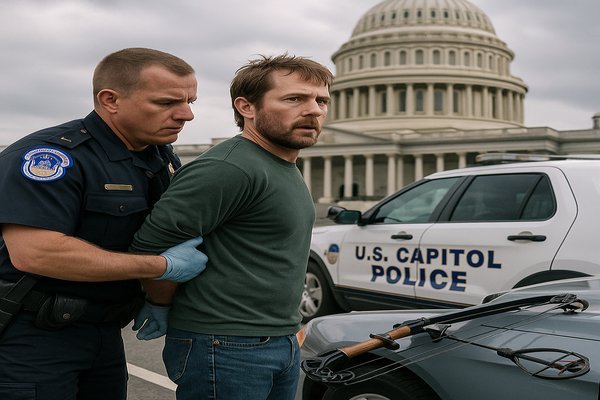
The U.S. Capitol gun arrest has reignited nationwide concern over the safety of America’s most secure government institutions. A Maryland man was detained by U.S. Capitol Police after officers discovered firearms, a bow, and arrows inside his vehicle parked just blocks from Congress. The bizarre discovery, made on July 16, 2025, has triggered a federal investigation and renewed scrutiny over the multi-billion-dollar security system guarding the heart of U.S. democracy.
Security After January 6
In the aftermath of the January 6, 2021, insurrection, lawmakers poured massive investments into physical and digital security infrastructure. Surveillance towers, AI-powered threat-detection systems, reinforced fencing, and expanded police ranks were part of a sweeping overhaul. The Capitol Police budget has since grown by nearly 40%.
Yet, the U.S. Capitol gun arrest exposes glaring vulnerabilities. Despite upgraded monitoring and advanced training, a suspicious vehicle managed to remain in a restricted area undetected until a passerby alerted officers. The incident highlights that while technology has improved, human vigilance remains an irreplaceable defense line.
The Arrest That Shook Washington
Capitol Police Chief Thomas Manger confirmed that officers approached the vehicle at approximately 5:30 a.m. after reports of “odd behavior” near Pennsylvania Avenue. Witnesses described the suspect pacing, muttering, and gesturing toward the Capitol building.
When officers questioned him, he appeared anxious and made cryptic remarks about “government surveillance.”
A quick search revealed two AR-15-style rifles, a loaded Glock handgun, a composite bow, and seven hunting arrows neatly packed inside. The U.S. Capitol gun arrest immediately became headline news for its surreal combination of weapons and its proximity to the U.S. Capitol—an unsettling reminder of how fragile public safety can be even in fortified zones.
What Investigators Found
Authorities later cataloged the following items seized during the U.S. Capitol gun arrest:
- Two AR-15-style semi-automatic rifles with loaded magazines
- One Glock 19 handgun with spare ammunition
- A compound bow and seven carbon-tipped arrows
- Tactical gloves, camouflage netting, and handwritten notes referencing “Congress”
FBI Special Agent Carla Simmons told reporters, “This is an unusual hybrid threat. We rarely encounter archery gear in Capitol-related security cases.”
Following the arrest, FBI counterterrorism units executed a search warrant at the suspect’s Maryland residence and seized electronic devices to determine whether extremist affiliations or online radicalization played a role.
What Comes Next
Federal prosecutors have charged the suspect with firearm possession on federal property, unlawful transportation of weapons, and violation of restricted-area statutes.
A federal magistrate has ordered a psychiatric assessment prior to arraignment.
If investigators uncover intent to harm public officials, the U.S. Capitol gun arrest could escalate to terrorism-related charges under federal law—carrying a potential sentence of up to 25 years. The case also raises questions about how individuals with documented mental-health challenges can still acquire and transport high-powered weapons across state lines.
A Troubled Background
The suspect, a 38-year-old Maryland resident, reportedly lived alone and had been unemployed for several months. Neighbors described him as polite yet increasingly withdrawn. “He’d spend nights practicing archery in his backyard and mutter about government satellites,” one neighbor told Reuters.
Investigators confirmed he received intermittent mental-health treatment but had no previous criminal record. The U.S. Capitol gun arrest has reignited a national debate over the intersection between gun access, untreated mental illness, and gaps in public safety screening.
Billions Spent, Gaps Remain
Despite nearly $92 million invested in security upgrades since 2021, recurring audits have identified weak points in vehicle inspection, staffing, and response coordination. The U.S. Capitol gun arrest validated those warnings.
Former Capitol Police Chief Yogananda Pittman stated, “Technology alone cannot secure democracy. You need trained eyes, intuition, and mental-health awareness on the ground.”
The Department of Homeland Security (DHS) has since raised the Capitol complex threat level to Level 2, signaling credible risks of repeat or copycat incidents.
A Case Study in Hybrid Threats
Security and counterterrorism experts classify the event as an example of “hybrid threat behavior”—where traditional firearms mix with unconventional weapons or erratic motives.
Dr. Lena Ortiz, a national-security analyst, said, “The U.S. Capitol gun arrest exposes how unpredictable lone-actor threats have become. Psychological instability and ideological confusion can converge to produce unpredictable violence.”
Experts argue that existing threat models often focus on conventional terrorism, overlooking individuals who defy standard behavioral patterns. This case, they note, highlights the need for integrated approaches combining law enforcement, behavioral science, and public awareness.
From Shock to Policy Calls
Members of Congress across party lines denounced the breach and called for stronger preventive measures. Senator Lisa Heinrich (D-NM) commented, “No incident is trivial. The U.S. Capitol gun arrest proves we need smarter surveillance and faster detection.”
Representative Jim Himes (D-CT) emphasized on social media, “Security and mental-health reform must work in tandem. Ignoring one will always endanger the other.”
The Capitol Police Union released a statement urging lawmakers to fund more canine units, deploy mobile X-ray scanners, and expand night-shift personnel. Officers reportedly remain stretched thin despite years of recruitment drives.
Fear and Frustration
Online discourse following the incident reflected both disbelief and outrage. Hashtags such as #CapitolArrest, #DCWeaponsFind, and #StrangeArsenal dominated social platforms within hours.
Users questioned how a heavily armed man could reach such a sensitive location without detection. Others joked darkly about the presence of a bow and arrows, calling it “a medieval twist in modern security failures.”
Yet many citizens voiced deeper fears—if the U.S. Capitol gun arrest could happen in one of the world’s most guarded cities, what about state capitals, schools, or public events with fewer defenses?
Lessons for Other Democracies
Governments around the world have taken note. Parliaments in the U.K., Germany, and Japan have requested internal reviews of their own security systems.
The U.S. Capitol gun arrest underscores a universal dilemma: how to keep democratic spaces open to citizens while ensuring safety from unpredictable threats.
Comparisons are being drawn to Brazil’s 2023 Congress invasion and Germany’s 2024 Reichstag standoff, where lone actors exploited procedural gaps despite heavy surveillance. Experts warn that symbolic sites everywhere face similar hybrid threats combining ideology, disinformation, and mental-health breakdowns.
Internal Links
- UK YouTube Creators Boost Economy with £2.2 Billion Impact in 2024
- Autism Drug Breakthrough: Kennedy, GSK Fast-Track Approval