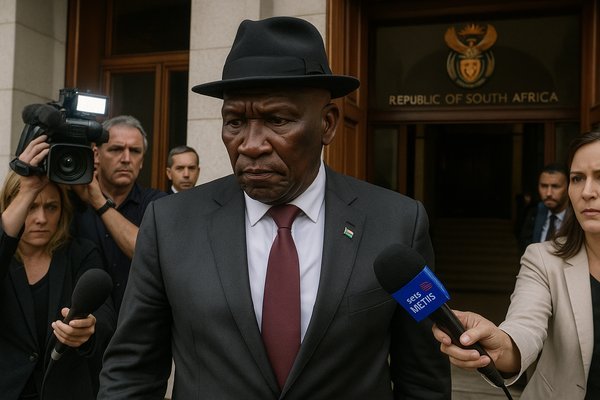
The Police Minister Suspension has sparked a major political storm in South Africa, marking one of the most decisive moves in President Cyril Ramaphosa’s ongoing anti-corruption campaign. Police Minister Bheki Cele was suspended on Tuesday following allegations that he was involved in a multimillion-rand procurement scandal linked to inflated public safety contracts. The move signals Ramaphosa’s determination to restore public trust in institutions that have long battled credibility crises.
Years of Suspicion and Unanswered Questions
The suspension did not occur in a vacuum—it is the culmination of years of speculation surrounding the Ministry of Police’s procurement practices. Between 2021 and 2023, the ministry signed several high-value contracts with private security firms to supply armored vehicles, surveillance drones, and crowd-control equipment.
Investigators now believe these deals may have been deliberately overpriced, funneling millions of rand to politically connected companies. Whistleblower reports and leaked documents—first surfaced in late 2024—alleged that senior officials within the ministry ignored due diligence processes and sidestepped parliamentary oversight.
The contracts, valued at over R1.4 billion, were meant to modernize the South African Police Service (SAPS). Instead, they exposed systemic vulnerabilities and set the stage for what would become one of the biggest governance crises in Ramaphosa’s presidency.
The Presidency Confirms the Suspension
In a nationally televised statement, President Ramaphosa confirmed the Police Minister Suspension, calling it “a necessary measure to ensure transparency and accountability.” He emphasized that the government must remain above reproach:
“No one, regardless of rank or political affiliation, is above the law. This suspension ensures the integrity of our investigation and our commitment to clean governance.”
The Police Minister Suspension is effective immediately, pending the outcome of a joint investigation by the Special Investigating Unit (SIU) and the National Prosecuting Authority (NPA). Both agencies will examine whether irregularities occurred in tender approvals, whether bribes were paid, and whether senior officials obstructed oversight mechanisms.
Ramaphosa has appointed an acting minister to oversee ongoing police operations, assuring citizens that law enforcement stability will not be compromised during the probe.
Analysis: A Defining Moment for Ramaphosa’s Legacy
Political analysts view the suspension as a defining moment for President Ramaphosa’s leadership. Since assuming office in 2018, his tenure has been marked by a promise to clean up state institutions tarnished by the Zuma-era “State Capture” scandals.
Dr. Thandi Mokwena, a senior governance expert at the African Governance Institute, remarked:
“This suspension represents both an opportunity and a risk. If handled decisively, it could strengthen Ramaphosa’s reformist image. But if it stalls or gets politicized, it may reinforce public cynicism about accountability.”
The Police Minister Suspension also carries implications for South Africa’s fragile economic climate. Credit agencies such as Moody’s and Fitch Ratings have repeatedly stressed that transparent governance remains crucial for investor confidence. Any perception of institutional decay could further strain investor sentiment and weaken South Africa’s sovereign outlook.
At the same time, decisive action could reassure markets that Ramaphosa is serious about tackling corruption, especially in security and energy sectors that rely heavily on government contracts.
Opposition and Civil Society Reactions
Opposition parties and watchdog groups have largely welcomed the Police Minister Suspension. The Democratic Alliance (DA) issued a statement describing the move as “a long-overdue act of accountability.” DA leader John Steenhuisen said:
“For too long, corruption within the security sector has gone unpunished. This is a step in the right direction, but accountability must extend beyond a single minister.”
Civil society organizations such as Corruption Watch and OUTA (Organisation Undoing Tax Abuse) also praised the decision but urged authorities to follow through with prosecutions. OUTA’s CEO Wayne Duvenage noted that previous suspensions had ended without convictions:
“The real test of this Police Minister Suspension lies in the follow-through. We’ve seen many high-profile suspensions before—few result in justice. South Africans deserve more than symbolic action.”
Several community policing forums have echoed similar sentiments, saying that restoring faith in the SAPS will require systemic reform, not just leadership changes.
Impact on the South African Police Service
The Police Minister Suspension adds to the turbulence already surrounding the South African Police Service (SAPS), which faces mounting criticism over inefficiency and corruption. Crime rates remain stubbornly high, with recent statistics showing over 27,000 murders and 47,000 sexual offenses recorded last year alone.
Experts believe the ministry’s leadership crisis could either destabilize the institution further or serve as a catalyst for long-overdue reform. SAPS insiders told GSN that morale among officers remains low, as corruption allegations cast doubt on leadership credibility.
Security analyst Sipho Dlamini observed:
“This moment offers a rare chance for structural reform. If the president leverages the Police Minister Suspension to push for digital procurement, audit transparency, and merit-based promotions, it could transform policing integrity in South Africa.”
Parliamentary Oversight and Policy Reform
In a rapid response to the suspension, Parliament’s portfolio committee on police announced the establishment of a special subcommittee to review all major procurement contracts since 2020. The subcommittee, chaired by ANC MP Grace Maseko, will collaborate with the Auditor-General and the Public Protector’s office to identify systemic loopholes.
Lawmakers have already begun drafting legislation to mandate real-time digital audits of all state contracts exceeding R10 million—a reform gaining bipartisan support. Parliamentary spokespeople said the measure is aimed at preventing future irregularities similar to those that triggered the Police Minister Suspension.
If passed, this legislation could mark a significant leap forward for transparency in government procurement, creating a permanent digital record accessible to both auditors and the public.
ANC Internal Politics and Ramaphosa’s Authority
Within the ruling African National Congress (ANC), reactions to the Police Minister Suspension have been mixed. Reform-minded members have praised Ramaphosa’s courage, while loyalists aligned with former President Jacob Zuma accuse him of targeting political rivals.
An ANC insider told GSN anonymously:
“This suspension is not just about corruption—it’s about control. Ramaphosa is consolidating power before the policy conference, sending a message to those who oppose his reform agenda.”
Observers warn that the political fallout could deepen existing factional divisions. Yet for Ramaphosa, the Police Minister Suspension also serves as a rallying point to demonstrate leadership resolve and differentiate his administration from predecessors criticized for inaction on corruption.
Public Opinion: Cautious Optimism
The South African public has reacted with cautious optimism to the Police Minister Suspension. On social media, many citizens expressed relief that high-level accountability was finally being enforced. However, skepticism persists over whether justice will be served.
Public sentiment is divided between those praising Ramaphosa’s “bold step” and others warning that suspensions without convictions achieve little.
“We’ve seen this movie before,” wrote one user on X (formerly Twitter). “Let’s see if anyone ends up in jail this time.”
The suspension has reignited conversations about transparency in law enforcement, government ethics, and the importance of sustained institutional oversight rather than isolated disciplinary actions.
International Reactions and Investor Implications
The Police Minister Suspension has drawn international attention from outlets such as Reuters, BBC, and Al Jazeera, framing it as part of a broader continental struggle against high-level corruption. International investors view the move as a test of South Africa’s ability to uphold rule of law while maintaining political stability.
According to a report by Fitch Ratings, credible investigations and visible accountability will “enhance perceptions of governance reliability” and may help stabilize the rand. Conversely, failure to secure convictions could reinforce negative investor sentiment about governance efficiency in Africa’s most industrialized economy.
Foreign diplomatic missions have also issued cautious statements, praising South Africa’s commitment to transparency and judicial independence.
A Turning Point or Temporary Fix?
The Police Minister Suspension represents a pivotal moment for South Africa’s democracy and for Ramaphosa’s reform narrative. It could become a milestone in rebuilding institutional trust—or another episode in a cycle of political theater.
Ultimately, South Africa’s credibility will hinge on how swiftly and transparently the SIU and NPA conclude their investigations. If followed by prosecutions and genuine reform, the Police Minister Suspension may stand as a symbol of democratic resilience. If not, it risks becoming another missed opportunity in the nation’s long battle against corruption.
Internal Links
- France Ghana Debt Relief: 5 Bold Gains from G20’s First Deal
- US Student Visa Ban: 6,000 Visas Revoked Over Crimes, Terror Links
External Links
- Reuters: South Africa corruption probe expands to police ministry
- BBC: Ramaphosa’s anti-corruption campaign in focus