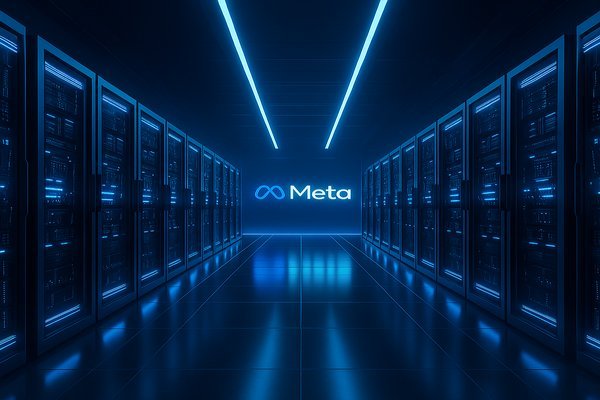
Meta Platforms, the tech giant formerly known as Facebook, is embarking on one of the most ambitious infrastructure investments in history. In 2025, CEO Mark Zuckerberg confirmed that the company will allocate “hundreds of billions” of dollars to develop a sprawling network of Meta AI Data Centers—part of two groundbreaking projects named Prometheus and Hyperion. This bold move positions Meta as a frontrunner in the global race for AI dominance, with the stated goal of achieving what the company calls “superintelligence.”
A New Phase of Meta’s Evolution
After years of focusing on social media and virtual reality, Meta is now transforming itself into an AI-first company. Zuckerberg’s 2025 statement marked a defining moment for the company’s trajectory, signaling a shift from advertising-driven profits to AI infrastructure supremacy. The Meta founder argued that the company must “control its own compute destiny,” a reference to the immense computing power required to train next-generation models that can rival or surpass human intelligence.
This transformation is not happening in isolation. Meta’s move mirrors the broader trend of Big Tech investing in physical AI infrastructure, as cloud computing and data storage become the foundation of tomorrow’s intelligence economy.
📰 Related Read: Explore how digital vulnerabilities are growing alongside AI expansion in our feature — Ghana Cyber Crime Hits GH₵15m Losses in 2025.
💡 Also Read: See how rival firms are racing ahead in quantum research in our analysis — Google’s Quantum Computing Race.
What Are Meta AI Data Centers?
Meta AI Data Centers are hyper-scalable, next-generation facilities designed to handle the world’s most demanding artificial intelligence workloads. According to Meta’s internal roadmap, these massive sites will support everything from large language models (LLMs) and computer-vision systems to robotics, AR/VR integration, and real-time translation engines.
The two flagship projects—Prometheus and Hyperion—will form the dual backbone of Meta’s future AI ecosystem. Prometheus will focus on training colossal datasets, while Hyperion will specialize in inference acceleration through quantum processing and AI-native hardware. Each site is expected to span areas comparable to small cities, rivaling even the largest Google Cloud and Amazon Web Services (AWS) zones.
Why This Matters Now
Zuckerberg’s announcement comes at a time when the global AI arms race is intensifying. Microsoft, Amazon, and Google have already poured tens of billions into generative AI research. OpenAI’s GPT-5 is expected to redefine language understanding, while NVIDIA’s valuation has soared above $3 trillion, reflecting insatiable demand for GPUs.
Within this environment, Meta’s $64–$72 billion capital expenditure forecast for 2025 represents a clear pivot—from social-media dominance to AI infrastructure leadership. Analysts view this as both a competitive necessity and a long-term bet on controlling the foundations of machine intelligence.
By owning its full compute backbone through Meta AI Data Centers, Meta seeks to eliminate dependency on cloud vendors, reduce costs, and maintain tighter control over privacy, data efficiency, and intellectual property. It’s not just about training AI; it’s about owning the entire AI supply chain.
Prometheus and Hyperion: The Core of Meta’s Vision
Prometheus: The Training Engine
Named after the Greek figure who gave fire to humanity, Prometheus will serve as Meta’s main training hub. It will reportedly host petabytes of data, thousands of AI-accelerator chips, and custom cooling systems powered by renewable energy sources. The facility will incorporate liquid-cooling and heat-recapture technologies to cut carbon output and increase computational density—part of Meta’s push toward sustainable AI infrastructure.
Hyperion: The Intelligent Edge
Hyperion, named after the Titan of light, will focus on AI inference and real-time deployment. It will power AR glasses, Meta’s metaverse operations, and even advanced autonomous systems across industries. In essence, Prometheus will train AI models, while Hyperion ensures they function seamlessly in the real world—both running on the backbone of Meta AI Data Centers.
How Big Is the Bet?
To grasp the scale of Meta’s wager, consider this:
- Microsoft (2024 CapEx): ≈ $36 billion
- Google (Alphabet): ≈ $40 billion
- Amazon AWS: ≈ $50 billion
By contrast, Meta’s $64–$72 billion outlay in a single year could outpace them all. Insiders reveal that 60% of this budget will go to physical infrastructure—servers, networking, and power management—while the remaining 40% will fund AI research, model development, and global integration.
All major Meta platforms—Facebook, Instagram, WhatsApp, and Threads—will soon run on this unified compute layer. The result: faster AI-generated recommendations, smarter ad delivery, and more immersive virtual experiences—all driven by the network of Meta AI Data Centers.
Superintelligence: The Next Frontier
Meta defines superintelligence as AI that can outperform humans in reasoning, learning, and adaptation. While such systems remain theoretical, the company’s FAIR (Facebook AI Research) division is making significant progress in neuromorphic computing, quantum-AI integration, and self-learning architectures.
Experts say that Prometheus and Hyperion are being designed for modularity and forward compatibility, enabling seamless upgrades as new breakthroughs emerge. Meta’s vision isn’t limited to faster machines—it’s about building a cognitive infrastructure capable of powering an entire generation of autonomous systems.
Reactions, Risks, and Concerns
The world’s response has been divided:
- Investors are cautiously optimistic; Meta’s stock rose 2.8% after the announcement.
- Privacy advocates warn that expanded AI infrastructure could amplify data surveillance risks.
- Environmental experts question Meta’s carbon neutrality claims, noting the energy intensity of large-scale AI operations.
Despite the controversies, analysts agree that Meta’s shift signals a paradigm change in tech strategy. Infrastructure is no longer “back-end support”—it’s the core competitive frontier for the age of artificial intelligence.
Global Implications
This is far from an American-only venture. Meta has identified potential Meta AI Data Center sites in Ireland, Canada, Singapore, and Ghana, marking a truly global expansion. The inclusion of Ghana underscores the company’s growing interest in Africa as a digital and energy hub for distributed computing.
By decentralizing training and inference workloads, Meta can reduce latency, comply with local data laws, and improve resilience against geopolitical risks. Partnerships with TSMC, ASML, and Siemens are already under discussion to support the construction of next-generation chips and power systems tailored to AI workloads.
The Bigger Picture
If completed as planned, Meta AI Data Centers could redefine how humans and machines interact—fueling AI models that learn, adapt, and generate at speeds beyond human comprehension. The initiative represents a clear statement from Zuckerberg: the next phase of competition will be fought not on social media timelines, but inside AI supercomputerscapable of shaping the future of thought, creativity, and intelligence itself.
Internal Link:
AI Antibiotic Breakthrough: New Solutions for Gonorrhoea & MRSA