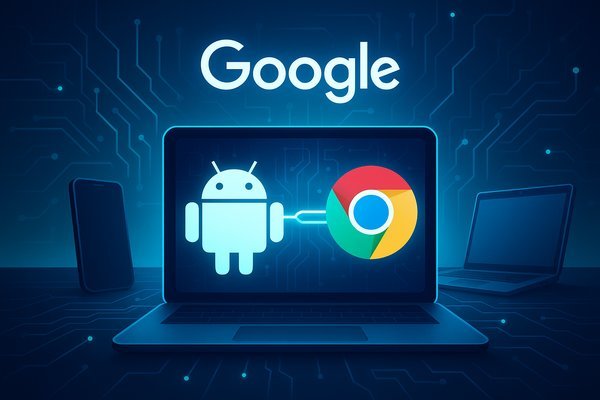
A Revolutionary Leap for Google
In a landmark move shaking up the global tech landscape, the Android-ChromeOS merger is being hailed as Google’s most ambitious initiative since Android itself.
Announced on July 17, 2025, at the company’s Mountain View headquarters, the integration represents a decisive shift in how Google envisions the future of computing.
Executives described the merger as a decade-long vision coming full circle, combining the agility of Android with the stability, security, and cloud-first architecture of ChromeOS. Tech analysts already compare its scale to Apple’s 2007 iPhone moment—an innovation capable of redefining how the world interacts with connected devices.
The global rollout of AndroChrome OS, as the hybrid platform is internally codenamed, aims to unify billions of devices into a single intelligent ecosystem where smartphones, laptops, tablets, and smart TVs all share the same digital DNA.
Why the Android-ChromeOS Merger Matters
For nearly fifteen years, Google maintained two parallel operating systems: Android, which dominates the mobile world with more than three billion active devices, and ChromeOS, the lightweight system behind classroom and enterprise laptops.
While this dual strategy expanded Google’s reach, it also created friction. Developers faced inconsistent APIs, users dealt with fragmented experiences, and update schedules varied across platforms.
The Android-ChromeOS merger is Google’s answer to that problem—a unified digital ecosystem where devices communicate seamlessly. CEO Sundar Pichai called the initiative “a reinvention of the user experience itself.”
He elaborated:
“We’re building one adaptive operating system that learns, syncs, and evolves with you—whether you’re coding on a Chromebook, editing video on your Pixel, or streaming content on your TV.”
The merger will make device switching invisible, syncing apps, files, and workspaces automatically through Google Cloud. It also integrates Gemini and Bard AI tools at the core, enabling real-time translation, adaptive voice control, and predictive automation.
The developer preview launches in Q4 2025, with full consumer integration set for mid-2026.
Key Benefits for Users
At its heart, the Android-ChromeOS merger promises simplicity, power, and continuity. Google’s documentation outlines sweeping improvements designed to enhance user experience and productivity:
- Seamless App Synchronization: Install once, use everywhere—mobile, laptop, or TV.
- Universal Clipboard and Notifications: Copy, paste, and manage alerts across devices effortlessly.
- Enhanced PWA Support: Progressive Web Apps achieve near-native performance and offline access.
- Unified Security Protocols: Shared kernel-level protection for encryption, sandboxing, and biometrics.
- Streamlined Workspace: Docs, Gmail, and Meet integrate within one adaptive task view.
- Consistent Design: The Material You 3.0 framework offers cohesive visuals across all screens.
- Optimized Power Management: Adaptive Battery balances performance and efficiency between connected devices.
To preserve backward compatibility, AndroChrome OS will include a virtualization layer allowing older Android and Chrome apps to run seamlessly, protecting years of app development investment.
Developer Reactions and Early Adaptation
The merger has sparked significant interest in the developer community.
Amina Rao, a senior Android engineer at JetBrains, noted:
“If executed carefully, this could finally fix the long-standing fragmentation that developers have struggled with.”
Google’s Unified API Framework allows developers to write once and deploy everywhere, eliminating redundant coding for different devices.
To facilitate this transition, Google introduced a Developer Transition Hub via the Android Dev Center, complete with migration guides, beta kits, and real-time community support.
Workshops are already planned in Berlin, Bengaluru, and San Francisco, helping developers adapt to AndroChrome SDK 1.0. Early reports suggest app development time could fall by up to 35%, allowing developers to target more users globally with fewer resources.
Strategic Implications of the Android-ChromeOS Merger
Beyond usability, the Android-ChromeOS is a bold strategic maneuver.
Analysts see it as a direct challenge to Apple’s tightly integrated iOS–macOS ecosystem and Microsoft’s Windows-Copilot approach.
Leo Bernstein, senior analyst at Forrester Research, explained:
“This is Google’s bid to own the cross-platform future. The Android-ChromeOS merger consolidates its software dominance into one unified frontier.”
The move simplifies enterprise management via Google Workspace Admin Console, improves BYOD security, and streamlines deployment for large-scale organizations.
In the education sector, AndroChrome OS could unify tablets and laptops under one administrative policy—enhancing accessibility and reducing operational costs.
In emerging markets, the OS’s cloud-hybrid mode allows work and learning to continue offline, syncing automatically once internet access resumes—a major step for digital inclusion.
Industry Impact: From Laptops to Wearables
Hardware manufacturers are already preparing for the ripple effects of the Android-ChromeOS merger.
Companies such as Samsung, Acer, HP, and Lenovo—which produce both Android and ChromeOS devices—stand to benefit from a unified firmware architecture and faster software pipelines.
According to a 2025 IDC report, Chromebook market share could grow by 20% globally within two years, driven by this integration.
Meanwhile, competitors like Microsoft are tightening Windows–Azure connectivity, and Apple continues blending macOS and iPadOS around Apple Silicon chips.
The Android-ChromeOS merger will also strengthen Google’s presence in IoT and wearables.
Smart home systems, Android Auto dashboards, and Wear OS devices will run on the same core, ensuring faster updates and a unified user interface across ecosystems.
Security Upgrades in the Unified OS
Security remains central to the merger. ChromeOS has earned a reputation for zero ransomware outbreaks, and bringing Android into that shielded environment promises greater protection for billions of users.
Key upgrades include:
- Bi-weekly security patches across all devices simultaneously.
- Unified biometric standards powered by Titan M4 security chips.
- AI-driven sandboxing for isolating and testing risky apps.
- Centralized permission control with real-time privacy analytics.
- Quantum-safe encryption for next-generation cyber protection.
With these measures, the Android-ChromeOS merger positions Google as a leader in mobile security—on par with Apple and ahead of Microsoft in speed and consistency.
What’s Next for AndroChrome OS
The next major milestone in the Android-ChromeOS merger will come in December 2025, when Google releases the AndroChrome OS beta on Pixel 9 devices and select Pixel Slate Chromebooks.
An open beta will follow in March 2026, accompanied by a major Developer Summit focusing on AI-integrated features such as predictive multitasking, Gemini-powered workflow assistance, and adaptive layouts.
Hiroshi Lockheimer, Google’s SVP for Platforms & Ecosystems, summed it up best:
“The Android-ChromeOS merger represents the future of connected computing—one experience that is fluid, adaptive, and powerful.”
Long-term, Google plans to integrate AndroChrome OS with its experimental Fuchsia kernel, merging three core systems into one flexible and future-ready platform.
Comparing Google and Meta’s Tech Ambitions
While the merger focuses on software unification, Meta’s AI Data Center Initiative—anchored by Prometheus and Hyperion—targets infrastructure dominance.
Both efforts embody the same philosophy: ecosystem consolidation and digital supremacy.
Google’s mission centers on user-level coherence, while Meta’s centers on AI compute power and infrastructure scale.
Together, they represent the new age of convergence—where operating systems, AI, and hardware evolve as one intelligent network.
For context on Meta’s corresponding projects, see:
🔗 Meta AI Data Centers: Inside the Race for Superintelligence
Conclusion: Redefining the Digital Ecosystem
The Android-ChromeOS merger marks one of the most pivotal shifts in Google’s history.
If successful, it could reshape computing for the next decade, establishing a new standard for cross-device functionality, AI integration, and global accessibility.
Beyond a technical feat, the merger signals a deeper transformation—a world where every device, app, and service exists in harmony.
By uniting its flagship platforms, Google isn’t just merging two systems—it’s merging the digital future itself.
Internal Link Summary
- Trump AI Action Plan: 5 Bold Moves Stir Global Debate
- Google AI Africa Investment: $37M Boost, Accra Center Opens
External Link Summary
- Android Dev Center
- Google Cloud – cloud integration and AI platform