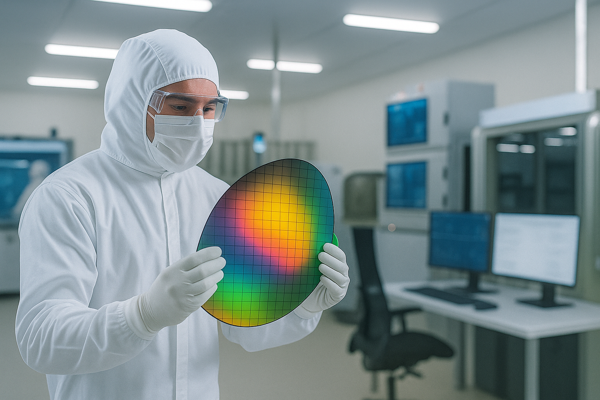
In a bold leap forward, a 2nm semiconductor breakthrough has been announced by a global chipmaker based in Seoul. The company revealed its cutting-edge microprocessor on June 18, 2025, marking a major milestone in semiconductor innovation. The chip—designed for ultra-fast performance and improved energy efficiency—is expected to enter mass production by late 2026.
This breakthrough is more than just a technical win. It represents the next frontier for artificial intelligence (AI), mobile devices, electric vehicles, and high-performance computing. Analysts are already calling it the single most significant advancement in chip design since the introduction of the 5nm node in 2020.
What Makes the 2nm Semiconductor Breakthrough Special?
At the heart of the semiconductor is a dramatic reduction in transistor size. Smaller transistors allow chipmakers to pack more onto a single wafer, translating into faster performance and better efficiency. With this innovation, devices can now:
- Run 45% faster compared to 5nm processors.
- Use up to 75% less power, a huge leap for energy conservation.
- Support more powerful AI features, from real-time language translation to generative AI.
- Extend battery life significantly in mobile and electric devices.
- Stay cooler with advanced energy management, reducing overheating risks.
These benefits will flow into smartphones, laptops, data centers, autonomous vehicles, and even medical devices. For consumers, it means faster apps, smoother streaming, and devices that last longer without charging. For industries, it represents a foundation for more scalable AI and green computing.
Global Demand for the 2nm Semiconductor Breakthrough
The demand for chips has skyrocketed in recent years, driven by AI adoption, electric vehicles, and the Internet of Things. According to Gartner, global semiconductor sales are projected to hit $680 billion in 2026, with the 2nm semiconductor expected to contribute significantly to this surge.
Industry leaders are taking notice:
- Apple is reportedly exploring how the chips can power the next generation of iPhones and MacBooks.
- Tesla sees applications in electric vehicles, where energy-efficient processors could extend driving ranges.
- NVIDIA, a titan in AI and GPU development, views the 2nm semiconductor breakthrough as essential to scaling large language models and high-performance computing.
As global competition intensifies, countries like the U.S., South Korea, Taiwan, and Japan are investing billions in securing supply chains for next-generation semiconductors. This breakthrough gives the Seoul-based company a strong edge in the race for chip dominance.
Industry Voices on the Semiconductor Breakthrough
Experts are hailing this development as transformative.
Dr. Leila Kim, a nanotech expert from MIT, said:
“This breakthrough is not just evolutionary—it’s revolutionary. It will shape the tech ecosystem for years to come.”
Tech publications like Wired and TechCrunch have called it “the next big leap” in chip manufacturing. MarketWatch described it as the “critical enabler for the AI-driven future.”
Meanwhile, corporate executives see it as a way to differentiate their products in a crowded marketplace. The CEO of a leading smartphone maker commented, “With the 2nm semiconductor , we can finally achieve AI processing on-device without relying so heavily on cloud infrastructure.”
Geopolitical Impact of the 2nm Semiconductor Breakthrough
The 2nm semiconductor is not only a technological milestone but also a geopolitical one. Semiconductors have become the backbone of global economies, and controlling advanced chip technology is seen as a strategic advantage.
- The U.S. is pushing the CHIPS Act to expand domestic manufacturing.
- South Korea is leveraging this breakthrough to solidify its role as a semiconductor powerhouse.
- Japan is reinvesting in chip alliances, aiming to reduce reliance on foreign suppliers.
- China, facing export restrictions, is accelerating efforts to achieve self-sufficiency in chipmaking.
The unveiling of the 2nm semiconductor adds new intensity to this global competition, with implications for supply chains, trade policies, and even defense technologies.
What’s Next After the 2nm Breakthrough?
Looking ahead, industry analysts forecast:
- Consumer devices powered by 2nm chips as early as 2027.
- Improved AI and machine learning, with chips capable of running advanced models locally.
- Greater chip efficiency in cloud and edge computing, making data processing faster and greener.
- Cleaner energy usage, as devices consume less electricity.
By 2030, experts predict that the semiconductor will underpin nearly all advanced computing applications, from quantum research to medical diagnostics.
Challenges Facing Mass Production
Despite the excitement, challenges remain. Producing chips at the 2nm semiconductor scale requires:
- Extreme ultraviolet (EUV) lithography, a costly and complex technology.
- Precision manufacturing facilities that cost tens of billions of dollars to build.
- Supply chain resilience to secure rare materials and prevent disruptions.
If any of these bottlenecks arise, mass adoption of the 2nm semiconductor could face delays. Still, the Seoul-based chipmaker has pledged to ramp up production with strategic partners and government backing.
Market Implications
The introduction of the 2nm semiconductor will trigger ripple effects across industries:
- Smartphones and laptops will get faster, smaller, and longer-lasting.
- Data centers will cut energy costs, reducing their carbon footprint.
- Automotive technology will advance with safer and more efficient self-driving systems.
- Healthcare devices will benefit from miniaturized chips that enable real-time diagnostics.
Investors are already shifting focus toward companies positioned to benefit from this leap. Analysts expect semiconductor stocks to outperform broader markets in 2026–2027.
A Defining Moment for Technology
The 2nm semiconductor marks a defining moment in the history of technology. It is a leap that will not only make devices faster and more efficient but also reshape industries and influence global power dynamics.
From smartphones to satellites, this innovation is set to touch nearly every aspect of modern life. As nations and corporations compete for leadership in the semiconductor space, the 2nm semiconductor stands as a symbol of human ingenuity and a preview of the digital future.
The countdown to mass production has begun—and with it, a new era of computing is on the horizon
Internal Links:
- AI Antibiotic Breakthrough: New Solutions for Gonorrhoea & MRSA
- Gold Price Record High: Gold Surges Past $3,500 Mark